Wednesday, 2 February 2022

Flavourings make e-cigarettes more harmful. Another good reason to ban them.

Most Canadian governments which have banned flavoured e-cigarettes have done so in order to reduce the number of young people who are brought into nicotine use through the use of attractive flavourings. Vaping manufacturers have objected to these measures, and are claiming that flavours "save lives" because they encourage smokers to switch to e-cigarettes.

Missing from this discussion has been a consideration of the additional health risks that flavouring additives introduce to vaping, and the benefits to the health of vapers if the types and quantities of these ingredients were reduced. 

Most e-liquids sold in Canada are flavoured. The Vaping Industry Trade Association last year reported to Health Canada that there are "400,000 unique flavouring compounds being utilized in the manufacture of e-substance manufacture in Canada." That's about one unique ingredient for every 4 of Canada's 1.5 million vapers. (They did not provide a list of these compounds, and their estimate is higher than other published information.) [1] Yet current restrictions on e-cigarette ingredients are minimal and often vague.

This post presents background information on (1) current approaches to regulating e-liquid flavours and other ingredients, including Health Canada's ground-breaking proposals, (2) the flavourants that are currently in use, (3) the risks these chemicals can pose and (4) implications for public health decision-makers.

Part 1: How flavours and ingredients are currently regulated.  

Restrictions on what e-vapours smell or taste like

In Canada, three provinces have already implemented prohibitions on selling e-cigarettes that have a flavour or aroma of anything other than tobacco, and two territories have taken steps in this direction. None of these governments have imposed bans on any specific ingredients, but have instead chosen to allow manufacturers to decide what ingredients they can use without causing a "characterizing" flavour.

  • Nova Scotia extended the prohibitions in the Tobacco Access Act to include e-cigarettes, effective April 2020 1. Its ban covers tobacco or e-cigarettes which have "a characterizing scent or flavour, other than tobacco, that is noticeable before or during use, or both." 
  • Prince Edward Island's restrictions, which came into force on March 1, 2021. Its Tobacco and Electronic Devices Sales and Access Act Regulations establishes that the flavour bans in its law apply to "an agent added to tobacco or an electronic smoking device to produce an aroma or taste other than the aroma or taste of tobacco, including the aroma or taste of candy, chocolate, fruit, a spice, an herb, an alcoholic beverage, vanilla or menthol."
  • New Brunswick's Tobacco and Electronic Cigarette Sales Act was modified to ban the sale of any e-liquids that have a "noticeable flavour" other than tobacco. This came into effect on September 1, 2021. 
  • The Nunavut legislature adopted a new Tobacco and Smoking Act last June which would forbid the sale of e-cgiarettes that "contains an ingredient or combination of ingredients that imparts a distinguishing aroma or flavour, including that of a spice or herb, but not including that of tobacco." The government has yet to sign this law into effect.
  • In late December, the Northwest Territories circulated draft Tobacco and Vapour Products Control Regulations which would ban all vapour products that "impart an aroma or flavour, including that of a spice or herb.. except flavoured vapour products that impart a distinguishing aroma or flavour of tobacco and no other distinguishing aroma or flavour."

In other parts of the world, seven countries have used the same 'characteristic flavour' approach to regulate e-liquid s. That is, they prohibit the sale of vaping products which produce a flavour or aroma that is characteristic of something other than tobacco.

  • Finland was the first to introduce this measure (in 2016). The Finnish Tobacco Act (s. 24) prohibits characterizing flavours other than tobacco-flavour in e-cigarettes. 
  • The two other European countries to have implemented similar restrictions are Hungary (May 2020) and Estonia (2019). Estonia's law originally banned all flavours but tobacco, but this was amended to allow menthol in 2020, coinciding with the EU-wide removal of menthol from tobacco. 
  • The four other countries which have adopted flavour restrictions are Denmark (all flavours other than tobacco and menthol, effective April 1, 2022), the Netherlands, (All flavours other than tobacco, effective July 1, 2022), Ukraine (all flavours but tobacco, effective July 2023), and Lithuania's (ban on flavourings other than tobacco by July 2022).

Four U.S. states (New York, Massachusetts, New Jersey and Rhode Island)  have also implemented bans on e-liquid flavourings other than tobacco-flavour. California's law is suspended pending the results of a referendum. 

Restrictions on flavouring ingredients
Canada's federal government has proposed a different approach to regulating flavouring ingredients. Instead of only prohibiting flavouring ingredients purely on the characteristics they give to the product, they also propose to limit the ingredients that can be used. Health Canada's draft regulations, circulated in June 2021, would set a list ('schedule') of approved flavouring ingredients (40 flavouring ingredients permitted in tobacco-flavoured e-liquids and 42 different ingredients permitted in mint-menthol flavoured e-liquids). This list is the belt for the suspenders of an additional proposed ban on any "sensory perception other than one that is typical for mint, menthol or a combination of mint and menthol."

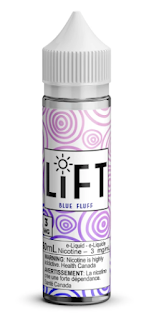
If this regulation is adopted, it will extend the promotional restrictions on flavours that have been in effect since the law came into force in May 2018. Schedule 3 of the federal Tobacco and Vaping Products Act, in force since May 2018, identifies five flavour categories that cannot be promoted in Canada: confectionery, dessert, cannabis, soft drink and energy drink. In Canada it is not illegal to sell an e-liquid that tastes like Cotton Candy, but it is illegal to use a label or promotion for that flavour. This is why such flavours are sold with eupheumistic names "Blue Fluff - Carnival Snack".

Restrictions for other ingredients in Canada and elsewhere

Governments in several countries have adopted some restrictions on e-cigarette ingredients on the basis that they are inherently harmful or on the basis that they might lead people to think that these products produce certain health benefits.

Canada's Tobacco and Vaping Products Act  (Schedule 2)  bans the use amino acids, caffeine, colouring agents, essential fatty acids, glucuronolactone, probiotics, taurine, vitamins and mineral nutrients. A different federal law, the Consumer Product Safety Act (CPSA) imposes a general prohibition on the manufacture or sale of products which are "a danger to human health or safety" and requires manufacturers to report adverse incidents. (Tobacco manufacturers are exempted from the requirements of this law). 

The Tobacco Directive of the European Union requires member states to ban the use of vitamins, caffeine, taurine and other stimulants and colouring agents. Unlike Canada, the EU also bans the use of additives that have CMR properties (carcinogenic, mutagenic or reprotoxic) and requires that "ingredients may not pose a risk to human health in heated or unheated form." 

New Zealand prohibits the use of several chemicals in vaping liquids in its Smokefree Environments and Regulated Products Regulations 2021 (Schedule 5). These include a ban on carcinogenic, mutagenic, reprotoxic chemicals, those which have specific organ toxicities (STOT-RE, with exceptions for benzoic acid and nicotine salts), and other chemical categories. 

Requirements for ingredient disclosure 

No country is known to require e-liquid manufacturers to list all ingredients on the product labels, but some countries require manufacturers to provide governments with that information.

Neither consumers nor governments know the entirety of the ingredients of the e-liquids sold in Canada. There is currently no requirement for manufacturers to provide Health Canada with a list of ingredients in their vaping liquids and no obligations to identify the flavouring compounds on packaging. The federal Vaping Products Labelling and Packaging Regulations require manufacturers to provide consumers with limited information on e-liquid ingredients. If flavourings are included, the manufacturer need only indicate that they contain "flavour". That said, Health Canada has signaled its intention to develop reporting regulations for vaping products since 2017, and more recent indications suggest/state that draft regulations might be published in winter 2022.

No provincial government requires vaping product manufacturers to provide ingredient list. British Columbia's E-substance regulation requires that manufacturers provide notice about the product before marketing, but does not require information on ingredients.

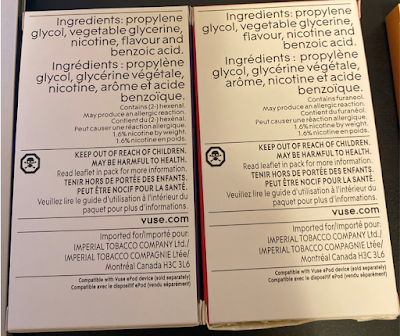
Nevertheless, in Canada some manufacturers voluntarily identify the presence of certain harmful ingredients. In packages for VUSE pods, BAT-Imperial Tobacco lists the presence of the toxic compounds (2-) hexanol (blueberry) and furaneol (strawberry) . 


In the European Union manufacturers of e-cigarettes must provide notification to governments 6 months before placing a product on market. There is an EU-wide common gateway for these reports. There is a standard reporting form which requires companies to provide details on each ingredient. Manufacturers are required to report on toxicity of ingredients and on the emissions produced. 

In New Zealand, manufacturers must (by February 2022) provide notification of all products that they intend to sell, and they must report all adverse reactions. They must provide government with information on each chemical ingredient (name and amount). 


Part 2. The chemicals that give flavour to e-cigarettes

Flavouring additives currently used Canada


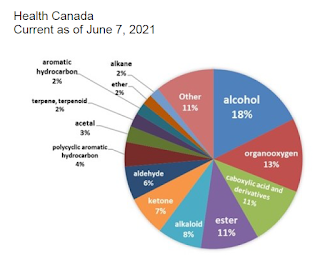
Between 2017 and 2019, Health Canada purchased 825 samples of vaping liquids in major Canadian cities and analyzed these liquids using chromotography. This Open Characterization project was cited as background to the proposed flavour restrictions. [2]

This analysis identified over 1,500 unique chemical compounds (a smaller number than the 400,000 compounds reported by the Vaping Industry Trade Association) . Many of these compounds appeared in a small number of products and only 4 compounds (nicotine, propylene glycol and glycerol and β-Nicotyrine) were found in more than half of the e-liquids. The chemicals detected were in a wide range of chemical families, with alcohol and organooxygen being the most common. 

This study found that tobacco-flavoured e-liquids had somewhat fewer flavouring ingredients than did those marketed as fruit, mint-menthol, desert or confectionary. It also found significant variation over time, but whether this reflected differences in the e-liquids sampled or changes to the formulation was not made clear. Flavouring chemicals were also found in the "unflavoured" category, and the 5 most frequently detected flavour chemicals had sweetening properties (vanillin, ethyl maltol, ethyl vanillin, vanillin propylene glycol acetal and cyclotene). 
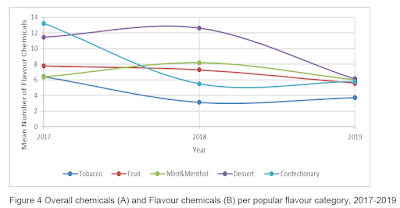
Health Canada: Open Characterization 

Flavouring additives used in other countries

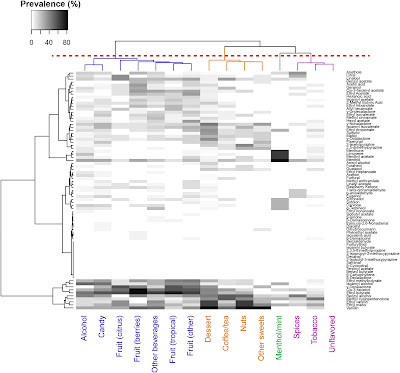
Because e-cigarette manufacturers are required to disclose their ingredients to governments in the European Union, it is possible to identify which compounds are most commonly used with which flavours. Analyses of e-cigarette ingredients been conducted on behalf of governments in Europe, including the Netherlands [3] and France [4]. For the almost 17,000 products reported to the Netherlands' government, 213 unique flavouring compounds were identified, of which only 25 were found in more than 10% of the products. The most common flavouring chemicals used in tobacco-flavoured e-cigarettes were: Ethyl maltol, Methyl cyclopentenolone, Vanillin, 2,3,5-Trimethylpyrazine and Furaneol. For mint-menthol flavours, the 5 most common ingredients were: Menthol, Menthone, Ethyl maltol, Vanillin and Eucalyptol. The figure from Krusemann et al [5] below identifies the use of 79 chemicals in various flavour categories.


Part 3: The health effects of e-cigarette flavourings (including those Health Canada proposes to authorize)

Many e-liquids produce toxic compounds, some of which are not present in cigarette smoke

A number of reports have been published which raise concerns about the toxicity of e-cigarette ingredients, including flavourings. These include studies of e-cigarette liquids purchased in Ontario [6] which found that one fifth contained chemicals associated inhalation toxicity. this study found that 70% of e-liquids had measurable levels of tobacco-specific nitrosamines (TSNAs). Health Canada's subsequent study found no nitrosamines,[2] but did identify other compounds which are thought to cause cancer, including one (Naphthalene) which was found in 1 in 8 samples.

Toxicologists reviewing the evidence on the health effects of specific e-cigarette ingredients [7] express concern that although many e-liquid ingredients are thought to be safe as a food additive, little is known about what happens when they are inhaled. Also unknown are the toxic properties of the chemicals that are produced when flavouring and other e-liquid ingredients are combined and heated. With much left to be learned, it is nonetheless established that many flavouring ingredients used are known to be harmful. [8]

The French government recently reviewed the toxicity of e-cigarette ingredients, developing a priority list with 3 categories for regulatory consideration: (1) those which were known to pose significant risks, (2) those which were known to pose risks, and (3) those whose risks were not established. Fifty of the chemicals that manufacaturers had reported to government as used as ingredients or found in emissions were found to be cancer-causing, mutagenic, reprotoxic, endocrine disruptors, or toxic to specific organs.
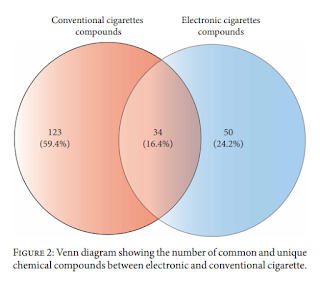
Health Canada and other governments have based their decision to liberalize the vaping market on their determination that vaping is less harmful than smoking, in part because "vaping products typically contain ...lower levels of several of the harmful chemicals found in smoke". Equally, however, vaping products typically contain several harmful chemicals that are not found in smoke: the systematic review cited earlier found one-quarter of the harmful compounds found in conventional and e-cigarettes were unique to e-cigarettes.[7] 


Health Canada proposes to restrict flavourants on the basis of their attractiveness to youth, not on the basis of their harms to users.

As mentioned above, Health Canada is the first government to propose regulating the ingredients that will be allowed in e-cigarettes. This creates the potential to block the use of compounds that are known to be harmful. It also creates a more manageable set of ingredients for which health effects can be monitored. Health Canada will allow nicotine and 5 carrier agents and nicotine-modifiers (propylene glycol, glycerol, benzoic acid, citric acid, sorbic acid). It has identified 40 flavouring ingredients that will be permitted for tobacco-flavoured liquids and 42 for mint-menthol flavoured.

This list was created with the intention to "strike a balance between reducing the appeal of vaping products, to protect youth from inducements to use vaping products, and leaving some flavour options for adults who smoke and who have transitioned, or wish to transition, to vaping." Consistent with this aim, the government proposes to prohibit the use of sugar and flavouring compounds that make e-liquids taste sweet (including commonly-used ingredients like Ethyl maltol and Vanillin).

The regulatory aim is not to make vaping liquids less harmful. Reflecting the absence this objective, the list of permitted flavourings includes chemicals that are known to be carcinogenic, mutagenic or reprotoxic, and that are not approved for use even in foods. These are Estragole, Furfuryl alcohol, Pyridine, Isophorone, Alpha-terpinene, Wintergreen oil, Para-cymene, Pulegone, Menthofuran, 4-ethylanisole and methyleneisophorone. Other ingredients on Health Canada's list of authorized ingredients have been identified as the highest priority for regulation in France (including Benzoic Acid, Pyridine) and its second-highest (Propylene Glycol, Ethyl vinyl ketone, Butyric acid, 2-acetylpyridine, Alpha-terpinene, Nonanoic aacid, Glycerol, Thymol and Carvone).

Curiously, it was the Vaping Industry Trade Association which first drew public attention to the potential harms of these flavouring ingredients. In its brief to government, the major manufacturers want government to identify the chemicals that will be banned instead of identifying those that will be permitted. (Our submission recommended that the list of prohibited ingredients be expanded to include the acids which increased the addictiveness of these products by facilitating inhalation).  

Part 4: Implications for public health

A. Provincial governments should not rely on timely federal measures to protect kids from enticingly flavoured e-cigarettes.

It is unlikely that Health Canada's proposed flavour restrictions will survive without a significant fight, and the industry may be able to postpone implementation through legal and other tactics. 

Because this new Canadian approach would set a world precedent and would denying the vaping industry access to an endless source of chemicals to create new flavourings, it will be fiercely opposed. Already this industry is lobbying fiercely to defeat and delay this measure. Because it is a novel regulatory approach, it is more vulnerable to legal and technical challenges. The Canadian Vaping Association reports it has raised $1 million in its legal fund. The "technical issues" raised by the Vaping Industry Trade Association seem to have already caused delays.

Those provinces and territories (or even municipalities) which have not already banned e-liquid flavours should consider doing so soon.

B. Governments should limit flavouring ingredients in order to reduce the harms of vaping products

Flavourings in vaping liquids are harmful to young people who are encouraged by them to try an addictive product. (30% of Canadian vapers have never smoked cigarettes) [10]

For those who are using vaping products to reduce or end smoking vaping flavours unnecessarily add to harmful chemicals they will ingest with their nicotine dose. (One-third of Canadian vapers are former smokers and about 40% are dual users.) [10]

Because people interpret pleasant tasting compounds as safer, and less pleasant compounds as being more harmful, any flavouring that makes e-cigarettes "taste better" will also make it "seem less harmful." Reducing or eliminating flavours will help consumers better comprehend the risks. 

New labelling requirements, such as requiring full disclosure of ingredients and addidtional warning on flavoured products, would assist vapers in understanding how to reduce these risks if they wish to continue vaping. 

A ban on flavourings in e-cigarettes that are sold as recreational drugs need not apply to vaping products which are approved as therapeutic products or smoking-cessation aids under the provisions of the Food and Drugs Act. 

To protect the health of vapors, provinces and territories should adopt the most extensive flavour restrictions possible, including bans on mint-menthol flavours. 

C. Governments should collaborate in developing ingredient standards for e-liquids.

Health authorities across the globe are faced with new regulatory challenges as a result of the introduction of vaping products and other novel nicotine devices.

Many vaping manufacturers operate globally. With their human and financial resources, their trade secrets and their willingness to challenge regulation, they have a significant advantage over national health regulators. This disadvantage can be somewhat addressed if regulators collaborate in understanding these new products and in developing a regulatory response to them.

Health Canada's proposed regulation breaks important new ground, and implementing this approach will provide a precedent for other countries. European health agencies are using mandatory reports on ingredients and emissions to establishing a foundation for some ingredient controls.

Health Canada should accelerate ingredient restrictions by collaborating with European and other countries to identify chemicals which should be banned from e-liquids or their emissions because of their ability to induce young people to  experiment, to facilitate addiction or to exacerbate harms.

References 

[1] Vaping Industry Trade Association. Consultation Response to proposed Order Amending Schedules 2 and 3 to the Tobacco and Vaping Products Act. September 2021

[2] Kosarac I, Kubwabo C, Fan X, et al. Open Characterization of Vaping Liquids in Canada: Chemical Profiles and Trends. Front Chem. 2021;9:756716. Published 2021 Oct 14. doi:10.3389/fchem.2021.756716

[3] Krusemann, EJZ. The role of flavors in attractiveness of electronic cigarettes. Thesis submitted to Wageningen University.

[4] Anses. Declaration des produits du tabac et produits connexes en France. Produits du vapotage - Bilan 2016-2020.

[5] Krüsemann, EJZ, Pennings, JLA et al. GC–MS analysis of e-cigarette refill solutions: A comparison of flavoring composition between flavor categories. Journal of Pharmaceutical and Biomedical Analysis. Volume 188. 2020,

[6] Czoli CD, Goniewicz ML, Palumbo M, Leigh N, White CM, Hammond D. Identification of flavouring chemicals and potential toxicants in e-cigarette products in Ontario, Canada. Can J Public Health. 2019;110(5):542-550. doi:10.17269/s41997-019-00208-1

[7] Armendáriz-Castillo, I, Guerrero, S et al. "Genotoxic and Carcinogenic Potential of Compounds Associated with Electronic Cigarettes: A Systematic Review", BioMed Research International, vol. 2019, Article ID 1386710, 8 pages, 2019. https://doi.org/10.1155/2019/1386710

[8] Barhdadi, S., Rogiers, V., Deconinck, E. et al. Toxicity assessment of flavour chemicals used in e-cigarettes: current state and future challenges. Arch Toxicol 95, 2879–2881 (2021). https://doi.org/10.1007/s00204-021-03080-6

[9] Anses. Priorisation des substances chimiques dans les émissions des produits du vapotage. November 2021.

[10] Statistics Canada. Canadian Tobacco and Nicotine Survey. As reported in Physicians for a Smoke-Free Canada. The Canadian Tobacco & Nicotine Survey, 2020-21

Wednesday, 19 January 2022

NNSW - Progress towards implementing the advice of Canada's Chief Medical Officers of Health

The overarching objectives of these recommendations are to protect young people from inducements to use vaping devices by regulating such devices as equivalent to tobacco products, and to encourage smokers who use vaping devices to use them solely to end or reduce their use of all nicotine-containing products.

Council of Chief Medical Officers of Health
January 2020 

In early 2020, a few weeks before COVID-19 was declared a pandemic, Canada's Council of Chief Medical Officers of Health (CCMOH) issued their third statement about vaping. The occasion was National Non-Smoking Week, and the focus was on the need to intensify regulations on vaping products and to re-construct the policy approach to this market. 

This post tracks the development of regulations which respond to those recommendations. Over the past 24 months, eight provinces, three territories and the federal government have amended their legislation or regulations in order to strengthen controls on the vaping product market. 

No apparent progress, however, has been observed towards the CCMOH recommendations that a new and broadened regulatory approach towards nicotine products be established, or that nicotine product manufacturers be required to provide evidence that their products will benefit the public before they can be marketed.

Links to additional information, including a downloadable summary of this progress, are provided at the bottom of this post.

MARKET REGULATIONS 

Flavour bans

The CCMOH called for a ban on all flavoured vaping products (with exemptions for some flavours), either by federal or provincial governments. 

At the time of the recommendation only one province (Nova Scotia) had decided to ban all flavours but tobacco, which was put into force on April 1, 2020. Two other provinces followed suit: Prince Edward Island (March 1, 2021) and New Brunswick (September 2021). Nunavut passed legislation to ban flavours in 2021, but this has not yet been proclaimed into law. The Northwest Territories recently initiated a consultation process on the topic. Three provinces now only allow the sale of most flavours in specialty vape shops (Ontario, July 2020; British Columbia, September 2020; Saskatchewan, September 2021).

Last June, Health Canada published draft regulations that would ban flavours other than tobacco, mint, menthol, as well as prohibiting sugars and sweeteners and restricting the flavouring ingredients that could be used.

(In the past two years six European countries have introduced legislation to ban flavours: Denmark, Hungary, Netherlands, Ukraine and Lithuania. Such measures were adopted in Finland in 2016 and Estonia in 2019.) 

Nicotine restrictions

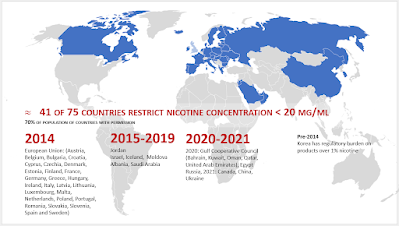
The CCMOH called for the nicotine content in vaping products to be limited to a maximum of 20 mg/ml. It also called for the development of other standards on nicotine delivery, such as temperature or the use of nicotine salts, if evidence supported these measures.

As a result of Health Canada regulations, nicotine concentration of vaping liquids was capped at 20 mg/ml effective July 23, 2021. Two provinces had earlier imposed this standard: British Columbia and Nova Scotia, both in September 2020.

(The 20 mg/ml maximum has been adopted by 41 countries, covering 70% of the population living in countries where e-cigarettes are permitted for sale.)


Safety requirements for ingredients

The CCMOH called for constituents of e-liquids to be regulated on the basis of their potential to cause harm when inhaled rather than oral ingestion.

The federal government is the only Canadian jurisdiction which is proposing to restrict the ingredients that can be used in vaping products, and some ingredients are already banned. These restrictions are based on the impact of the ingredients on flavour sensation or colourings, not on inhalation risk. (In the proposed revised Schedule 2 to the federal law, Health Canada is proposing to permit the use of some flavouring agents which are known to be harmful when swallowed or inhaled, including estragol, furfurl alcohol, pyridine, isophorone and others.)

Taxation 

The CCMOH called for vaping products to be taxed "in a manner consistent with maximizing youth protection while providing some degree of preferential pricing as compared to tobacco products."

Four provinces have imposed specific excise taxes or higher sales taxes on vaping products than on other consumer goods. B.C. increased the PST on vaping products from 7% to 20% (January 2020), Nova Scotia has a tax of $0.50 per millilitre of liquids (September 2020), Newfoundland and Labrador has a 20% tax on devices and liquids (January 2021) and Saskatchewan increased its sales tax on those products from 6% to 20%.(September 2021). 

The federal budget delivered in April 2021 proposed a specific excise tax of $1 per 10 ml of vaping liquids or fraction therefor (effectively a minimum tax of $1 per pod or other unit sold). A consultation on the tax was held, and the government indicated that the tax will come into effect “in 2022”.

Age 21 

The CCMOH called for the minimum age to be sold tobacco or vaping products to be increased to 21 years.

Both federal and provincial governments have minimum age laws. The federal minimum age remains 18, and only Prince Edward Island has raised the minimum age to 21 (March 1, 2020).

(In late 2019, the United States raised the minimum age to be sold tobacco or vaping products to 21, joining at least 7 other countries which ban the sale of tobacco to younger people  - Sri Lanka, Mongolia, Honduras, Uganda, Ethiopia, Philippines, and Singapore).

Age-gating

The CCMOH called for requirements for age-verification of internet purchases of vaping products that are the same as those required for cannabis.

In April 2021, Health Canada included the development of “Amendments to the Tobacco Access Regulations (Age Verification for Online Sales)” in its Forward Regulatory Plan.  The department indicated that the proposed regulation would identify the “mechanisms that must be undertaken to verify age and identity in the context of online sales.”   No further information has been made public.

Promotion

The CCMOH called for the federal government to restrict the advertising/marketing/promotion/ sponsorship of vaping devices in a manner consistent with maximizing youth protection and to allow adult-oriented marketing if aimed solely at supporting adult smokers ending or reducing their use of all nicotine-containing products. It called on provincial governments to ban all point- of-sale advertising other than in adult-only specialty vape shops. 

Since 2020, federal regulations on vaping product promotions have been put in place. These regulations forbid advertisements that can be seen by youth (" a vaping product or a vaping product-related brand element must not be promoted by means of advertising done in a manner that allows the advertising to be seen or heard by young persons."). 

All provincial governments have passed legislation to ban point-of-sale advertising where it can be seen by children. The federal regulation also prohibits these ads.

Federal regulations permit some forms of advertising to adults, but neither they nor provincial regulations restrict ads based on whether they are linked to supporting ending or reducing nicotine use. 

Packaging

The CCMOH called for the federal governments to require plain and standardized packaging along with health risk warnings for all vaping products

Federal government requirements for health warnings on vaping products came into force on July 1, 2020.  The only health risk identified in these warnings is addiction. 

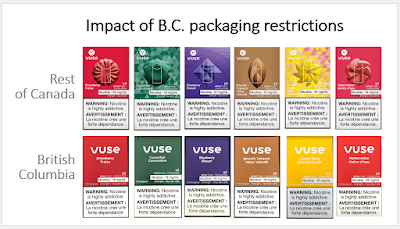
The federal government does not currently propose to require plain packaging of vaping products, but one province has taken steps in this direction. British Columbia's E-Substances Regulation allows the sale of vaping products only when “packaged in a plain manner that does not contain any text or image other than as required or permitted under this section.” 


Pre-market requirements.

The CCMOH called for the federal government to require product manufacturers to disclose all ingredients of vaping devices to Health Canada as a condition of being marketed, including establishing consistency in reporting nicotine levels in both open and closed vaping systems.

Health Canada has indicated its intention to require vaping manufacturers to report such information. In the Forward Regulatory Plan 2021-2023, it identifies that “Vaping Product Reporting Regulations” will be developed, and that draft regulations would made public this winter.   

Retail Licensing

The CCMOH called for provincial governments to require a vendor's licence for those selling vaping products.

Five provinces have adopted requirements for retail licenses or have imposed registration requirements on retailers who wish to sell vaping products: Quebec (2015), British Columbia (July 2020), Nova Scotia (July 2020), Newfoundland and Labrador (2021), New Brunswick (April 2022). In Prince Edward Island, vaping products may only be sold in specialty stores that meet specific requirements, although a license is not required. Ontario requires specialty vape stores to be registered with local health authorities. 

ADMINISTRATION AND GOVERNANCE 

Enforcement 

The CCMOH called for the federal government to enhance compliance, enforcement and public reporting and called on provincial governments to routinely use youth test purchaser.

Health Canada has subsequently made public the result of its enforcement activities, and has reported on the results of three rounds of inspections of vaping retailers. In December 2021, Health Canada disclosed that it “has not pursued any prosecutions against regulated parties manufacturing or selling vaping products under the TVPA.”

As reported earlier this month, there is limited information on the results of compliance activities underway in Canadian provinces. 

Health Education 

The CCMOH called for governments to collaborate to enhance public awareness and educational initiatives on the risks of vaping products, targeted at young, parents, educators and health care professionals.

There is no consolidated report on such activities. Health Canada runs a “Consider the Consequences” campaign directed at young persons, with a 3-year budget of $12 million. Reported expenditures for Health Canada’s Youth Vaping Prevention Campaign were over $6 million in 2019-2020

Cessation support

The CCMOH called for governments to establish comprehensive cessation initiatives for people with nicotine addiction, especially for youth.

There is currently no consolidated report on such activities. Health Canada has provided financial support for the development of programs to support vaping cessation among younger Canadians,  as have some provincial governments.

Health Research

The CCMOH called for governments to monitor and research and short and long-term health effects of vaping products and to research the effectiveness of policy approaches to address youth vaping.

In 2020, the Canadian Institutes for Health Research with the Canadian Cancer Society awarded 27 grants for research directed to the health effects of vaping and policy approaches to address youth vaping. Through its Substance Use and Addictions Program, Health Canada has provided support for the development of youth vaping cessation interventions and research on policy development.

The CCMOH called for governments to research the effectiveness of vaping products in supporting smokers to end or reduce their use of all nicotine-containing products.

The Canadian Task Force on Preventive Health Care has conducted a systematic review of evidence on ‘Tobacco Smoking in Adults’ and is currently preparing draft guidelines. These are expected to be released in 2022/23. It is not clear that this will address “ending or reducing their use of all nicotine-containing products”, which is not an identified goal of the federal Canada’s Tobacco Strategy.

Monitoring and Surveillance

The CCMOH called for federal and provincial governments to enhance surveillance and reporting of vaping product use and population health impacts.

Since January 2020 national surveys have been established or expanded to include vaping use. These include Statistics Canada’s annual Canadian Tobacco and Nicotine Survey, which was conducted in the winter of 2019-2020, 2020-2021 and is currently in the field for 2021-2022. The results of the first two waves have been made  public. Since 2020, Statistics Canada's annual Canadian Community Health Survey has included questions on e-cigarette use, although this data not yet been released.

Health Canada has supported consumer research on vaping product use, including a vaper panel which has monitored behaviours of some individuals over a two-year period.

Other national surveys were diminished in this period. The formerly bi-annual Canadian Student Tobacco, Alcohol and Drug Survey was last conducted in 2018-2019. It did not take place in the 2020-2021 school year, as an apparent result of a delay in changing suppliers. The contract was awarded in December 2020 to CCI Research and the survey is in the field for the 2021-2022 school year. Federal funding supports the COMPASS survey, which is conducted in selected schools by University of Waterloo. 

Provincial surveys on vaping behaviours in the general population are conducted in some provinces, (including Quebec and Ontario) as are provincial surveys of young person's vaping (QuebecOntarioBritish Columbia).

Policy Revision 

The CCMOH called for governments to work together to develop a broad regulatory approach to all alternative methods of nicotine delivery (i.e. other than tobacco products). They recommended that a component of any such regulatory approach should be the requirement for  manufacturers to demonstrate that marketing new products is in the public interest.

No efforts to develop such a regulatory approach have been made public. 

(Premarket authorization is the approach now required by the U.S. Food and Drug Authority for e-cigarettes and novel tobacco products).

Resources-Fact sheets:

Monday, 10 January 2022

Reporting on enforcement of Canada's tobacco and vaping laws.

This post reports on efforts by Canadian governments to ensure that retailers of vaping products follow provincial and federal laws, and identifies where official and community reports on enforcement action can be found.

VAPING

Federal enforcement of restrictions on vaping marketing. 

Since 2019, Health Canada has proactively disclosed reports on its activities to ensure compliance and enforcement of the federal Tobacco and Vaping Products Act and the Consumer Product Safety Act. These reports are made available on Health Canada's website

  • Between July 2019 and December 2019, Health Canada conducted on-site inspections of 1080 specialty vaping shops and 2083 convenience retailers. Four out of five (84%) vape stores and one in eight (13%) convenience stores failed inspection. Enforcement actions included "seizure" (products remained on-site), and warning letters. Infractions noted were those related to toxic labelling, testimonials or endorsements, child resistance container packaging requirements, promotion of prohibited flavours, and tobacco product-related brand elements.
  • Between July 2020 and March 2021 Health Canada conducted on-line inspections of 304 Instagram accounts, finding that more than half (161, or 53%) were non-compliant with respect to promoting prohibited flavours, providing testimonials or endorsements. No other forms of non-compliance (absence of health warnings, youth access to media, etc) were identified. Warning letters were sent to these businesses.


Low compliance with federal law has been identified by non-governmental bodies in the health and industry sectors. In the summer of 2021, our agency found that vaping industry leaders were frequently non-compliant. The Vaping Industry Trade Association (representing large manufacturers) has issued its own guidelines for compliance, and also commissioned a review of the sales practices of a sample of on-line stores. In this review, 93% of the internet stores inspected were found to contravene federal prohibitions on certain flavours, and that fewer than half posted the mandatory health warning. 

Instagram promotion of a
 dessert-flavoured vaping product
 
There are indications retailers who receive warning letters nonetheless fail to align their business practices with federal law. This month we reviewed the Instagram accounts of the 161 businesses that had received warning letters from Health Canada inspectors. We found that 72 (45%) continued to display testimonial-endorsements or promote prohibited flavours, some of which are shown here. Other infractions, such as the absence of health warnings, the use of lifestyle imagery and youth access to the marketing were observed in many cases. 

Health Canada does not routinely disclose whether it has pursued any prosecutions under these acts, but in 
Instagram promotion 
using testimonial endorsement
December 2021, it disclosed that to date
 it had not "pursued any prosecutions against regulated parties manufacturing or selling vaping products under the TVPA." The decision to escalate enforcement proceedings is explained as follows:

"If compliance cannot be achieved, subsequent enforcement actions are pursued depending on a range of factors, including but not limited to:
• severity/impact of the alleged non-compliance;
• continuation or the probability of reoccurrence of the non-compliance;
• compliance history of the establishment;
• program priorities and available resources. "

Compliance and Enforcement activities by provincial governments

The following governments have made public certain enforcement activities related to vaping retailing. 

Prince Edward Island engaged a dedicated tobacco enforcement officer in 2019, following concerns that inadequate enforcement was leading to increased infractions (with 20% of retailers willing to sell to an underage test shopper).  Nine months after PEI's restrictions on flavoured vaping liquids came into force (in March 2021), three retailers had been taken to court, and charges had been laid against an additional retailer. Outcomes of enforcement activities are not proactively disclosed on the provincial web-site, but are communicated to the media. (This is a significant change from  past years, when PEI was reluctant to disclose the name of offending retailers.)

In December, 2021, the Nova Scotia government made public that on 29 occasions during the year its enforcement officials had seized vaping products which contravened provincial law because they were flavoured or had excessive amounts of nicotine. The retail value of the products seized was $605,000. In November, charges were laid against one of the suppliers (Vaporhub), with a hearing scheduled this month. Nova Scotia charges against individual sellers have also been made public last October.

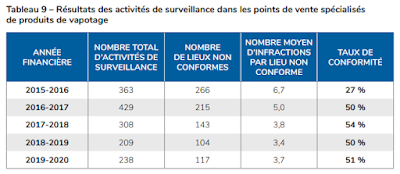
Every five years, the Quebec government reports on its experience in administering its tobacco laws. The most recent of these is dated November 2020. In the preceding five-year period, the Quebec government found that compliance had grown, but that half of vape stores were non-compliant in their most recent inspections. Compliance rates grew from 27% in 2015-2016 to 51% in 2019-2020. Compliance was higher with respect to sales for minors (90% of stores passed inspection). 


TOBACCO

Routine disclosure of tobacco-related enforcement by federal and provincial governments

Health Canada previously made public annual reports on its compliance activities, but the most recent of these dates from activities now 5 years old (for 2016-2017). In that year the department conducted 6,792 retail inspections, reviewed the adequacy of more than 1,000 regulatory submissions  and analyzed samples of tobacco products. One in ten (11%) of retailers were found to be non-compliant with respect to labelling, promotion or other marketing practices, and one in 10 (11%) of manufacturers did not fully comply with reporting requirements. No charges were laid, and the most recent prosecution identifeid dated from 2006.

Newfoundland's tobacco law is enforced by Digital Government and Service NL. Compliance reports do not appear to be made public. 

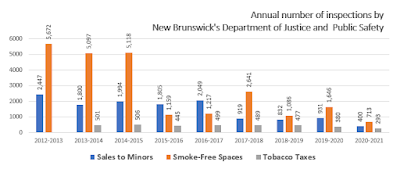
New Brunswick's tobacco laws are inspected by the Inspection and Enforcement Branch of the Department of Justice and Public Safety, with some information provided in the department's annual reports. From this we know that the number of inspections has fallen considerably, but not whether compliance has improved.


The Ontario government delegates responsibility for inspection to local boards of health, and has established a guideline and protocol that requires annual inspections of each retail location. Under this protocol, boards of health are required to "publicly disclose a summary report of all retailer/owner convictions". The City of Toronto, for example, provides monthly updates on convictions, and Peel Region provides an ongoing list of retailers who have been found to be selling to youth.

The Quebec government report cited above provides the most extensive detail on tobacco and vaping-related compliance and enforcement activities by any Canadian government. Over a 5 year period the department conducted 32,949 inspections, observing non-compliance on 12,307 occasions (37%). Of the 10,617 charges that were laid as a result, 88% resulted in a guilty plea or verdict. The report also provides information on the inspection results for different aspects of the law.  Overall, slightly more than half (57%) of tobacco retailers were found compliant with respect to signage and displays, and 93% had refused to sell to a minor when tested. 

In December 2021, Saskatchewan's Auditor General raised concerns about enforcement of that province's tobacco and vaping laws. The departmental audit found that one-fifth (19%) of identified retail locations were not inspected, and that many retailers were not tracked at all. The AG noted that there were repeated offenses but that they "found no cases where the Ministry took retailers to court."

As part of its overhaul of tobacco legislation, the Alberta government is establishing a new enforcement procedure and team. Enforcement responsibilities had previously been unassigned.  This past summer the province reported that "the enforcement team is expected to be operational in the second half of 2021." 

The British Columbia government delegates responsibility for enforcement of its tobacco- and vaping-related laws to local health authorities. On its web-site, the province provides some information on enforcement results and practices (including its Compliance and Enforcement Policy Manual. Some tribunal results are also posted.


Wednesday, 29 December 2021

Year-end Quiz: Tobacco Control in 2021

Before 2021 fades completely, here is a quiz to test your knowledge of tobacco control events over the past 12 months. The answers can be found at the bottom of this post. No peeking!

1. In 2021, one of Canada's major pension funds announced that it would divest its tobacco shares. Which one was it?

2. In 2021, which two provinces banned all flavours in vaping liquids other than tobacco flavour?  

3. In 2021, Health Canada reported that over the past year it had inspected more than 300 Instagram accounts managed by vaping manufacturers or retailers. How many were found NOT to be following the law?  (Bonus points -- for what percentage of infractions were charges laid?)

4. In 2021, in which province did smokers face a $10 per carton increase in tobacco taxes?

5. In 2021, which vaping product made by a multinational tobacco company was removed from the Canadian market (and which one was introduced)?

6. In 2021, tobacco companies' insolvency protection entered its third year, and the companies were authorized to continue "business as usual" while they tried to reach a settlement with the provinces to resolve the lawsuits against them. Which province stated that its objective was to end "business as usual" for tobacco companies in Canada?

7. In 2021, the Quebec Court of Appeal ruled on a constitutional challenge to that province's Tobacco Control Act filed by the Canadian and Quebec Vaping Associations. On how many issues did the Court side with the vape store owners?

8. In 2021, Statistics Canada released the second cycle of the Canadian Tobacco and Nicotine Survey. Among Canadians who reported using a vaping device over the past month, what proportion said they were former smokers?

9. For the fiscal year ending March 31, 2021 - and to the nearest $ billion, how much revenues did Canadian governments report they had received in tobacco taxes? 

10. In December 2021, New Zealand announced its strategy to achieve Smokefree Aotearoa by 2025. Which of the following were not included in its strategy:

a) Ensuring Indigenous leadership and decision-making across all levels of the action plan. 
b) Increasing stop smoking services
c) Lowering the amount of nicotine in tobacco products
d) Examine how best to restrict filters
e) Forbidding tobacco sales or supply to people born 2007.
f) Suing tobacco companies

11. Match the slogan to the company

A) Philip Morris International
B) British American Tobacco
C) Altia

1. "Moving beyond smoking"
2. "A better tomorrow"
3. "Delivering a Smoke-Free Future"

12. In 2021, Canadian tobacco companies filed financial reports with the Ontario court as part of their efforts to maintain insolvency protection while they negotiate a settlement with provincial governments and other Canadians who are suing them. From these reports, what proportion of their expenses are related to purchasing tobacco leaf (to the nearest 10%)?

13: What is their profit margin (retained earnings as a percentage of total revenues, excluding tobacco taxes) to the nearest 10%?    

14. The Canadian Student Tobacco Alcohol and Drug Survey (CSTADS) measured tobacco and e-cigarette use among high school students in 2008-2009, 2010-2011, 2012-2013, 2014-2015, 2016-2017 and 2018-2019. In 2018-19, 19% of students in grades 7 to 12 (approximately 402,000 young Canadians) had ever tried smoking a cigarette, and 34% had ever tried an e-cigarette. What change was seen in these behaviours in the 2020-2021 cycle of the biennial survey?

15. In answer to Health Canada's 2021 Canadian Cannabis Survey, which of the following substances did the fewest Canadians think were associated with moderate or great risk to the user?

A. Drinking alcohol on a regular basis
B. Smoking tobacco on a regular basis
C. Using an e-cigarette with nicotine on a regular basis
D. Smoking cannabis on a regular basis
E. Vaporizing cannabis on a regular basis
F. Eating cannabis on a regular basis.

16. Which of the following Canadian-based companies and products were in development in 2021

A. PODA. A heated-nicotine product that saturates tea pellets with synthetic nicotine (and is therefore not subject to current federal laws).
B. TAAT.  A nicotine-free hemp cigarette that is engineered to mimic a tobacco cigarette (but without the nicotine).
C. TPJ. The former "Punk Juice" company is expanding to make 36 million non-tobacco nicotine pouches per month. 
D. DITCH. A programmable e-cigarette designed to wean smokers off nicotine.  

17. Which Canadian legislature set new precedents by adopting a law to ban smoking in all publicly-funded rental housing as well as banning price-promotions aimed at tobacco retailers? 

18. What tobacco-related commitments were included in the platforms of federal political parties during the election for Canada's 44th Parliament?

19. During the 2021 federal election, which vaping organization registered with Elections Canada as a third party, and who was their financial agent?

20. As of December 11, 21 months have passed since the World Health Organization declared COVID-19 to be a pandemic. How long is it since the WHO identified smoking as a pandemic?

21. In 2021, did COVID surpass tobacco as the leading cause of preventable death in Canada? 

------------------------------------------------------------------------------------

Answers

1. Quebec's Caisse de dépot announced in January that it had signed the Tobacco-Free Finance Pledge . The "Caisse" was established by the Quebec government to manage several public and parapublic pension plans in Quebec, including the Quebec Pension Plan. Other large public pension funds in Canada which do not invest in tobacco include Ontario's Teachers Pension Plan, OMERS, and Alberta's AIMCo.  The Canadian Pension Plan Investment Board has not adopted this responsible investment policy.

2. These flavour restrictions came into force in Prince Edward Island in March, and in New Brunswick in September. 

3. Health Canada found non-compliance on 53% of the accounts.  No charges were laid, although warning letters were sent. 

4. Cigarette taxes went up by $10 per carton in British Columbia: $4 as a result of federal tax increases and $6 following a provincial tax increase. Tobacco taxes are now highest in B.C., although sales tax differences make the total price higher in some Atlantic provinces. 

5. In August 2021, Japan Tobacco International withdrew its Logic Compact device from the Canadian Market. In September 2021, Philip Morris International began selling VEEV vaping products in Ontario.

6. In 2021, none of the provinces made any public comments about the lawsuits. To date, none has identified any non-monetary objectives.

7. Zero. The Appeal Court upheld the Quebec law in its entirety. 

8. One-third (33%). Of the estimated 1.46 million Canadians who had used a vaping device in the past month, 485,100 were former smokers, 438,500 were never smokers and 532,400 were current smokers (smoked cigarettes in the past month). 

9. $7.53 billion. Of that amount, $4.46 billion was received by provincial governments, $54 million by territorial governments and $3.1 billion by the federal government. 

10. The only measure not included in New Zealand's plan is suing tobacco companies.

11. Their recently-trademarked slogans reflect their transformation goals: PMI is "delivering a Smoke-Free Future", BAT has "A Better Tomorrow", Altria is "Moving beyond smoking."

12: Two of the companies provided information on how much they spent on tobacco - 4% and 2% of their operating costs respectively.

13: The profit margin exceeded 50%. During the period reported, the annual combined net (after tax) cash retained by the companies is about $1.7 billion dollars. This is about one-half of the $3.3 billion they collectively received through sales and other activities (after excise, sales and income taxes are discounted). 

14. The formerly biennial CSTADS survey did not take place in 2020-2021. The contract for the next cycle was not signed until December 2020, with work commissioned for the 2021-2022 school year. 

15. F. The 2021 Canadian Cannabis Survey found that the percentage of Canadians who thought people have moderate or great risk of harming themselves with regular use was as follows:

A. Drinking alcohol on a regular basis - 75%
B. Smoking tobacco on a regular basis - 95%
C. Using an e-cigarette with nicotine on a regular basis - 89%
D. Smoking cannabis on a regular basis - 74%
E. Vaporizing cannabis on a regular basis - 75%
F. Eating cannabis on a regular basis - 63%

16. They all are. 

17. Nunavut adopted a new Tobacco and Smoking Act in spring 2021. The law has not yet come into force.

18. The platform commitments were as follows:

19. Rights4Vapers registered with Elections Canada as an official third party, and the chairman of the Vaping Industry Trade Association was listed as their financial agent. 

20. More than 35 years. In its 1986 resolution (WHA39.14), the World Health Organization called for action on the "pandemic of smoking and other forms of tobacco use, which results in the loss of the lives of at least one million human beings every year and in illness and suffering for many more."

21. No. Between January 1, 2021 and December 25, 2021 there were 14,400 confirmed COVID deaths. (Other estimates of excess deaths from COVID in 2021 are not yet available, although they are for 2020). Annual deaths from smoking in Canada are currently estimated at 51,700.


Thursday, 16 December 2021

Tobacco tax revenues are (almost) keeping pace with inflation, despite declining sales

This week the federal government released the Public Accounts for the fiscal year ending March 31, 2021. Contained within them was information on the amount of excise tax and duties collected by Revenue Canada that related to tobacco (and other goods). 

This post reports on these revenues and those of the other 13 Canadian jurisdictions that assess taxes on tobacco products. Further information is available on the following fact sheets:

Adjusted for inflation, combined tobacco tax revenues are the lowest they have been in 20 years. 

In fiscal 2020-2021, federal and provincial-territorial governments collected $7.528 billion in specific taxes levied on cigarettes, cigars, manufactured tobacco and other tobacco categories. This is down from the highest amount reported 5 years ago ($8.43 billion in 2016-2017).

Once inflation is taken into consideration, the collective revenues from tobacco taxes of Canadian governments have remained relatively stable over the past 20 years.


Tax increases have (mostly) overcome the impact of falling cigarette sales. 

Over the past 20 years, the number of cigarettes legally sold in Canada has fallen, and the decline has been more rapid in recent years. 

Nominally, taxes collected in 2019-2020 were slightly more than they had been in 2003 ($7.6 billion vs. $7.1 billion), even though the number of cigarettes sold had fallen by about one-third (from 36 billion to 23 billion). Once inflation is taken into consideration, the value of the tax revenues had fallen by about one-fifth.


Tobacco taxes represent a small fraction of government revenues

In Canada, tobacco tax revenues generally account for about 1% of government revenues. This proportion has been stable in recent years. In the low-tax provinces of Quebec and Ontario, the contribution to government revenues is under 1%, and in no jurisdiction is it greater than 2%. 


The amount of taxes provided by an "average" smoker has grown slightly

An estimate of the average amount of tobacco taxes paid by Canadian smokers can be calculated by dividing tobacco tax revenues by the number of smokers in each jurisdiction. Differences between provinces will reflect variances in the tax rates between provinces and also in the proportion of the market which is untaxed (eg. contraband). 

By this method, smokers in the Atlantic provinces currently pay the most in provincial taxes - more than $1,800 per year in Nova Scotia and Newfoundland. Smokers in Quebec pay less than half that amount ($733 per year). On average, across the country a smoker payd about $5.00 per day in tobacco taxes to provincial and federal governments, or $1,800 per year.

Although per-smoker revenues have grown over the past two decades, the growth in value is only marginally larger than the inflationary increase. In 2003 the average  annual revenue per smoker across the country was $1,257. Although it had grown to $1,800 by 2020, the value of that revenue was only marginally higher ($1,346 if stated in equivalent 2003 dollars).

Note: Statistics Canada cautions that data from the Canadian Community Health Survey for 2020 should be used with caution because of methodological changes imposed by the pandemic. These methodological issues may contribute to the apparent sharp increase in 2020 in some provinces.