Are you old enough to remember the Frank statement? Probably not.
It was the iconic moment in the 1950s, when tobacco companies begain to speak directly to the public about the growing evidence that smoking caused lung cancer.
This In the subsequent decades it has been denounced by U.S. courts and historians as a PR exercise aimed at reassuring smokers instead of warning them. Canadian companies took a similar strategy of offering reassurance, although their tactics did not involve widely published commitments. These strategies were similarly denounced by courts.
Earlier this week we learned that Canadian Tobacco Companies have engaged PR firms to try to forestall regulations on their products.
In that context, it is interesting to consider more closely the message that BAT/Imperial Tobacco is sending to its customers .
There are echoes of the Frank statement in this communication -- an expression of concern and a pledge to research candy wrapped around a core message of denial (nothing proven!) and deflection of responsibility (THC!).
Move on, customers, nothing to see here!
ICYMI the text from govype.ca is printed below.
To Our Customers
Given the recent cases of acute respiratory illness from vaping reported in the US recently, we fully support any measures that will ensure the safety of those consumers who use vaping liquids and devices. As the distributor of Vype vaping products across Canada, Imperial Tobacco Canada takes consumer safety responsibilities very seriously.
Although investigators in the USA have not yet finally determined the cause of all of the recently reported cases, the US Food and Drug Administration is warning that there appears to be a particular danger for people who have bought vaping products on the street (i.e. not sourced from a reputable manufacturer), and for those who vape liquids with oils containing THC or containing an additive called “Vitamin E Acetate”.
Our parent company, British American Tobacco (BAT), has invested billions of dollars in the research and development of their potentially reduced risk products and the ingredients and components used in these products have been scrutinised by the BAT team of 50 toxicologists for their suitability for vaping.
To the best of our knowledge, no Vype products have been identified in any of the US reports to date. We can confirm that oils containing THC and Vitamin E Acetate are not, and have never been, added to our Vype products.
As for the one possible case in Canada, few details have been shared and authorities have not contacted us about it, which suggests it does not involve our product.
UPDATED OCTOBER 11th
The US Food and Drug Administration (FDA) warns public to stop using Tetrahydrocannabinol (THC)-containing vaping products and any vaping products obtained off the street.
The FDA has issued a recent important consumer guidance on recent vaping illnesses dated 4th October 2019 entitled, “FDA warns public to stop using Tetrahydrocannabinol (THC)-containing vaping products and any vaping products obtained off the street."
Please see the full text of that consumer guidance by clicking the link here.
Showing posts with label Tobacco Industry Tactics. Show all posts
Thursday, 17 October 2019
Monday, 14 October 2019
Everything old is new again: Tobacco companies set up a lobbying arm to fight vaping regulations.
This is not the first or the only Canadian vaping industry lobbying group. The Canadian Vaping Association has made its views known to legislators and policy makers for a number of years. But there is an important distinction between these two groups, and the CVA is no friend of big tobacco. Its members are the specialty vaping shops whose grey-market business was disrupted when the federal government legalized the sale of e-cigarettes last year. Recently, this organization has called for the sale of vaping devices to be removed from corner stores. Convenience stores are arguably the ground zero of the youth vaping epidemic, but they are also the main route to market for the products sold by tobacco companies, and are the main competition to the CVA membership.
What is important to take away from today's story is that Canada's 3 big tobacco companies -- Imperial Tobacco, JTI-Macdonald and Rothmas, Benson and Hedges - are working together to influence government policy and that they are partnered with well-connected PR firms to oppose health regulations.
In short, these same companies are using the same strategies for the same purposes as they did with cigarettes a few decades ago -- strategies that have been denounced by Quebec courts as being an unlawful conspiracy.
The companies unlawfully conspired through the CTMC, say the courts.
It is not even 8 months since the Quebec Court of Appeal issued its judgment against these companies. After combing through decades of evidence and many thousands of exhibits detailing their actions, the Appeal court upheld the 2015 verdict of Justice Riordan. In its unanimous 5-judge ruling, the Appeal Court also found that the tobacco companies had used their lobbying agency, the Canadian Tobacco Manufacturers Council (CTMC), as a way to delay regulations and prevent smokers from learning how harmful their products were. The courts described these actions using terms like "conspire" and "collude".
Their CTMC lobbying contributed to the courts' decision to hold them liable for the injuries suffered by some Quebec smokers:
"By engaging in this collusion for several decades in ... the activities of the Ad Hoc Committee and thereafter the CTMC, the appellants jointly participated in a wrongful act which caused injury."The courts found that the companies' bad faith efforts were not limited to government- and public-relations activities. Their marketing practices were also found to be misleading, and part of an attempt to offer false reassurance to smokers or "lull" Canadians into a sense of non-urgency about the health risks.
(Quebec smokers have yet to receive a penny of the $13+ billion damages the court ordered -- but that is another story.)
Déja vu all over again
Like the CTMC in the 1960s, VITA was created this year in the wake of rapidly growing public, scientific and government concern about the harmfulness of nicotine products.
It was in 1962, after the UK Royal College of Physicians published a report condemning smoking as a cause of lung cancer that the Canadian tobacco companies laid down the basis of a public relations effort that would last for decades. They did so only when medical evidence of harm had reached a tipping point, and when major health bodies - like the Canadian Medical Association - were urging the government to do something to address this newly-understood problem.
Their PR campaign soon became formed as an "Ad Hoc Committee" to manage government relations, and then institutionalized into the CTMC. (You can read more about this sad history in paras 1000 to 1648 in a 2014 legal filing)
Sixty-plus years later, VITA was created in similar circumstances. The summer of 2019 was a blizzard of news stories about vaping - Congressional hearings, FDA enforcement actions, health bulletins! As the evidence accelerated, Canadian governments too were under increased pressure to force changes to the vaping market.
It was wrong then. Can it be less wrong now?
There is a direct parallel between the conspiracy that was so carefully documented and denounced in the Quebec class actions and the public relations efforts of the Canadian companies this fall. As before, instead of reaching out to provide customers with information about new research, the companies are today trying to deflect those concerns and convince the public that there is no urgent need for action.
Imperial Tobacco's press release from September 19 2019 is an example of how the company seeks to offer reassurance by dissociating its products from any documented health problems and to deflect concern to other possible causes of any adverse health effects.
There are echoes too in the packaging and marketing of the products, and the ways in which these fail to provide adequate warnings as they seek to diminish health concerns. From the Quebec court rulings, we now have very concrete and specific requirements for a manufacturers' duty to warn. (It is found in para 227 of Justice Riordan's ruling and is also pasted below). The warnings on the vaping products and advertisements today fall far short of this mark.
There are other ways in which today's vaping advertisements run against the court rulings because they would lead a "credulous and inexperienced consumer" to misjudge the health harms of the product being advertised. No regulator, so far as we know, has asked a court to consider whether campaigns like "looks small, hits big" mislead consumers in this way.
The Quebec courts have said this type of behaviour is wrongful. But that ruling is one made in hindsight - and does not appear to have had a preventative effect. Stronger health laws are needed to change the marketing of vaping products -- The core job of VITA is to prevent those laws from happening.
A different country. A different story.
In the United States, the companies are adopting a different public relations strategy.
At the end of September, JUUL announced that in the United States it would put down lobbying and marketing tools. It said it was "refraining from lobbying" the federal government and "committing to fully support and comply" with federal law. It pulled out of financing a referendum to overturn San Franciso's ban on e-cigarettes.
There are reasons why the companies take a different approach in the USA. The regulatory environment is different south of the border, where e-cigarettes have not yet been approved for sale by the FDA. Their sale is being allowed while the approval process is underway, but a decision is on the horizon.
In Canada in 2018, Parliament decided that it was in the public interest for these products to be marketed. No company is required to get approval, and there are negligible constraints on the product designs that can be introduced.
In the FDA system, the onus is on people wishing to introduce a new product to the market to demonstrate that doing so is appropriate for the protection of public health and provide evidence to this effect.
In Canada, at the federal level at least, the regulatory burden is on government, not industry. It is government which must demonstrate that a new regulation is appropriate for the protection of health and which must provide evidence of economic benefit to doing so.
What's a government to do? Just say no to VITA.
Canadian governments which wish to avoid repeating the mistakes of the past should give wide berth to tobacco industry lobbying groups. Support for governments refusing to meet with the tobacco/vaping industry and its proxies can be found in a number of places.
For example, the global tobacco treaty - the Framework Convention on Tobacco Control -- requires that parties (like Canada) protect public health from tobacco industry interference. There are guidelines laid down on how to do so. Ten of 33 countries were recently assessed as doing better at this than Canada.
The Quebec Court of Appeal gives additional comfort for keeping lobbyists at bay. In its March 2019 ruling, it wagged its finger at the federal government for having given too much access to the CTMC.
[494] ... [The federal government] maintained a close relationship with their lobbyist, the CTMC, and so forth. Perhaps the government could even be accused of giving the impression, through this accredited collaboration, that tobacco was not really harmful or that it was not as harmful as some claimed, which was an impression that the appellants themselves were busy spreading, maintaining and building. Perhaps the government actually knew as much as the appellants about the dangers of cigarettes and should have banned the product or more severely restricted its distribution and above all should have done so sooner (the government didn't start until 1988, with the Tobacco Products Control Act, which came into force in 1989). Perhaps the government failed to inform the public and displayed reprehensible inaction...According to this morning's report, VITA has set up meetings with legislators in Nova Scotia and has already met with Health Canada.
One sensible thing for Health Ministers to do would be to read the Quebec rulings and to counsel their staff against repeating the errors of the past.
-----------------------------------------------------------------------------------------------------
Justice Riordan's statement of a manufacturer's duty to warn
227. Our review of the case law and doctrine applicable in Quebec leads us to the following conclusions as to the scope of a manufacturer's duty to warn in the context of article 1468 and following:
a. The duty to warn "serves to correct the knowledge imbalance between manufacturers and consumers by alerting consumers to any dangers and allowing them to make informed decisions concerning the safe use of the product";
b. A manufacturer knows or is presumed to know the risks and dangers created by its product, as well as any manufacturing defects from which it may suffer;
c. The manufacturer is presumed to know more about the risks of using its products than is the consumer;
d. The consumer relies on the manufacturer for information about safety defects;
e. It is not enough for a manufacturer to respect regulations governing information in the case of a dangerous product;
f. The intensity of the duty to inform varies according to the circumstances, the nature of the product and the level of knowledge of the purchaser and the degree of danger in a product's use; the graver the danger the higher the duty to inform;
g. Manufacturers of products to be ingested or consumed in the human body have a higher duty to inform;
h. Where the ordinary use of a product brings a risk of danger, a general warning is not sufficient; the warning must be sufficiently detailed to give the consumer a full indication of each of the specific dangers arising from the use of the product;
i. The manufacturer's knowledge that its product has caused bodily damage in other cases triggers the principle of precaution whereby it should warn of that possibility;
j. The obligation to inform includes the duty not to give false information; in this area, both acts and omissions may amount to fault; and
k. The obligation to inform includes the duty to provide instructions as to how to use the product so as to avoid or minimize risk.
Tuesday, 17 September 2019
One week into the Canadian election, JUUL launches a political action campaign.
Tomorrow, the Canadian election campaign official enters its 2nd week. So far the focus has been on traditional voter issues -- jobs, the environment, taxes, etc.
But in the wake of the (now seven) recent deaths of young American vapers, the media has asked federal leaders whether they will follow the example of U.S. governments and put more restrictions on the marketing of vaping products. The response was a decided non-committal.
Is it a coincidence that in my e-mail today was an invitation from JUUL to "protect my vapour access" by becoming an "advocate for reasonable policies that protect adult access to vapour products to encourage them to make the switch from combustible cigarettes."? (As a keenly interested party, I had subscribed to their e-mail service.)
The invitation lead to a recruitment site - The Switch Network - which asked about my willingness to participate in a range of political actions -- from signing a petition, e-mailing elected officials, attending rallies or demonstrations or testifying at hearings.
A democracy depends on an active and engaged citizenry. But mobilizing addicts during an election? I think that may be a new one, even for the nicotine industry.
But in the wake of the (now seven) recent deaths of young American vapers, the media has asked federal leaders whether they will follow the example of U.S. governments and put more restrictions on the marketing of vaping products. The response was a decided non-committal.
Is it a coincidence that in my e-mail today was an invitation from JUUL to "protect my vapour access" by becoming an "advocate for reasonable policies that protect adult access to vapour products to encourage them to make the switch from combustible cigarettes."? (As a keenly interested party, I had subscribed to their e-mail service.)
The invitation lead to a recruitment site - The Switch Network - which asked about my willingness to participate in a range of political actions -- from signing a petition, e-mailing elected officials, attending rallies or demonstrations or testifying at hearings.
A democracy depends on an active and engaged citizenry. But mobilizing addicts during an election? I think that may be a new one, even for the nicotine industry.
Tuesday, 13 August 2019
Monetizing peer pressure: JUUL joins in.
This, I believe, was a departure in tobacco marketing in Canada. I could not recall a previous time when tobacco companies recruited such a direct and sales-focused type of 'paid influencer'.
One might have thought that this practice was banned by Canadian tobacco law, which has for many years told manufacturers that they can't offer prizes, money or other inducements to purchase tobacco products. (IQOS and other heat-not-burn devices are considered tobacco products under federal law).
The ban was recently reaffirmed when the federal Tobacco and Vaping Products Act was overhauled in 2018:
29 No manufacturer or retailer shall
(a) provide or offer to provide any consideration, for the purchase of a tobacco product, including a gift to a purchaser or a third party, bonus, premium, cash rebate or right to participate in a game, draw, lottery or contest...
Six months have passed since Physicians for a Smoke-Free Canada filed a complaint to Health Canada about the IQOS referral offer yet the IQOS referral web-site is still active (referiqos.com).
Which brings us to JUUL.
Yesterday, JUUL presented me with a similar, if somewhat less lucrative, offer. As the e-mail presented the offer, every referred adult smoker who makes a purchase gets a discount of $20 on their account, with a similar credit given to the person who referred them.
The federal law sets different rules for vaping promotions than it does for tobacco. You are allowed to offer cash or other 'considerations' -- but only in a physical store ("retail establishment") to which young persons do not have access.
30.6 (1) No manufacturer or retailer shall, in a place to which young persons have access,
(a) offer to provide any consideration, for the purchase of a vaping product, including a gift to a purchaser or a third party, bonus, premium, cash rebate or right to participate in a game, draw, lottery or contest; or
(b) offer to furnish a vaping product in consideration of the purchase of a product or service or the performance of a service.
(2) No manufacturer or retailer shall, in a place other than a retail establishment where vaping products are ordinarily sold,
(a) provide any consideration, for the purchase of a vaping product, including a gift to a purchaser or a third party, bonus, premium, cash rebate or right to participate in a game, draw, lottery or contest; or
(b) furnish a vaping product in consideration of the purchase of a product or service or the performance of a service.
Influence peddling
Tobacco companies have long known that peer pressure is a driving force for uptake of nicotine. Imperial Tobacco Canada (BAT) infamously studied the role that peer pressure played in teenagers - its Project 16 report found "there is no doubt that peer group influence is the single most important factor in the decision by an adolescent to smoke."
New communications technologies now allow the companies to harness the power of peer pressure -- and the law seems unable to prevent it from happening.
Everything new is old again
For a century, tobacco companies have pioneered marketing strategies and pushed the envelope of marketing codes and legal restrictions. For decades, governments have been caught flat footed, unable to keep up with, let alone control, the inventiveness and deep pockets of marketers. The difference now is that we know the consequences of regulatory inaction.
If paying people to encourage their friends to use use of addictive and harmful products is permitted under the federal TVPA, then a new law is needed.
Thursday, 8 August 2019
Imperial Tobacco is encouraging you to pimp your vape
On July, Imperial Tobacco posted an ad on its Instagram account, announcing that "ePod Skin Collections are coming soon. Stay tuned! Happy Canada Day!"
Sure enough, later last month the company put on offer 19 different sleeves that can be used to dress up a vaping device. They are pretty spiff, and are sold under evocative descriptors like "maze", "tropico", "relief", and "express". The skins can be ordered from the company' web-site for about $4 each.
When decorative covers were first sold by British American Tobacco for the ePen 3 in the United Kingdom, they were launched as "high fashion pieces" commissioned by clothing designer Henry Holland. His aim was to help consumers incorporate things in their lives that gave them "positivity", "empowerment" and helped them "feel really good about themselves."
Res ipsa loquitur
Linking addictive nicotine to a fashion lifestyle is likely not permitted under Canada's federal Tobacco and Vaping Products Act (s. 30.2), which may be why there was no similarly splashy launch to sale of these fashion accessories in Canada.
The Tobacco and Vaping Products Act says that "30.2 No person shall promote a vaping product, a vaping product-related brand element or a thing that displays a vaping product-related brand element by means of lifestyle advertising."
Health Canada recently finalized regulations to put cigarettes in plain packaging. One of the reasons for doing so was that branded packages functioned as 'mini-billboards', encouraging young people to try smoking.
By the same logic, these fancy-dress sleeves will serve as mini-billboards for vaping products -- a consumer-carried lifestyle advertisements.
Only in Canada, you say? Pity.
The skins are not yet listed for sale in the few other countries where the epod is marketed, eg France, Germany and the United Kingdom.
Sure enough, later last month the company put on offer 19 different sleeves that can be used to dress up a vaping device. They are pretty spiff, and are sold under evocative descriptors like "maze", "tropico", "relief", and "express". The skins can be ordered from the company' web-site for about $4 each.
When decorative covers were first sold by British American Tobacco for the ePen 3 in the United Kingdom, they were launched as "high fashion pieces" commissioned by clothing designer Henry Holland. His aim was to help consumers incorporate things in their lives that gave them "positivity", "empowerment" and helped them "feel really good about themselves."
Res ipsa loquitur
Linking addictive nicotine to a fashion lifestyle is likely not permitted under Canada's federal Tobacco and Vaping Products Act (s. 30.2), which may be why there was no similarly splashy launch to sale of these fashion accessories in Canada.
The Tobacco and Vaping Products Act says that "30.2 No person shall promote a vaping product, a vaping product-related brand element or a thing that displays a vaping product-related brand element by means of lifestyle advertising."
Health Canada recently finalized regulations to put cigarettes in plain packaging. One of the reasons for doing so was that branded packages functioned as 'mini-billboards', encouraging young people to try smoking.
By the same logic, these fancy-dress sleeves will serve as mini-billboards for vaping products -- a consumer-carried lifestyle advertisements.
Only in Canada, you say? Pity.
The skins are not yet listed for sale in the few other countries where the epod is marketed, eg France, Germany and the United Kingdom.
Wednesday, 31 July 2019
Big Data for Big Nicotine - Insights from the trademark registration for the JUUL C1
Yesterday, word went round that JUUL had opened a flagship store in Canada's flagship city. And to mark the opening of the store on Toronto's Queen Street West, the controversial vaping company launched a pilot program for its new "C1" device.
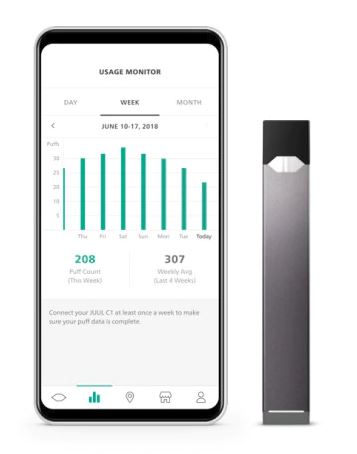
The JUUL C1 differs from the current ubiquitous model in that it is equipped with bluetooth capacity, and is intended to be used in conjunction with a mobile app. Visitors to the store or JUUL's Canadian web-site (or the U.K. site where the C1 is also being sold) would have every reason to think that this has been done for their benefit:
The JUUL app, currently a pilot, is designed to help users manage their nicotine consumption and combat unauthorized use. The app provides connected features such as:
• Usage Monitor, gain greater control and visibility of your usage. Real-time monitoring with daily, weekly, and monthly tracking of your puff use.
• Device Lock, JUUL C1 features automatic device security. You can manually lock the device, or set it to Auto-Lock to prevent unauthorized use when your JUUL C1 is not being used by you.
• JUUL Locator, keep track of your JUUL C1. When in range, ring it to play a sound. When out of range, see where it was last paired to your phone to help you stay on your switching journey.
For this information, a more helpful source is the trade-mark database managed by Industry Canada. Not quite 2 weeks ago (on July 22), JUUL filed its description of goods that would be sold under the JUUL C1 label. (Trademark registration 1976819). In addition to the location and blocking functions, the C1 also seems designed to monitor and report on the movements and communications of vapers.
In their own words, JUUL C1 covers a host of other data-collection functions:
"computer software for use in posting, transmitting, retrieving, receiving, reviewing, organizing, searching and managing text, audio, visual and multimedia data and content via computers, mobile phones, wired and wireless communication devices, and optical and electronic communications networks; computer software for calculating, mapping, transmitting and reporting information relating to the location, movement, proximity, departure and arrival of individuals and objects via computers, mobile phones, wired and wireless communication devices, and optical and electronic communications networks."
Juul is not the first company to include surveillance mechanisms in its device. Reuters commissioned a teardown of the bluetooth function of IQOS, and reported last year that the technology would allow the company to gather data from unwitting users.
In the era of digital marketing and Big Data, this type of consumer research can't be considered a surprising development. But shocking, nonetheless!.
Subscribe to:
Posts (Atom)