Showing posts with label regulatory examples. Show all posts

Wednesday, 30 October 2019

Finland's strong controls on e-cigarettes include a ban on flavours.

Recently the academic journal Tobacco Control published a new study on Finland's experience with banning flavours in e-cigarettes. In this paper, Eeva Ollila of the Cancer Society of Finland analyzed the legal challenges and defiance to the law by manufacturers and retailers, and identified the need for greater controls at the EU and other levels. See you in court: obstacles to enforcing the ban on electronic cigarette flavours and marketing in Finland.

Canadians reading her research may be forgiven for thinking 'we should be so lucky'.

Despite the enforcement challenges, Finland has largely succeeded in protecting its young people from e-cigarette uptake. This is shown in the results from its annual school health survey which were reported in Eeva Ollila's paper. Colour was added for ease of reading.

This data show that, unlike Canada, after Finland legalized e-cigarettes (in 2016), use by early high school students went down (green lines). (Snus - which is illegal in Finland - may be a different issue!).


Finland’s tobacco endgame includes lowering e-cigarette use.

Finland has embedded a tobacco end-game in its national public health strategies and also in its tobacco laws.


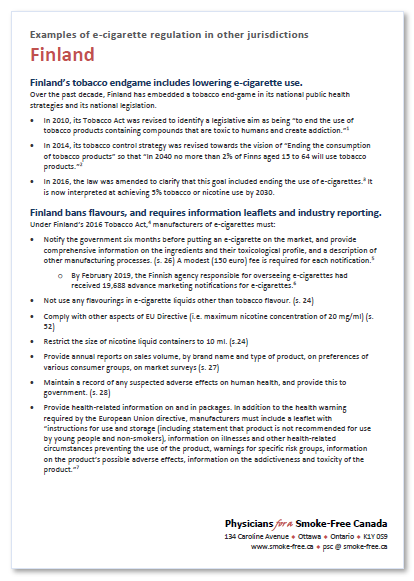
Finland puts limits on nicotine, flavours and ingredients:Under Finland’s 2016 Tobacco Act manufacturers of e-cigarettes must:
  • Not use any flavourings in e-cigarette liquids other than tobacco flavour. (s. 24)
  • Comply with other aspects of EU Directive (i.e. maximum nicotine concentration of 20 mg/ml) (s. 52)
  • Restrict the size of nicotine liquid containers to 10 ml. (s.24)

Finland requires manufacturers to file extensive reports to government.
  • Six months before putting a product on the market, manufacturers must  provide comprehensive information on the ingredients and their toxicological profile, as well as a description of other manufacturing processes. (s. 26) A modest (150 euro) fee is required for each notification. 
  • Manufacturers must provide annual reports on sales volume, by brand name and type of product, on preferences of various consumer groups, on market surveys (s. 27)
  • Manufacturers must maintain a record of any suspected adverse effects on human health, and provide this to government. (s. 28)

Finland requires manufacturers to provide information to consumers.
Manufacturers must provide health-related information on and in packages.
  • In addition to the health warning required by the European Union directive, manufacturers must include a leaflet with “instructions for use and storage (including statement that product is not recommended for use by young people and non-smokers), information on illnesses and other health-related circumstances preventing the use of the product, warnings for specific risk groups, information on the product’s possible adverse effects, information on the addictiveness and toxicity of the product.”

In Finland, tobacco and e-cigarette retailers pay high licensing fees.
Retailers of tobacco and/or nicotine-containing liquids are regulated by Valvira, the National Supervisory Authority for Welfare and Heath. Retailers must:
  • Have a retail licence issued by the local authority.
  • Submit an annual payment at a rate set by local authorities. The maximum is EUR 500 per point of sale (i.e. for each cash register). The maximum for retailers who sell both tobacco products and nicotine-containing liquids is EUR 1,000. 
  • Refrain from displaying tobacco or nicotine products in their stores. Tobacco specialty stores may do so, but not if the displays are visible from outside. Retailers are permitted to show purchasers a catalogue of available products and price list, if they have been asked. Standards for this material is set by regulation.
  • Have one employee designated as a monitor of the store’s compliance with regulations. 

A public register of retail licences and wholesale notices for tobacco and nicotine products is maintained by Valvira. (There are about 7,250 tobacco and nicotine retail licences in Finland (because each point of sale or cashier must be licensed, this means there will be fewer than 7,250 retail outlets). Of these, about 340 sell nicotine liquids. About 2,750 annual visits are made by municipal inspectors to licensed tobacco/e-cigarette retailers.

Finnish health authorities do not promote the use of E-cigarettes as part of a harm-reduction strategy.
The Finnish Institute for Health and Welfare (a government agency) does not promote using e-cigarettes or identify harm reduction as a goal of e-cigarette regulation. The first messages on its web-page on e-cigarettes caution:
  • The nicotine in electronic cigarettes is highly addictive and has its own health effects.
  • The use of electronic cigarettes impairs the normal functioning of the lungs and reduces the function of the lungs.
  • Experimental studies have shown that the use of electronic cigarettes can contribute to the development of cardiovascular changes.
  • cigarette liquids and vapors contain a number of harmful substances, such as PAH and VOC (volatile organic compounds). Some of the compounds are the same, carcinogenic compounds, as in tobacco smoke, but generally in smaller amounts.
  • Silica and metal particles and drug residues have been found in some e-cigarette liquids.
  • Some e-cigarette fluids have caused toxic effects on cells in laboratory tests.

Finland monitors of youth and adult tobacco use on an annual basis.
Finland’s public health monitoring includes annual surveys of school health behaviours, and adult smoking behaviours.

Finland imposes a tax on e-cigarettes (at about one-tenth of that on cigarettes).
Finland's tax on e-cigarettes is EUR 0.30 per ml of liquid. The tax on a typical 2 ml/200 puff pod of nicotine fluid is thus about EUR 0.60 or CAD $0.80. This is equivalent ot the Finnish tax on 2 cigarettes (EUR 0.27 or CAD 0.40 per cigarette).

This information - and references - are available in a downloadable fact sheet.


Wednesday, 4 September 2019

Why so anodyne? Canadians need strong, effective and truthful warnings on vaping packages

The federal government summer season of no-big-decisions usually runs from third week of June (St. Jean Baptiste Day) to the first week of September (Labour Day). On the eve of the break this year, Health Canada handed public health groups with a challenging summer task: published in the Canada Gazette on Saturday June 22 were 27 pages of proposed regulations for vaping products. Responses were due 75 days later, on September 5.

The proposed regulations are no trivial matter. They are the first significant regulatory proposals from government to constrain the way that nicotine products are packaged and labelled, or to control the amount or type of nicotine that can be sold as a recreational drug. 

For decades, nicotine other than tobacco was controlled as a medication under the Food and Drugs Act. The tolerance that was given to vape shops was so extensive that many Canadians who bought nicotine liquids for vaping devices were likely unaware that they were participating in an illegal sale.

All this changed when the federal Tobacco and Vaping Products Act was approved by Parliament and proclaimed in May 2018. The legalization of nicotine changed the commercial market, bringing nicotine into the Fast Moving Consumer Goods (FMCG) market. Convenience stores became the route to market for multinational tobacco companies to compete for this new market. (Picture below courtesy of Toronto area South Bayview Bulletin Board).


Health Canada has yet to make public whether or how it will regulate the types of ads that appear in many convenience stores (several provinces have banned them). Their first priority was to develop labelling requirements and child-resistant container requirements. As Health Canada describes them, 

The proposed labelling requirements include a list of ingredients, and, depending on the presence of nicotine and its concentration, a health warning that nicotine is highly addictive, the concentration of nicotine, and warnings regarding the toxicity of nicotine when ingested. In addition, the proposed Regulations would set out expressions that may be used on the product or package to indicate when a vaping product is without nicotine. The proposed Regulations would also require refillable vaping products, including devices and their parts, to be child resistant.

Why so anodyne?

Health Canada's proposals for package warnings for vaping products are surprisingly unambitious for a country which invented graphic health warnings. The regulations require a only a text warning, only for one health effect and only on one side of the package. They are arguably less powerful than the warnings currently placed on a voluntary basis by the industry. 


Canada can do better 

This proposed warning seems even more  milquetoast now than it did when it was first Gazetted in June. South of the border, health authorities have spent the summer snarling at nicotine companies and expressing concerns about potential acute risks for young people who vape:
* top medical authorities issued unequivocal warnings that vaping products are "not safe" for non-smokers, 

Admittedly, only one other country currently requires graphic health warning messages on vaping product packages (South Korea). Admittedly, it is important to design them thoughtfully -- and that takes more than the 75 days given to respond to the proposed regulations. Admittedly, Health Canada should not leave the packages of these risky products unregulated for any longer than necessary.   

For that reason, we are proposing that in the short run, Health Canada require a strengthened and more prominent version of its warning be on all packages as soon as possible. Within the next year, however, it should be possible to refine and adapt a series of rotating messages which provide Canadians with the information about the range of health risks associated with vaping to which they are entitled. One of our suggestions on how to do this is shown below.


How much is too much? How fast is too fast? 

The proposed regulation also sets limits on how much nicotine is permitted in the liquids or cartridges used with vaping devices. The level -- at 66 mg / mL -- is much higher than any of the major products currently on the market. This is in stark contrast to the European Union, Israel, Korea, and Iceland where the maximum level allowed is 20 mg/mL. 

Nor does the regulation address the additional risks of nicotine salts -- which are shown even by the industry research to reach the brain more quickly than those which do not use this 'protonated' technology. It does little to respond to increasing concerns about the collateral damage of the nicotine arms race that is happening between JUUL and its imitators.

A time for sober second thought

More often than not, the final version of regulations varies little from the version that is initially published. Concerns about departmental regulation making once resulted in Parliament being given an opportunity to vet Tobacco regulations before they came into effect. This provision was removed when the law was updated  to include vaping products last year.

So the only recourse left is for a change of opinion by the department and the central agencies (Treasury Board, Privy Council Office, Cabinet) to which it reports. Cross your fingers!

Our submission

Physicians for a Smoke-Free Canada's full response to the proposed regulation can be downloaded here. Our key recommendations are:

1. Vaping packages should carry warnings of the following risks:
  • Vaping products may increase the risk of cardiovascular diseases.
  • Vaping products may increase the risk of lung diseases.
  • Vaping products are not effective smoking cessation devices for most people.
  • Dual use of vaping products and combustible cigarettes increases the risk of disease compared to exclusive use of either product.
  • Use of vaping products during pregnancy may harm the fetus
  • Young people who vape can harm the parts of their brain that control attention, learning, mood and impulse control.
  • Nicotine can harm adolescent brain development, which continues into the early to mid-20s
2. Manufacturers should be required to place warnings on at least 50% of the top of two principal display surfaces, with one side each for English and French.
3. Graphic health warnings for vaping product packages should be developed. 
4. Plain packaging of vaping products should be required.
5. The maximum allowable nicotine concentration should be set at 20 mg/mL.
6. The impact of the introduction of nicotine salts on youth vaping should be reviewed.

Tuesday, 30 July 2019

Vive la France! Vive la France mobilisée!

Earlier this summer, the French government continued with one really good idea:  getting French communities to work together to combat addiction, and giving them the money needed to do so effecxtively.

The announcement was made in the form of a second request for proposals on the web-site of the French Ministry of Solidarity and Health (even in French the title is catchy -- "Ministère des Solidarités et de la Santé".  Civil society organizations, academics, health professionals and other non-commercial interests are invited to apply for funding.

A similar RFP was issued last year for mobilization projects focused on tobacco, with a budget of 5 million euros. The "Fonds de lutte de tabac" as it was then known, allocated more than 90 million euros to other tobacco-related program costs.

The Ministry's objectives for civil society activities, as translated, are pasted below. They include exposing the marketing practices of tobacco, alcohol and cannabis industries, and denormalizing the use of these addictive products. Applications can be submitted up to September 16, 2019.

The best part? French tax payers are not footing the bill for this work. Since 2017, the "Fonds de lutte" has been financed by a special tax on the tobacco industry.


Call for proposals: Mobilizing Civil Society against addiction

As part of the fund for the fight against addiction, a call for projects is launched to support actions of a national nature carried out by civil society actors . It is open until September 16, 2019 .

The objective is to support national projects that aim to:

  • improve information and understanding, especially of the general population or specific audiences, elected officials and opinion leaders, on the impact and dangers of the use of psychoactive substances (in particular tobacco, alcohol and cannabis) and the benefits of stopping or reducing consumption;
  • deconstruct the marketing and marketing strategies of the tobacco, alcohol and / or cannabis industries;
  • promote the denormalization of tobacco, alcohol and cannabis in society, especially among young people;
  • promote the involvement of users or former users themselves (young people, peer helpers or expert patients, pregnant women, etc.), especially in stop-smoking, risk-reduction and / or advocacy projects;
  • equip and support the practices of health professionals and the socio-educational sector in the prevention of risky consumption of psychoactive substances or risk reduction.
This call for projects is aimed at associations, groups of associations working in the fields of the fight against tobacco and addictive behaviors, prevention and health promotion, the fight against precariousness, Patients, users and consumers associations, learned societies and health professionals.

Project promoters must be non-profit and have no link with the tobacco industry (Article 5.3 of the World Health Organization Framework Convention on Tobacco Control) or supply chain operators alcohol or cannabis.