Monday, 6 January 2020

Another new year, another round of tobacco manufacturers' price increases.

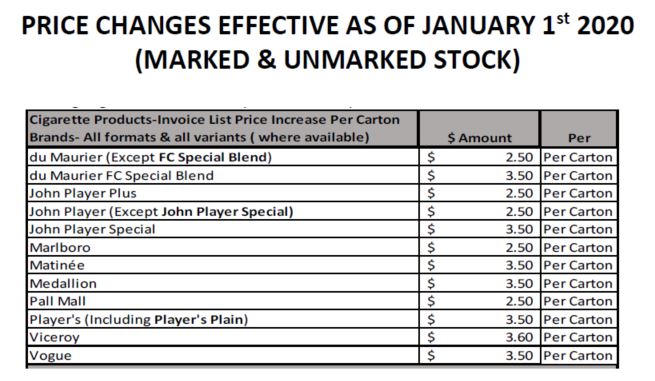
This week Canadian tobacco companies raised the price they charge to retailers for cigarettes and other toabcco products. This month the price (per cigarette) went up by 1 to 1.5 cents in in most parts of Canada ($2.50 to $3.60 per carton), as shown in the memo sent by Imperial Tobacco to retailers on December 2nd.

.
From a public health standpoint, increases in tobacco prices are generally viewed as a good thing. There is a long and robust evidence base that higher cigarette prices lead to lower rates of smoking and lower levels of consumption by those who do smoke.

Price increases by tobacco companies, however, are often implemented in ways which defeat this health objective.

That's because tobacco companies want to raise prices without causing smokers to quit or reduce the number of cigaretes they buy. For them, prices are an optimizing exercise in increasing revenues on each sale while maintaining a large customer base. To address this challenge, the companies have adopted a number of pricing practices and marketing tactics.

This week's price increase is a good moment to review 5 pricing tactics they use in Canada.

Pricing tactic # 1: Blunt the impact of price increases by spreading them out 

A 60 cent a package increase is much more noticeable to smokers than two 30 cent increases -- which is why the companies favour multiple small increases rather than a few large ones.

For example, this week's wholesale price increase is at least the second set of increases over the year. Manufacturers' prices were also increased by 1 cent per cigarette ($2 per carton) in May, bringing the annual total increase by manufacturers to at least $4 to $6.00 per carton. There may have been additional increases this year, but the ones cited here were the only ones shared with us by retailers. There is no public registry of tobacco wholesale prices in Canada, as there is in Iceland.

Pricing tactic #2: Disguise price increases behind tax increases

Tobacco companies have a long tradition of timing their own price increases to match any rise in taxes. This week an example of that is shown in the higher price increases that are taking place in British Columbia when compared with the other provinces.

British Columbia is the only province to have timed a tobacco tax increase to the New Year. A $4 per carton increase was included as part of the measures announced by the government in November to discourage youth vaping and tobacco use. (B.C. now has the second highest rate of cigarette tax  in Canada.)

Although the B.C. tax increase represents only $0.40 per package of Players cigarettes, for example, the actual increase for smokers will be $0.83. Imperial Tobacco increased the price of that brand by $0.35 per pack across the country and added an additional $0.08 in British Columbia. Upset smokers will blame the government for the increase, not the manufacturers.

Cigarette tax rates in Canada, January 1, 2020


Pricing tactic #3: Price segment your brands so that there are cheaper brands available to price-sensitive smokers 

For over a decade, tobacco companies have used price-segmentation to divide their brands into higher priced premium brands, mid-range value brands and lower cost budget or super-value brands. Each of these categories had about one-third of the market in 2015, as Japan Tobacco informed Health Canada. 


In a market where all cigarette brands are sold at the same price (as was the case in Canada before 2003), a smoker facing a price increase had the options to quit, to cut down or to pay the price increase. With price-segmentation of brands, a fourth option was introduced - the smoker could also choose to switch to a lower priced brand.

In Canada there are no minimum price laws or other legal restrictions on tobacco companies selling brands as lost-leaders or below the cost of production.

Pricing tactice #4: Localize prices to give price-sensitive smokers the option of cheaper retail outlets.  

Just over a decade ago, it was illegal for manufacturers to charge different prices to different retailers for the same product. That changed in 2009 when the federal Competition Act was amended, Soon after tobacco companies began charging different prices to different retailers, a practice that was made easier because they replaced traditional wholesale distribution with their own 'direct distribution' contracts with retailers.

The conditions imposed on retailers when they purchase cigarettes ensure that the retail price set by the manufacturer is charged by retailers. Retailers who wish to benefit from lower wholesale prices are obliged to restrict their profit (markup) to a lower percentage.

The result is that the same brands of cigarettes are sold at lower prices in some neighbourhoods than in others.  An example from our price survey in Montreal in early November 2019 shows how large these differences can be: the price of the same budget cigarette brands  (Pall Mall, Philip Morris) was $7.62 per pack in one store and $9.00 and $9.25 per pack only a couple of kilometres away. Even stores in the same chain (eg Couche Tard / Circle K) were charging different prices for the same cigarette brands at different locations.

This pricing practice has allowed the companies to introduce another option for smokers facing a tax or price increase -- to switch to purchasing their cigarettes at a cheaper retailer.

Pricing tactic #5:  Discourage tax increases. 

Most of the price paid by smokers for a package of cigarettes results from the federal and provincial excise taxes that are imposed on them. The World Health Organization recommends that taxes represent at least 70% of the price. Health Canada reports that taxes represent about 64% of the cost of a package of "the most popular price category" of cigarettes: because taxes are mostly at a fixed rate per cigarette this percentage varies by province, brand and retailer.

Tobacco companies want governments to keep taxes lo because a) lower prices will not encourage smokers to quit (and may encourage more young people to start smoking) and b) when taxes are low the companies have more "pricing room" in which they can escalate their profit margins.

Recent reports written on behalf of British American Tobacco and presented to governments in Ontario and Quebec encourage government to abandon excise taxes in favour of alternative tax models or to ensure that any increase is gradual, predictable and small.

And yet their own price increases are equivalent or greater than the tax that they claim will drive smokers to the illegal market. The Quebec government has not increased tobacco taxes since 2014; the Ontario government last raised tobacco taxes in March 2018.

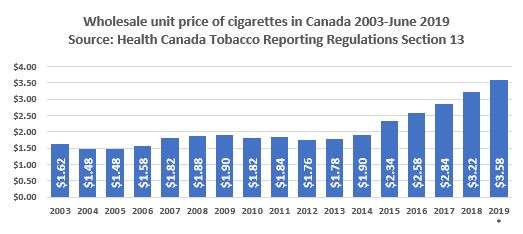
While taxes have stayed steady in the largest provinces, industry prices have climbed significantly. Reports filed with Health Canada show that the average manufacturers' revenue per cigarette increased by more than 25% between 2017 and the first half of 2019. This is equivalent to $7.40 per carton.
Data provided by Health Canada, November 2019.
Data for 2019 is for half year only

-----------------------------------------------------------------------------------------

Spotlight on:  

Cigarette pricing in Montreal


Our survey of posted prices in central Montreal in November illustrates the use of price segmentation and price localization. Montreal smokers who are concerned about price increases are offered the opportunity to switch to lower cost brands and to switch to cheaper retail outlets.

The same survey was conducted in 2018 and 2017. Results from those years shows that the companies have also been successful in grabbing pricing room for themselves and successfully blocking tobacco tax increases.

The companies raised their prices on their cheapest cigarettes by an average of by 33% in only 2 years (from 12 cents to 16 cents per cigarette, or $8 per carton.) By contrast, during the same period, the Quebec government did not increase taxes and the federal government increased them by 1.5 cents per cigarette.

Wednesday, 1 January 2020

Yet more federal government opinion research on vaping

Last spring the federal Privy Council Office (the department which serves the Prime Minister and Cabinet) commissioned a series of focus groups across Canada to gain information on a number of topical issues. The topics ranged greatly, with Canadians being asked for their input on possible names for national pharmacare and climate plans, to their views on steel tariffs and pipelines.

Although the focus groups were held in April, May and June, the results were only recently released. They were prepared by Phoenix Strategic Perspectives under the title "Spring 2019 Focus Groups" POR 139-18 and are available in three separate reports on the National Library 

One topic put to the last cycle of focus groups in June related to vaping products and smoking. The conclusions from this report are reproduced below.

---------------------------------------------------------------------------------------------

6. Vaping and Smoking


Issues in this section were explored with participants in Surrey, Fredericton, Sorel, and Belleville.

Smoking and vaping status

Most groups included a mix of smokers (daily and/or occasional smokers) and non-smokers. The exceptions were the group of women in Fredericton and homeowners in Surrey, all of whom were non-smokers. Among those who are non-smokers, many are former smokers. At least a few participants in most groups said they have tried vaping.


Experience and familiarity with vaping

Those who have tried vaping said they did so either out of curiosity, typically in a social setting (e.g. with friends), in order to try to quit smoking, or in order to try to reduce stress. A few added that they believe vaping is expensive and/or more expensive than smoking cigarettes. Those who have not tried vaping identified the following as things they feel they know or have heard about it:
  • it is very popular among youth (i.e. trendy)/considered ‘cool’;
  • there is a lack of knowledge about its long-term health effects;
  • the vaping liquids come in a variety of flavours;
  • one can vape with or without nicotine;
  • smokers use it as a way to quit smoking;
  • one can strengthen or weaken the intensity or dose of what is inhaled;
  • it is not regulated/not as regulated as cigarettes;
  • it has been linked to the condition known commonly as ‘popcorn lung’ (bronchiolitis obliterans);
  • some vaping devices have exploded;
  • big tobacco companies are involved in it;
  • it looks silly;
  • it is a gateway towards smoking;
  • it is addictive; and
  • it smells good.

Sources of information about vaping

Participants have learned about vaping from various sources which include the following:
  • relatives/friends and acquaintances;
  • social media;
  • internet;
  • news;
  • seeing people vaping;
  • vape shops (identified by some as increasing in number in their neighbourhoods); and
  • advertising.


Perceived benefits and harms of vaping

Perceived benefits or potential benefits of vaping included the following:
  • it can/might help people quit smoking;
  • it may prevent young people from starting to smoke (i.e. an alternative to smoking);
  • it is not as bad for one’s health as smoking/contains fewer chemicals than cigarettes;
  • it does not smell bad/make one’s clothes smell bad;
  • it does not create second-hand smoke; and
  • the proliferation of vape shops creates employment.

Some said they could think of no benefits to vaping, while some others said they did not know or did not know enough about vaping to offer an opinion.

The most commonly identified harm or potential harm associated with vaping was lack of knowledge/studies about its possible long-term health effects. Other harms associated with vaping included the impression that it was a gateway/pathway to smoking for youth, the danger posed by exploding devices, and the possibility of becoming addicted to it.

Participants tended to express uncertainty when asked about the health effects of vaping, and specifically the harmfulness of vaping compared to smoking tobacco cigarettes. This uncertainty was based on the previously mentioned widespread impression that there is a lack of knowledge/studies about the long-term health effects of vaping. Having said that, the uncertainty in question was often related to how harmful vaping is, not to whether vaping is harmful at all. Indeed, there was a relatively widespread impression that vaping is probably not good for one’s health, even though it is as yet unclear what the health impacts are, and even though it might not be as bad as smoking.

Participants made the following points in this regard:
  • vaping liquids contain chemicals, and inhaling these chemicals into one’s lungs cannot be good for one’s health;
  • inhaling any kind of smoke (whether produced by cigarettes or vaping devices) is not good for one’s health;
  • vaping with nicotine is no better than smoking a cigarette; and
  • vaping may not be as harmful as smoking, but this could result in people vaping more frequently because they think it is not harmful to them, and this increased frequency of vaping could result in negative health effects or addiction.
Some participants were more categorical, suggesting that vaping is harmful (pointing to reports that vaping can cause conditions such as popcorn lung and water on the lungs) and/or dangerous (pointing to reports of malfunctioning of devices resulting in explosions).

Finally, some participants did suggest that in their opinion vaping is less harmful than smoking, but it was also observed that this does not mean that vaping is not harmful simply because it is less harmful than smoking.


Perceptions of smoking

Most participants in these locations interact with people who smoke. This includes friends, relatives, and colleagues, and the frequency of interaction ranges from rarely, to occasionally, to frequently (e.g. daily). Asked how they feel when people in their social circle smoke in their presence, most said they do not like it, with some going so far as to say they hate it. Other feelings elicited by people in their social circle smoking in their presence included disappointment, and a ‘live and let live’ attitude.

Reasons for critical or negative reactions to people smoking in their presence included the following: the smell of cigarettes, the odor it leaves in their clothes/feeling dirty, not wanting to be exposed to second-hand smoke/health concerns, difficulty breathing, allergies being triggered, the temptation to smoke themselves, not wanting their children exposed to smoking/smokers, and difficulty understanding how people can continue smoking given the dangers it poses to health. Participants who expressed a ‘live and let live’ attitude towards those smoking in their presence sometimes added that people in their circle who smoke do so outdoors (i.e. not in proximity to them in an enclosed space).


Perceptions of smoking as a health issue today

There was near unanimity among participants that smoking is a big health issue today. Reasons for this opinion included the following:
  • the effects of smoking have not changed, and illnesses caused by/linked to smoking remain with us (e.g. cancer, emphysema). Related to this was the impression that many smokers and even former smokers are only now beginning to experience the health effects of years of smoking;
  • dangers posed by smoking affect not only smokers but non-smokers (i.e. second-hand smoke);
  • health care costs associated with smoking-related illnesses/the strain it poses on health care resources;
  • smoking is an addiction and should be treated as an illness not just a “bad habit”;
  • the impact it has on the more vulnerable members of society (i.e. lower income Canadians are more likely to smoke but least likely to be able to afford the smoking cessation devices that might work);
  • youth/young people continue to smoke despite health warnings and scientific evidence of its impact on heath;
  • the environmental impact of smoking (e.g. cigarette butts and chemicals that remain in smoked cigarettes); and
  • smoking/having smoked can adversely affect one’s insurance/insurance premiums.
Some participants added that smoking is an important issue to them personally, mainly because of personal health issues/concerns (e.g. asthma, allergies, effects of second-hand smoke) and/or because of the impact it has on relatives/loved ones (e.g. cancer).

While there was near unanimity that smoking is a big health issue today, there were differences of opinion about whether the health risks to Canadians generally that is posed by tobacco has increased, decreased or remained about the same over the past five years. Participants tended to be divided between those who think the risk has decreased and those who think it is about the same.

Reasons for the impression that the health risk has decreased tended to be variations on the assumption that the proportion of smokers has been decreasing over time. This decrease was ascribed to various factors which included the following:
  • the increased cost of cigarettes;
  • greater awareness of the heath effects of smoking, especially among the young;
  • smoking is no longer socially acceptable and no longer seen as ‘cool’;
  • more and more people are quitting smoking as a result of successful cessation devices; and
  • more and more people are turning from smoking to vaping.
Participants who think the risk posed by smoking is about the same as it was 5 years ago provided the following reasons to explain their point of view:
  • they have not noticed any changes over the past 5 years in either health warnings or legislation related to cigarettes (which they noted have been in place for decades);
  • youth/young people continue to smoke despite health warnings and scientific evidence of its impact on heath;
  • people can still be seen smoking in public places (e.g. on work breaks); and
  • the risks posed by tobacco are similar for vaping, which is on the rise and appears to be supported by investment from the tobacco industry.
A few participants think the think the health risk posed by smoking may have increased compared to five years ago. Two reasons were given to explain why. One was the impression that the effects of smoking on health can take years to manifest themselves, the result being that more people may now be suffering from the effects of smoking than was the case five years ago. The other was the impression that e-cigarettes (viewed as a form of smoking) that contain nicotine can deliver higher concentrations of nicotine than regular cigarettes.

Impressions of smoking regulations and social acceptability of smoking

Participants were asked for their impressions of the opinion that smoking regulations have gone too far, and that those who smoke have no rights at all. The widespread impression among participants was that this was not the case. That being said, there was also a widespread impression that smoking is not (or no longer) socially acceptable. Reasons for this impression included the social censure that smokers often encounter (e.g. negative perceptions in general, ‘dirty looks’, critical comments), legislation limiting where smokers can smoke, and the impression that because smoking is harmful, non-smokers have a right to be protected from its effects. Participants who think it is socially acceptable to smoke, primarily men in Sorel, were of the opinion that there is a ‘live and let live’ attitude that still prevails when it comes to smoking and that smokers and non-smokers have reached a modus vivendi.

Impressions of smokers

Most participants said they have a ‘live and let live’ attitude when it comes to smokers, some adding that people have a right to take decisions regarding their own lives as long as it does not interfere with the rights of others. In some instances, participants said their feelings towards smokers vary by age. Specifically, some said they feel disappointment when they see younger people smoking or think that it is stupid for young people to start smoking given all that is known about the health effects of smoking. A few participants said they feel bad for smokers because smokers are often among the more vulnerable members of society (e.g. lower income, less formal education). Participants said their impressions about smokers have not changed considerably in the last 5-10 years. One participant said his impression of smokers changed over this period of time, specifying that after graduating from high school he no longer considered smoking ‘cool’.

Reaction to the statement that that those who smoke could quit if they really wanted to elicited nuanced reactions. There was a widespread impression that people have to really want to quit smoking in order to be successful. In other words, the decision to quit has to be a personal decision and the person in question has to be motivated. At the same time there was also widespread recognition that quitting is not as easy as simply taking the decision to do so, and that various factors come into play. For example, it was observed that smoking is an addiction, that many people need help to break the addiction (e.g. moral support, cessation resources), and that it may take numerous quit attempts before someone is successful.


Perceptions of smoking as a government priority

Most participants overestimated the percentage of the Canadian population aged 15 and older that smokes today (either daily or occasionally). [8] Participants were then read the following statement and asked for their reaction:

Some people say that smoking rates in Canada are decreasing and public focus should now be on other issues such as other health care issues, climate change or balancing the budget. Others say that there are still 4.6 million smokers in Canada and so tobacco should continue to be a high priority. From your own point of view, should tobacco continue to be a high government priority?

Participants were divided in their opinions, though most felt that the public focus should now be on other issues. Reasons given included the following:
  • enough has been done in this regard/efforts have been successful, and much has been achieved (e.g. smoking rates are declining, 15 percent of the population smoking is a good result/acceptable proportion, smoking will never be eliminated completely as long as it is legal);
  • public awareness of the hazards of smoking is now widespread and generally accepted; and
  • other important issues need to be addressed (e.g. opioids, the environment).
Those who think tobacco should continue to be a high priority observed the following:
  • young people continue to start smoking, despite all the information and evidence about the hazards of smoking;
  • smoking has important environmental consequences that should be addressed;
  • the health-related consequences of smoking will still be with us for years (e.g. cancer rates among smokers); and
  • a 15 percent smoking rate can realistically be reduced further (i.e. more progress can still be made).

Ways to help Canadians quit using tobacco products

Participants were informed that Canada’s Tobacco Strategy has committed to reducing tobacco use to 5 percent by 2035 and asked how the Government of Canada/Health Canada could best help Canadians quit using tobacco products, to meet this objective. The most frequently made suggestion in this regard was to subsidize/reduce the cost of smoking cessation resources/strategies (e.g. prescription medications). Other suggestions included the following:
  • raise the price of cigarettes;
  • prohibit smoking altogether;
  • focus on rewarding quitters (e.g. competitions with prizes);
  • focus information campaigns on positive sides of quitting/success stories (i.e. as opposed to scare tactics);
  • focus efforts on young/youth smokers;
  • promote non-smoking among new immigrant/new Canadian communities; and
  • restrict the sale of cigarettes to specialty shops.

Some participants in Belleville suggested addressing laws that facilitate access to cigarettes in certain circumstances, such as the selling of cigarettes on reserves.


Monday, 23 December 2019

Newly-released Health Canada research provides insight into young vapers

Last week, Health Canada made public its plans to ban advertising of vaping products wherever they can be seen or heard by youth. At the same time, they also released two surveys that provide information and insight into young people's vaping behaviours.

These surveys are:
  • Environics. Vapers Panel Survey to Measure Attitudes and Behaviours Regarding Vaping Products June 2019. POR 141-18
    This is an on-line survey conducted semi-annually of Canadian regular vapers (people who have vaped in the past month). The latest results can be found at:
    http://epe.lac-bac.gc.ca/100/200/301/pwgsc-tpsgc/por-ef/health/2019/141-18-e/index.html
Here are 5 take-away messages from these reports

1. Youth vaping has doubled in the past 2 years (and tripled in the past 4).

Canadian Student Tobacco
Alcohol and Drug Survey
This year's CSTADS survey was the first major representative Canadian survey of youth vaping since the federal government legalized the commercial sale of recreational nictoine. Prior to that date, vaping products were available in the grey-market of vape stores and on-line retailing.

The number of grade 10 and 11 students who had ever tried an e-cigarette jumped from one-third (33%) to almost one half (47%). The number of current users (those who have vaped in the past 30 days) doubled from 15% to 30%.

This increase has been seen across all provinces, but at different levels. The largest central Canadian provinces have lower rates of use than do the eastern or western regions, although the growth in Ontario (a 270% increase in 2 years) was one of the highest. New Brunswick did not participate in this survey in 2014-2017.

Canadian Student Tobacco Alcohol and Drug Survey

2. E-cigarettes seem more powerful than cigarettes at recruiting daily users.

Canadian Student Tobacco 
Alcohol and Drug Survey, 2018-2019
Although the proportion of children in grades 10 to 12 who have ever tried a cigarette (34.4%) is almost as high as those who have tried vaping (46.8%), a much higher proportion of vapers become regular users. Among this age group 25% of those who have ever tried vaping are now doing so daily with nicotine-based vapes, compared with 5% of those who have ever tried smoking.
The CSTADS results provided by Health Canada do not present information on dual users (those who both smoke and vape) or the relationship between past use of tobacco and e-cigarettes.

3. For young people, vaping is an on ramp to nicotine use, not an off-ramp for smoking.

Environics, POR 141-18
More than one half (56%) of young vapers (age 15-19) and almost one-third (29%) of young adult vapers (age 20-24) are non smokers (have never tried a cigarette, or smoked fewer than 100 in their lifetime). The  proportion of young people who had never smoked grew between February and June, 2019.

Even among the one-third (34%) of teenage vapers who also smoke cigarettes, only a minority (32% of dual smokers or 14% of all vapers aged 15-19) say they are trying to quit smoking. Among young adults (aged 20-24), 25% of regular vapers say the main reason they vape is to quit smoking.

4. Flavours are the "main reason" given by half of young people for vaping 

Environics, POR 141-18
(compiled from banner tables)
The most frequently-cited "main reason" of teenagers and young adults for vaping is because they "like the flaours and/or smell." Other key reasons are that "it is fun and exciting" and belief that these products are less harmful than cigarettes.

One-third of teenagers and young adult vapers say the main reason they vape is their belief that this is less harmful than smoking.

One-third of young adults say they now are using or have used e-cigarettes to help quit smoking.

5. Age-gating is not working very well.

In all provinces specialty vape shops have fewer restrictions on displaying products and promotions, and these stores are expected to be age-restricted. Nonetheless, the Environics report suggests that large numbers of underage vapers are given access to these places.

Vape shops are among the most frequently-cited place where under age regular vapers buy their devices (39% of underage vapers) and liquids (31%). One in 7 (14%-15%) of underage vapers reports they usually buy their own products on-line, with a comparable  number reporting purchases in convenence stores (10% for devices, 16% for liquids).

Children's use of vape shops is also reflected in their recall of seeing promotions in these stores. One in 5 teenage vapers (age 15-19) recalls seeing advertisement sin vape shops (33% of the 63% of this age group who recall ads).

Teenagers vapers are frequently not asked to show proof of age. Only one-quarter of teenage vapers (aged 15-19) are "always" asked to prove their age when buying vaping products, with another quarter "often" asked and another quarter asked "rarely or never". Teenagers report that when ID is required for on-line purchases, four times in ten (37%), they do not have to prove they are old enough other than by clicking a button

Thursday, 19 December 2019

Response to Health Canada's proposals to protect children from vaping promotions

We welcome the steps taken today by Health Canada to restrict e-cigarette promotions as an important initial step towards the comprehensive measures that are needed to protect children from vaping. We are especially pleased to see the Hon. Patty Hajdu make these proposals so quickly after she assumed responsibilities as the federal Minister of Health.

Protecting children from tobacco and nicotine marketing is a core public health measure, which is why we and other health groups, and parliamentarians have called on Health Canada to include these types of promotional restrictions since they first proposed legalizing vaping in 2016.

Tragically, this measure will not by itself be strong enough or fast enough to adequately address the crisis of youth vaping. We know from decades of experience with youth smoking that comprehensive protective measures are needed.  Urgently needed is a wide range of regulatory and programmatic activities at the federal level, such as:
  • effective and meaningful restrictions on flavours,
  • bans on additives that make it easier to become addicted to nicotine,
  • an end to promotional pricing (including taxes)
  • strong graphic health warnings,
  • controls on the ornamental design of packaging and devices (plain packaging)
  • public education,
  • research and surveillance,
  • industry reporting, including testing of emissions
  • support for cessation,
  • enforcement and industry accountability for the harms it causes.
The evidence of the government's failure to protect children when it opened the commercial market for recreational nicotine can be found in the results of Health Canada's survey of students smoking behaviour. The number of high school children using e-cigarettes has doubled since these products were marketed and promoted by big tobacco companies and large convenience chain stores. More than 1 in 10 (13%) of  children in grades 10 to 12 are vaping daily.

The vaping experience of the past months have highlighted the weaknesses of Canada's regulatory system to respond to market-driven problems. The measures proposed today were promised by Health Canada last February, and several more months will pass before they will finally be in place.  We look forward to working with Minister Hajdu and with parliamentarians to accelerate the implementation of these and other urgently-needed controls on the vaping market.

Links:

October 14, 2019:  Statement from the Council of Chief Medical Officers of Health calling for comprehensive vaping controls:
"We reiterate our call from April: We need to create environments that prevent youth vaping by strengthening regulatory frameworks and policies that restrict the accessibility and availability of vaping products and reduce the appeal of such products to youth. This includes plain packaging, health warnings and regulating the sale and marketing of vaping products and flavourings, and putting in place school and community policies that reduce use and encourage positive youth development."

"E-cigarette prevalence rates have doubled among students in 2018-19 since the last survey in 2016-17. Twenty percent (20%) of students (approximately 418,000) had used an e-cigarette (with or without nicotine) in the past 30 days, an increase from 10% in 2016-17. Prevalence of past-30-day use of e-cigarettes was not different between male (21%) and female (19%) students, but higher among students in grades 10 to 12 (29%) than those in grades 7 to 9 (11%). Students who have used an e-cigarette (with or without nicotine) in the past 30 days, are vaping frequently, with 40% (approximately 165,000 students) reporting daily or almost daily use."

Sunday, 15 December 2019

Canadian government revenues from tobacco taxes: an update

Every year federal and provincial governments provide the public with financial reports, including information on how much revenue the have collected in tobacco taxes.  The last of these 'Public Accounts' for the last fiscal year (April 1 2018 to March 31 2019) was tabled in the House of Commons last week. Time for an update on tobacco tax revenues!

Last year, Canadian governments collected more than $8 billion in tobacco taxes
Total tobacco tax revenue received by Canadian governments this year was $8.3 billion, of which $3.4 billion (41%) was collected by the federal government and $4.9 billion collectively received by the provinces. Almost all of this revenue results from the sale of cigarettes. Only the federal government provides details on the amount of tax received from taxes on different types of tobacco products. In the case of federal revenues, 94% cames from cigarette sales, 2% from cigars and 4% from all other tobacco products, including oral tobacco and heat not burn sticks.


In real terms, tobacco tax revenues have not really increased  - or decreased - by very much over the past decade
Although tax rates have moved up (with the expected decrease in cigarette sales), the amount of taxes received has hardly budged in this decade once revenues are adjusted to reflect the impact of inflation.


Last year, the average Canadian smoker paid $1,680 in tobacco taxes
The federal government receives an average of $690 each year from each of Canada's estimated 4.9 million smokers. The amount received by each province ranges from $665 (Ontario) to $1,674 (Newfoundland and Labrador) per smoker. The combined average federal and provincial tax burden for each smoker is $1,682, reflecting the fact that most smokers (63%) live in the provinces with the lowest taxes.


Tobacco taxes represent about 1.5% of Canadian tax revenues and about 1.1% of total government revenues.  
The contribution of tobacco tax revenues to the treasury of federal and provincial governments ranges from a low of 0.8% in Ontario to a high of 1.8% in Alberta. Expressed as a percentage of tax revenues, the contribution of tobacco taxes ranges from a low of 1.2% in Ontario to 3.8% in Alberta.


Links to Fact Sheets: 

Tax Revenues from Tobacco Sales. December 2019.
http://www.smoke-free.ca/pdf_1/totaltax.pdf

Taxes on cigarettes in Canadian jurisdictions. October 2019.
http://www.smoke-free.ca/pdf_1/taxrates.pdf

Tobacco taxes paid by smokers. December 2019.
http://smoke-free.ca/pdf_1/Tax-per-smoker.pdf


Thursday, 12 December 2019

What research tells us about young people and e-cigarette flavours

Many researchers are focusing on the role played by e-cigarette flavourings in encouraging young non-smokers to use these products.

Earlier this year, the Nordic Welfare Council produced a report intended to inform public health efforts by governments in the Nordic Region (Iceland, Sweden, Denmark, Norway, Faroe Islands, Finland, Aland, and Greenland).

Their report - The significance of flavour additives in the use of moist snuff and e-cigarettes – with a focus on young people and the Nordic region - provides a readable summary of the evidence as well as a summary of e-cigarette and oral tobacco (snus) use in those countries.

Their conclusions are pasted below, with links to the research on which they based their findings. Because this report is already 11 months old, further studies are also identified at the end of this blog post.

CONCLUSIONS OF THE NORDIC WELFARE COUNCIL:

  • "Flavour additives are a leading cause of young people trying tobacco products or e-cigarettes."
  • "New users have a preference for the particularly sweet flavours, such as those of sweets, fruit, chewing gum, soft drinks, etc."
  • "Young people also have a perception that e-cigarettes with the flavour of fruit, for example, are less harmful to health than e-cigarettes with the flavour of tobacco."
  • " If the product also contains nicotine, this may lead to dependence and potentially interest in trying other, more harmful tobacco products."
  • "Restrictions and regulations on flavour additives in e-cigarettes and e-liquids will therefore most likely have an impact on the use of these products by young people."

ARTICLES REVIEWED BY THE NORDIC WELFARE COUNCIL:

Never, current, and former smokers had distinct reasons for e-cigarette use and discontinued use and differed in flavor preferences.
Never, current, and former smokers (n=1,567; age 18-34)

Several reasons for first trying e-cigarettes predicted continued e-cigarette use, including good flavors, does not smell bad, can hide from adults, low cost, friends use, can use anywhere, to quit smoking regular cigarettes, and because they are healthier than cigarettes.
Longitudinal surveys. Middle and high school students (n=340)

Smokeless tobacco susceptibility was greatest among tobacco never-users who perceived flavored ST as easier to use.
2013-2014 Population Assessment of Tobacco and Health study (PATH) Tobacco never-users (n=7,718; age 12-17)

Ever and current e-cigarette users had higher odds of reporting that flavored ecigarettes were "less harmful" than nonflavored e-cigarettes, compared to youth who did not use e-cigarettes.
Data from a rapid response surveillance system. Students (sample [n]=3,704 from a population of students [N]=434,601; grade 6, 8, and 10)

The popularity of flavors across the range of tobacco products e.g. e-cigarettes and hookah suggest that flavoring might have broad appeal to young tobacco users.
2014 National Youth Tobacco Survey (NYTS). Middle and high school students (n=22,007).

Participants associated flavored smokeless tobacco with appealing non-tobacco products, such as chewing gum and alcohol. Availability of different varieties and flavors stimulated interest and curiosity in sampling or switching between smokeless tobacco products.
Interview. Adolescent males and smokeless tobacco users (n=23)

Dai, 2016 Flavored Electronic Cigarette Use and Smoking Among Youth.
Use of flavored e-cigarettes was associated with higher odds of intention to initiate cigarette use, lower odds of intention to quit tobacco use, and a lower prevalence of perception of tobacco's danger.
2014 National Youth Tobacco Survey (NYTS). Middle and high school students (n=21,491).

Dai, 2018 Single, Dual, and Poly Use of Flavored Tobacco Products Among Youths.
Use of flavored tobacco products is prevalent among youths. E-cigarettes were the leading flavored product and often concurrently used with other flavored tobacco products.
2014 National Youth Tobacco Survey (NYTS). (n=21,926)

Evans-Polce, 2018 Reasons for Vaping Among U.S. 12th Graders.
Three distinct classes of vapers were identified: adolescents who were Vaping for Taste + Entertainment, Vaping to Experiment, and Vaping to Replace Cigarettes.
2015 and 2016 Monitoring the Future study. Students, 12th graders.

Harrell, 2017 Flavored Tobacco Product Use among Youth and Young Adults: What if Flavors Didn't Exist?
 Most of the youth and young adult tobacco users reported using flavored tobacco. Three-fourths of flavored product users said they would no longer use the product if it was not flavored. This was highest for e-cigarettes and hookah and lowest for cigarettes.
Texas Adolescent Tobacco and Marketing Surveillance System (TATAMS). Youth (n=2,483) and Marketing and Promotions across Colleges in Texas (MPACT). Young adults (n=4,326)

Hoffmann, 2016 Flavour preferences in youth versus adults: a review.
Tobacco products in flavours preferred by young people may impact tobacco use and initiation, while flavours preferred by adults may impact product switching or dual use.
Review study. (n=59 studies)

 Kong, 2015 Reasons for Electronic Cigarette Experimentation and Discontinuation Among Adolescents and Young Adults.
The top reasons for experimentation with e-cigarettes were curiosity, appealing flavors, and peer influences.
Focus group and survey. Students (n=1,302; age 12- 22)

Kowitt, 2017 Perceptions and Experiences with Flavored NonMenthol Tobacco Products: A Systematic Review of Qualitative Studies.
Positive perceptions of flavored tobacco products and flavors led to experimentation and/or initiation of flavored tobacco products.
Review study. (n=20 studies)

Miech, 2017 What are kids vaping? Results from a national survey of US adolescents.
Among students who had ever used a vaporiser, 65-66% last used 'just flavouring' in 12th, in 10th and in 8th grade, more than all other responses combined. Nicotine use came in a distant second, at about 20% in 12th and 10th grade and 13% in 8th grade.
Survey. Students (n=44,892; grade 8, 10, and 12)

ModestoLowe, 2017 E-cigs . . . Are They Cool? Talking to Teens About E-Cigarettes.
Electronic cigarettes have gained wide acceptance among adolescents, especially those with sweet flavors such as bubble gum and cheesecake. This article outlines the basics of e-cigarettes and potential health hazards.
Motivational interviewing

Morean, 2018 Preferring more e-cigarette flavors is associated with e-cigarette use frequency among adolescents but not adults.
Compared to adults, a larger proportion of adolescents preferred fruit, alcohol, and "other"-flavored e-liquids, whereas adults disproportionately preferred tobacco, menthol, mint, coffee, and spiceflavored e-liquids.
School-based survey. Adolescents (n=396), and MTurk survey. Adults (n=590). 25

Patrick, 2016 Self-reported reasons for vaping among 8th, 10th, and 12th graders in the US: Nationally-representative results.
Overall, results suggest that decisions to vape are based on curiosity, taste, and pleasure, rather than for reasons such as quitting regular cigarettes or substituting for regular cigarette smoking.
2015 Monitoring the Future study. Students (n=4,066; grade 8, 10, and 12)

Pepper, 2016 Adolescents' interest in trying flavoured e-cigarettes.
 Adolescents were more likely to report interest in trying an e-cigarette offered by a friend if it were flavoured like menthol, candy or fruit compared with tobacco. Adolescents believed that fruitflavoured e-cigarettes were less harmful to health than tobacco-flavoured e-cigarettes. Perceived harm mediated the relationship between some flavours and interest in trying e-cigarettes.
Phone survey. Adolescents (n=1,125; ages 13-17)

Schiffman, 2015 The Impact of Flavor Descriptors on Nonsmoking Teens' and Adult Smokers' Interest in Electronic Cigarettes.
The e-cigarette flavors tested appealed more to adult smokers than to nonsmoking teens, but interest in flavors was low for both groups. Online survey. Non-smoking teens and adult smokers (n=648; age 13-80)

Shang, 2018 The impact of flavour, device type and warning messages on youth preferences for electronic nicotine delivery systems: evidence from an online discrete choice experiment. Fruit/sweets/beverage flavours significantly increase the probability of choosing ENDS among youth and flavour has the most pronounced impact among three attributes.
Online survey.

Tsai, 2016 Reasons for Electronic Cigarette Use Among Middle and High School Students - National Youth Tobacco Survey, United States, 2016.
Among students who reported ever using e-cigarettes, the most commonly selected reasons for use were use by "friend or family member", availability of "flavors such as mint, candy, fruit, or chocolate"; and the belief that "they are less harmful than other forms of tobacco such as cigarettes". Availability of flavors as a reason for use was more commonly selected by high school users than by middle school users.
2016 National Youth Tobacco Survey (NYTS). Student U.S. middle school (grades 6-8) and high school (grades 9-12).

Villanti, 2017 Flavored Tobacco Product Use in Youth and Adults: Findings From the First Wave of the PATH Study (2013-2014).
Flavor was a primary reason for using a given tobacco product, particularly among youth. Eighty-one percent of youth and 86% of young adult ever tobacco users reported that their first product was flavored versus 54% of adults aged ≥25 years.
2013-2014 Population Assessment of Tobacco and Health study (PATH) Adults and youth (n=45,971; age >12)

Zare, 2018 A systematic review of consumer preference for ecigarette attributes: Flavor, nicotine strength, and type.
Consumers preferred flavored e-cigarettes, and preference varied with age groups and smoking status. Several flavors were associated with decreased harm perception while tobacco flavor was associated with increased harm perception.
Review study. (n=66 studies)

STUDIES PUBLISHED SUBSEQUENT TO THE NORDIC COUNCIL REVIEW

Chen-Sankey, 2019. Perceived ease of flavored e-cigarette use and e-cigarette use progression among youth never tobacco users,
Perceiving flavored e-cigarettes as easier to use than unflavored e-cigarettes may lead to e-cigarette use progression among youth never tobacco users.
Path Study 2013-2014 and 2014-2015 (n=6,983).

Goldenson 2019 A Review of the Use and Appeal of Flavored Electronic Cigarettes
Nontraditional-flavored e-cigarettes are popular among youth, but may be less common among older adults and combustible cigarette smokers. Further research is needed to determine whether use of e-cigarettes in nontraditional flavors affects smoking cessation.
Review study

Meernick. Impact of non-menthol flavours in e-cigarettes on perceptions and use: an updated systematic review
Non-menthol flavours in e-cigarettes decrease harm perceptions (five studies) and increase willingness to try and initiation of e-cigarettes (six studies). Among adults, e-cigarette flavours increase product appeal (seven studies) and are a primary reason many adults use the product (five studies). The role of flavoured e-cigarettes on smoking cessation remains unclear (six studies).
Review Study (n=51 studies)

Schneller 2019. Use of Flavored E-Cigarettes and the Type of  E-Cigarette Devices Used among Adults and Youth in the US—Results fromWave 3 of the Population Assessment of Tobacco and Health Study (2015–2016)
Adults were far more likely to report using tobacco flavor alone, compared to any other individual flavor category or flavor category combinations (OR: 21.08, 95%CI: 5.92, 75.12). Whereas, youth were more likely to report using multiple flavor categories (OR: 2.03, 95%CI: 1.55, 2.65), with the most reported pairing being fruit and candy (36%).
Path Study (n=28,148 adults, 11,814 youth)

Soneji 2019. Use of Flavored E-Cigarettes Among Adolescents, Young Adults, and Older Adults: Findings From the Population Assessment for Tobacco and Health Study
The leading e-cigarette flavor types among adolescents were fruit, candy, and other flavors; among young adults were fruit, candy, and mint/menthol; and among older adults were tobacco or other flavors, fruit, and mint/menthol.
Path Study 2014-2015 (n=3086)


Monday, 2 December 2019

The FDA's ground rules for IQOS may have lessons for Canada

Last month, Philip Morris began selling the heated tobacco IQOS devices and sticks in the United States. This is almost 3 years after they were marketed in Canada.

The reason for the delay was that the US Food and Drug Administration would not permit the sale of this or any other new tobacco product until it was satisfied that doing so was in the public interest. In granting authority, the FDA imposed market restrictions and reporting requirements that were designed to limit harmful unintended consequences - like initiating use by non-smokers or former smokers.

As the industry trade magazine Tobacco Reporter describes, the impact of FDA requirement is significant:
Access to the IQOS store is strictly controlled. Customers have to show identification and declare whether they currently smoke cigarettes. Nonsmokers and those under 21 are turned away, according to Altria.
The IQOS marketing authorization requires Altria to keep detailed records and send the FDA quarterly reports on its sales, including details like demographic data on its customers and how many have switched to IQOS from cigarettes or use both products.
The company must also send an annual report with more granular information, including any reports of adverse experiences.
In this post, we summarize some of the different regulatory approaches that have been taken with respect to next generation tobacco products and ways to prevent post-market problems.

DIFFERENT COUNTRIES, DIFFERENT REGULATORY APPROACHES

Canada:  Post market reporting required (for tobacco)

In Canada, manufacturers can begin marketing new tobacco or vaping products without having first to seek the permission of federal or provincial governments. As long as they meet the many requirements of federal and provincial laws - taxes, packagign, ingredient restrictions, sales displays - they are allowed to be sold. After products are on the market, companies are required to file monthly or annual reports on certain marketing activities. Different types of nicotine products (eg cigarettes, e-cigarettes, oral tobacco, cigars) trigger different requirements.

Over the past decade tobacco companies have introduced Canadian consumers to new styles of cigarette filters (Aqua and Activate), oral tobacco (Snus), of heat-not-burn (IQOS, glo), of e-cigarettes (JUUL, Vype, Logic, Blu). On no occasion was Health Canada required to assess whether the marketing of these products was in the public health interest, or authorized to take action if this was not the case other than through the enforcement of pre-existing laws and regulations or the development of new ones. The structure of our tobacco regulatory system is one that leads to a perpetual game of catch-up.

The Canadian approach applies the same rules to all products within a certain category. Heat-not-burn tobacco products (like IQOS) and oral tobacco are treated as tobacco products under federal health and tax law, and subject to the same advertising restrictions as cigarettes. Vaping products and oral nicotine are subject to lesser restrictions. Reporting requirements for vaping products, for example, have not been developed although the products have been on the market now for 18 months.

European Union: Premarket notification required for e-cigarettes

In other parts of the world, rules have been put in place to limit the capacity of companies to take government by surprise when they launch new nicotine-carrying products. When the European Union Directive on tobacco was amended in 2014, it included requirements for manufacturers to give governments a six month 'heads-up' before marketing any novel tobacco product or electronic cigarettes. The directive also authorizes member states to establish authorization systems for such products. Many countries impose a notification fee to help defray the costs of processing or review.

Some of the challenges of this approach have recently been documented - including the volume of premarket authorizations that can result. Finland received more than 19,000 premarket notifications within a 3 year period. 

With this approach, governments are still playing a game of catch-up, but the industry has a little shorter head start than in Canada.

USA:  Premarket authorization required for next generation products

The U.S. has gone further than any other country in ensuring a review of products before they are marketed.

All tobacco products introduced to the market or modified after 2007 are required to submit a Premarket Tobacco Application  (PMTA) to the U.S. Food and Drug Authority. (Minor changes to cigarettes, however, can be introduced without this process if they are 'substantially equivalent' to a product already on the market).

In 2016, this requirement was extended to e-cigarettes. Those which were already on the market were given until May 2020 to submit an application for approval. (BAT's subsidiary recently did so for some of its vaping devices).  A little over a year from now, the FDA will be granting approval and setting the conditions of sale for JUUL, Logic, VYPE/VUSE and the hundreds of products sold by large and small manufacturers, or it will be ordering them them off the market.

Essentially that means that all of the "next generation products" must eventually be approved by the FDA or removed from the market.

In the USA, the government has the power to tell the companies to wait at the starting line until the regulations are ready and to expect that some will be sent off the field - even if they are well down the track.

Getting authorization is a privilege that comes with conditions 

Unlike Europe or Canada, the U.S. health regulators are obliged to assess whether or how allowing any of these new products will contribute to the health of Americans. As the FDA describes it:
A PMTA must provide scientific data that demonstrates a product is appropriate for the protection of public health. In order to reach such a decision and to authorize marketing, FDA considers, among other things:
  • Risks and benefits to the population as a whole, including people who would use the proposed new tobacco product as well as nonusers;
  • Whether people who currently use any tobacco product would be more or less likely to stop using such products if the proposed new tobacco product were available;
  • Whether people who currently do not use any tobacco products would be more or less likely to begin using tobacco products if the new product were available; and
  • The methods, facilities, and controls used to manufacture, process, and pack the new tobacco product.
So far, the FDA has approved two products under this process: The IQOS heat not burn cigarette (2019) and Swedish Match snus (2015). It recently authorized Swedish Match to inform consumers that their products pose lower health risks than cigarettes.

FDA Permission to sell Next Generation Products comes with strings attached:

The FDA process permits the regulator to apply specific rules to specific products. It allows them to permit some vaping device designs, but not all. It allows them to put different conditions on some manufacturers than on others.

The FDA's authorization for IQOS illustrates how a product-specific, company-specific authorization can be constructed. In the 122-page review made public this spring, the FDA transparently explained its reasons for issuing the authorization, including the reasons that the advice of some its own experts were rejected and over ruled. It set the constraints that Philip Morris must follow, including the guidance that it is to take measures to prevent new uers, former smokers or dual use:
 Limiting youth exposure and initiation and use of the products as you have indicated in your PMTAs (i.e., complete switching to IQOS by adult cigarette smokers) are important components of consideration for the marketing of these products to continue to be appropriate for protection of the public health.
The level of detail in the reporting requirements greatly exceed those currently in place in Canada. Under these requirements (page 102 to 110 of the authorization decision), PMI must report on past activities and give notice of future ones. The first four (of several dozen) of these obligations reflect how much more detail is required than in Canada.
  • A summary of U.S. sales and distribution of the tobacco products, including total U.S. sales reported in dollars, units, and volume, and broken down by U.S. census region, major retail markets, and channels where the products are sold (e.g., convenience stores, food and drug markets, big box retailers, digital platforms, tobacco specialty shops, company-owned stores). 
  • Data on product purchasers. Report any data collected about new purchasers, those who have switched tobacco products, and/or multiple product users. The results must be broken down by purchaser demographics (e.g., age, gender, race/ethnicity, geographic location) and must not include personally identifiable information.
  • An analysis of the actual delivery of advertising impressions, by channel, by product, and by audience demographics (e.g., age, gender, race/ethnicity, geographic location), including a breakout by age-group (i.e., adults, ages 25+; young adults, ages 18-24; and youth, ages 12-17 and ages 11 and under). This analysis must be verified against post-launch delivery-verification reports submitted to you from an accredited source. 
  • A summary of media tracking and optimization, by channel, by product, and by audience demographics (e.g., age, gender, race/ethnicity, geographic location), including a summary of realtime digital media monitoring to identify, correct, and prevent delivery of advertising impressions to youth, ages 17 and under, and including a summary of implementation of any corrective and preventive measures. 
The cost? Born by the tobacco industry

The FDA approach comes with a cost, as it takes a large infrastructure to manage approvals and post market surveilance. The FDA's budget for its tobacco control office is more than $660 million this year.  Importantly, these activities are not funded by the general taxpayer, but through a special assesasment of "Tobacco User Fees" charged to manufacturers on the basis of their market share in certain product categories.

The benefit? Greater transparency and more science behind decision-making

The FDA review process provides a tranparency that allows for independent scientists and public health contributors to participate knowledgeably in the regulatory process. Much of the companies' application, the FDA decision and the opinion of its critics and supporters become a matter of public record. (A year ago, Tobacco Control published a supplement of independent assessments of PMI's application).

The FDA invested more than US$180 million last year to outside researchers (Tobacco Centers of Regulatory Science) to participate in building the science to inform tobacco regulation. That's more than 4 times Health Canada's entire tobacco control budget!