Thursday, 15 October 2020

New longitudinal studies find little support for e-cigarettes as an effective tool for population-level smoking cessation

 About the PATH survey

In May 2020, we reported on a number of studies that analyzed data from the PATH survey. To recap, since 2013, there has been a remarkable survey operating in the United States that has deepened our understanding of tobacco and e-cigarettes use and consequences. It is the Population Assessment of Tobacco and Health Survey (PATH) - a longitudinal, nationally representative survey of 46000 Americans. This survey generates information on tobacco and e-cigarette use behaviours, and with its longitudinal design it interviews the same individuals every year. It is planned that the survey will continue at least until 2024.

Since May, more longitudinal analyses have been published using PATH survey data. Three of these explore the relationship between smoking cessation and e-cigarette use and merit a closer look.

July 2020:
PATH study finds e-cigarettes no more effective at helping smokers quit (but keeps more people using nicotine).

The first of these was published by Rufeng Chen and colleagues in June 2020. They followed a subsample of 2,535 people who were smokers in 2014-15, and who had tried at least once to quit smoking by 2015-16. Their success at quitting smoking was assessed at 2016-17. They found that, among those who used e-cigarettes to help them quit, about 13% were successful. However, this success rate was not significantly different from that achieved by smokers who used other methods to quit smoking. Importantly, two-thirds of successful quitters who used e-cigarettes were still using e-cigarettes by the time of the 2016-17 PATH survey. The authors conclude:

These results suggest e-cigarettes may not be an effective cessation aid for adult smokers and, instead, may contribute to continuing nicotine dependence.

August 2020:
Another PATH study finds quitting is no more likely with e-cigarettes.

Many of the same authors of the paper by Rufeng Chen and colleagues also collaborated on an August 2020 paper by John Pierce and colleagues. Pierce and colleagues used similar methods to those used by Chen and colleagues, but studied a slightly different time period, from 2013 to 2016 instead of 2014 to 2017. Use of e-cigarettes, use of approved pharmacotherapy or use of no product, all resulted in a smoking cessation rate of about 10% 1-2 years later. However, over half of e-cigarette users who successfully quit smoking were still using e-cigarettes at the end of the study period.

The authors concluded:

We found no evidence to support our first hypothesis that ENDS [electronic nicotine delivery systems] would be associated with increased abstinence duration from either cigarette or any tobacco. Twelve-month cigarette abstinence was ~10% and comparable across all methods used to quit, and the finding was robust to sensitivity analyses. Over half of those who used e-cigarettes to try to quit were still using e-cigarettes at the W3 follow-up.

Similarly our results did not support our second hypothesis that daily use of ENDS would be associated with increased cigarette abstinence. 

September 2020:
PATH study finds frequent e-cigarette use helps smokers quit.
 
Alison Glasser and colleagues analyzed three waves of PATH data from 2013 to 2016. They concluded:

This study suggests that consistent and frequent e-cigarette use over time is associated with cigarette smoking cessation among adults in the US.

At first blush, this conclusion seems at odds with the previous PATH studies, but closer inspection shows the results are the same.

In this study, the authors reported only on the frequency and consistency of e-cigarette use with later quitting success. They did not report on the the relationship between all e-cigarette use and smoking cessation, although that relative risk can be calculated from the data presented in the paper. As it turns out, the RR = 1.0, indicating no relationship between all e-cigarette use and 12 months or more of smoking cessation.

Still, there would be encouraging news for e-cigarettes as a possible smoking cessation method if there were a great many "consistent and frequent" users of e-cigarettes. Regrettably this is not the case. Out of 5894 study participants who were e-cigarettes users at the beginning, only 78, just 1%, were "consistent and frequent" users of e-cigarettes. For that 1% of users, quitting with e-cigarettes was more successful.

One might ask how many e-cigarette users who were trying to quit smoking successfully quit both smoking and e-cigarette use by the end of the study period in 2016? Glasser and colleagues do not provide that datum. However, Pierce and colleagues who analyzed the same PATH data sets over the same time period do provide the information. Here is the answer

None in the daily e-cigarette use group (n=56) and 45% (95% CL, 36.8-53.5%) of the no e-cigarette group (n=162) were abstinent from all tobacco [including e-cigarettes] for 12+ months at W3.

In other words, not a single e-cigarette user who was using e-cigarettes to quit was able to quit both combustible cigarette and e-cigarettes after three years.

In general, the PATH analyses show that, at the population level, e-cigarettes are not helpful in smoking cessation and even e-cigarette users who successfully quit smoking will still be addicted to nicotine in their e-cigarettes.

Would the same findings be true in Canada?

There is no ongoing longitudinal monitoring of nicotine use behaviour in Canada that is comparable to the US PATH survey for detail, size and quality. Nevertheless there is some Canadian information available that does offer some limited comparison.

Health Canada has commissioned a return-to-sample (semi-longitudinal) survey of Canadian vapers. Despite its limitations (non-representative sample, 25% response rate at T2, 992 usable responses), this survey has the merit of following the vaping behaviour of the same group of vapers over a one-year period, from 2019 to 2020. The report found that although 11% of vapers had smoked in 2019 but quit using cigarettes by 2020, a larger number (13%) were non-smokers in 2019 but in 2020 were smoking cigarettes.

In other words, the modest amount of quitting behaviour among vapers was more than offset by uptake of smoking in the same population. And one-half of vapers who had never smoked cigarettes at the beginning of the survey were doing so one year later.

So far, the Canadian evidence, like that in the USA, does not support the conclusion that vaping is an effective population-based smoking cessation method. 


Data from Environics Canada.
Vapers Online Survey to Measure Attitudes and Behaviours
Regarding Vaping Over Time (2019 to 2020).
POR 098-19.


Thursday, 8 October 2020

Another look at quitting rates: Insights from the Canadian Community Health Survey

Shortly after Statistics Canada released data from the 2017-2018 Canadian Community Health Survey (CCHS), we reported on the relatively small contribution of quitting to the progress against tobacco use, focusing on population growth and turn-over (deaths) over the past decade. 

This post takes a second look at changes in quitting behaviour over the past 20 years for Canadian men and women at different stages of life. It identifies some of the challenges in using quitting rates or quit ratios as indicators for tobacco control.  

The percentage of Canadians who are former smokers has barely changed since the beginning of the century....

Although the proportion of Canadians who smoke has fallen from one-quarter (26%) in 2000 to one-sixth (16%) in 2018, the share of the population who are former smokers has barely budged - hovering around 25%. As discussed earlier this summer, and shown below it is the growth in "never smokers" that has driven overall smoking rates down. 

Between 2000 and 20018, the number of smokers fell by 1.7 million, but the number of former smokers grew by only 1.2 million. The number of people who had never smoked one cigarette grew by 5 million.


But among Canadian who have ever smoked, a greater proportion have quit 

The slow growth in the number of former smokers can mask progress in the proportion of smokers (instead of the proportion of the whole community) that have stopped smoking.

Looking at the number of Canadians who have quit smoking as a proportion of those who have ever smoked shows that there has been overall growth in quitting. 

The daily smoker Quit Ratio (ratio of former daily smokers to ever daily smokers) has grown from half (51%) in 2000 to two-thirds (66%) in 2018 (shown below). The current smoker Quit Ratio, which includes those who continue to smoke on an occasional basis, has grown somewhat less (from 49% to 61%). The figure is available on the downloadable Excel sheet, linked below. 


Success in quitting comes with age...

Although virtually all smokers start before they are in their early 20s, successful quitting happens at all ages and accumulates as people age. This is illustrated in the chart below, which shows the percentage of ever smokers who have quit in 5 age groups over 2000 to 2018, the years of available CCHS data. 

The proportion of former smokers is particularly high for those over 65, in part because of the early death of smokers.  Those in the numerator live longer than those in the denominator!  (The median age of dying of a tobacco-related disease is in the early 70s.)


... which means an aging population will have more successful quitters

The increased proportion of smokers who have quit may be the result of the natural aging of Canada's population. Canada's population is aging: the median age of Canadians grew from 36.8 to 40.8 between 2000 and 2018. The proportion of Canadians participating in the CCHS who were 45 years or older grew from two-fifths in 2000 (42%) to one-half in 2018 (51%).   

Definitions:

When talking about smoking, we frequently divide Canadians into three groups: those who smoke on a daily or occasional basis ('current smokers'), those who used smoke but who don't any more ('former smokers') and those who have never smoked ('never smokers'). The CCHS is such a large survey (around 100,000 respondents) that it allows for more distinctions to be made: 

  • Current smokers includes:
    • Daily smokers - people who smoke on a daily basis.
    • Occasional smokers - people who report that they smoke, but not every day. 
  • Former smokers:
    • Former daily smokers are those who no longer smoke but who used to smoke every day.
    • Former occasional smokers are those who used to smoke (but not daily) and who no longer do. 
    • Sometimes, this term has been used to include those non-smokers who have never smoked daily and who smoked very little (from 1 to 100 cigarettes in their life).
  • Experimenters is the term now used to describe those who have smoked one cigarette in their life, but have never smoked more than 100 cigarettes and who do not smoke now.
  • Never smokers (or abstainers) are those who have never smoked one whole cigarette.

Download the data!

Excel files for the tables presented above:
Previously released Excel tables:

Tuesday, 6 October 2020

Active and passive smoking increase the risk of breast cancer: Women need to be warned

In 2009, a Canadian expert panel concluded that the relationship between breast cancer and active and passive smoking was "consistent with causality."  Since then the evidence that smoking and passive smoking cause breast cancer has grown stronger.

Breast cancer death and disease from tobacco smoke

In Europe in 2017 3,354 breast cancer deaths could have been avoided if women had not smoked nor been exposed to passive smoking, according to May, 2020 report that tallied these death tolls for all 28 countries of the European Union.

The toll breast cancer disease (but not deaths) takes related to smoking and passive smoking has been estimated for Canada for the year 2015.  In that year, active  smoking was responsible for 1,129 cases of breast cancer and passive smoking for 311 cases.  These two risk factors accounted for 4.6% and 1.3%, respectively, of all breast cancer cases in Canada.

Recent solid science underlies these estimates

In 2015, a respected group of researchers in Lyon, France combined the results of 86 studies on breast cancer and tobacco smoke to demonstrate that active smoking was related to a 9% increase in risk for breast cancer and that passive smoking resulted in a 20% increase in risk.   Information from the Lyon study was then used to produce the estimates of breast cancer death and disease in the European Union and Canada.

The Lyon researchers concluded:

As time passes, the evidence accumulates for considering that active tobacco smoking is associated with a modest, but real increase in the risk of breast cancer. The consistency of findings, the low heterogeneity of results of prospective studies, the dose–response found in prospective studies, the permanent higher risk since the first studies done on the topic, and the absence of influence of major confounders on associations are all indicating that the relationship would be causal. For passive smoking also, the evidence for a modest but real association with breast cancer strengthens with the accumulation of data. In this respect, public health policies should inform women about the risk of breast cancer associated with both active and passive smoking.

Implications for industrial practice and government policy

Two studies that estimated population attributable risk for breast cancer due to active and passive smoking used  different estimates of relative risk and different consequences of breast cancer as their endpoints.  No matter how you slice it, however, both investigative teams agree that breast cancer disease and death are in some measure (2.6% - 5.9%) attributable to active and passive smoking. 

A recent court decision in Quebec has clearly established that tobacco manufacturers have a duty to warn of dangers from using their product and that, according to Quebec law, they cannot omit telling consumers important facts.  That 2 to 6 percent of breast cancer is attributable to active and passive smoking would qualify as an important fact that tobacco companies omit telling consumers.

As shown below (with more illustrations at the end of this post, some governments already require warnings about breast cancer on cigarette packages. Canada is not yet among them.


Over the decades, Health Canada has gradually broadened the scope of health impacts that are communicated through health warning labels on tobacco packaging. Given the evidence reviewed here, one might expect breast cancer to be included in a future revision of regulated health warning labels.

Whatever governments might do or not do about this issue does not negate the tobacco industry's duty to warn.  This is made explicit in Section 16 of the Tobacco and Vaping Products Act. 

For greater certainty, this Part does not affect any obligation of a manufacturer or retailer at law or under an Act of Parliament or of the legislature of a province to warn consumers of the health hazards and health effects arising from the use of tobacco products or vaping products and from their emissions.
 
Tobacco companies should be warning women about the risks of breast cancer from active and passive smoking and they should be doing it now.


(photos courtesy of Rob Cunningham)


Wednesday, 30 September 2020

The economic rewards for driving smoking rates down to 5% by 2035.

The federal government has set the goal of reducing smoking rates in Canada to less than 5% by 2035. But are we on track to getting there? And are there economic benefits to governments and citizens if we do?

This summer, the Quebec Coalition for Tobacco Control and Physicians for a Smoke-Free Canada commissioned Dr. Hans Krueger to answer these questions. Dr. Krueger is a Canadian health economist who specializes in measuring the economic impact of health behaviours.

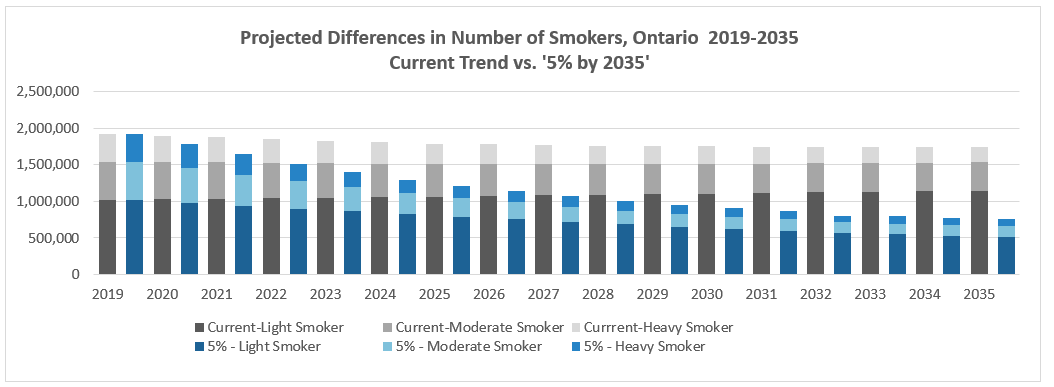
Dr. Krueger focused his efforts on Canada's two largest provinces, Ontario and Quebec. He found that if current trends continue, neither province would reduce smoking to 5% by 2035. Smoking rates are set to be twice as high -- 12.9% in Quebec and 11.5% in Ontario in 2035. 

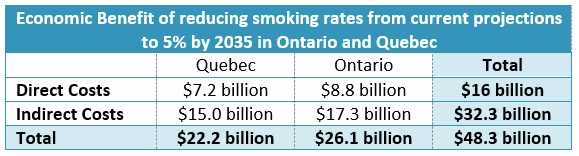
Should these provinces achieve a 5% prevalence rate by accelerating the current rate of decline there would be significant economic benefits. Dr. Krueger estimates that doing so would save Quebecers $22.2 billion and would save Ontarians $26.1 billion.

Current trends in smoking predict high future health care costs

Dr. Krueger used the Canadian Community Health Survey to analyze trends in smoking rates and intensity of smoking between 2000 and 2018. From these, he projected the current trends until 2035.  As an alternative scenario, he estimated how many smokers there would be if these provinces were on track to reduce smoking to 5% by 2035. He calculated that reaching this national target would result in 990,000 fewer smokers in Ontario and 641,000 in Quebec. 


Fewer smokers would reduce both the direct costs of treating smoking-caused disease and the indirect costs that result from earlier deaths and disability. Dr. Krueger calculated how much lower these costs would be each year if the '5% Trend' were in place, and how much the savings would add up to by 2035, factoring in inflation. The combined benefit was close to $50 billion, of which one-third would be in the health care costs mostly covered by provincial healthcare programs.


By providing a forecast of future costs, Dr. Krueger's study complements recent reports on the economic burden of smoking, such as that released this year by the Canadian Centre on Substance Use and Addiction and the University of Victoria.  It supports conclusions of other researchers that current measures are not sufficient to reach the 5% target. 

Dr. Krueger's report "The Economic Benefits of Reducing the Prevalence of Tobacco Smoking in Quebec and Ontario" is available here.


Sunday, 27 September 2020

Smoking and Income: Insights from the Canadian Community Health Survey

Earlier this summer, Statistics Canada released data files for the 2017-2018 Canadian Community Health Survey. This post is one of an occasional series which reviews this data for information on smoking patterns in Canada. Today's post is the first to look at the relationship between income and smoking behaviour. 

Inequities in income and smoking behaviour continue

In recent decades the relationship between economic disadvantage and smoking has been well established. A clear demonstration of this is in the smoking rates of each household income quintile (one-fifth of households). Those in the poorest households are 1.8 times as likely to smoke as those in the wealthiest: only 12% of Canadians in the highest group say they smoke cigarettes compared with 22% in the poorest.

The CCHS has reported on income quintiles since 2005. Although smoking rates have fallen in all household income groups over this period, the differences among them have not. In 2005, there was an 8 percentage point difference in smoking rates between lowest and highest income quintiles (27% vs 19%), while in 2017-2018, the gap was 9 percentage points (21% vs. 12%).  

Those in Canada's poorest one-fifth of families are 70% more likely to smoke than are those in Canada's one-fifth richest (RR=1.7).

This is is not because poorer Canadians are more likely to experiment with or become smokers. Canadians in all income levels are generally equally likely to have never smoked (this is less true for younger Canadians). Smokers in higher-income households, however, are more likely to quit than are those in poorer homes. For every 100 Canadians who have ever smoked more than 100 cigarettes, 70 in the highest income quintile will have quit, while only 57 in the lowest quintile will have done so.

Most smokers live in households with incomes over $60,000.

Although smoking rates are higher among poorer Canadians, it is not true that most smokers are poor. 

Statistics Canada provides information on household income brackets in increments of $20,000, with the highest category being "$80,000 or more". More than half (55%) of Canadian smokers live in families with household income over $60,000.

Families dealing with food insecurity are also affected by nicotine addiction. However, most smokers are not facing food insecurity. 

One signal that families are in economic distress is when they experience difficulties in obtaining enough food. The CCHS indicates when families have some difficulties accessing food ('marginal'), when they sometimes compromise quality or quantity of food consumed ('moderate') and when they have not had enough to eat regularly ('severe').

Slightly more than 1 in 10 Canadians (13%) live in families experiencing food insecurity, while more than 1 in 5 smokers (22%) do.

Canadians who are food secure smoke at half to one-third the rate of those who are facing moderate or severe food insecurity (14% vs 28% and 41%). Of the 2.5 million Canadians who live with moderate or severe food insecurity, one-third are  are smokers. 


Canadians living on social assistance are much more likely to smoke. However, the large majority of smokers are in the workforce.

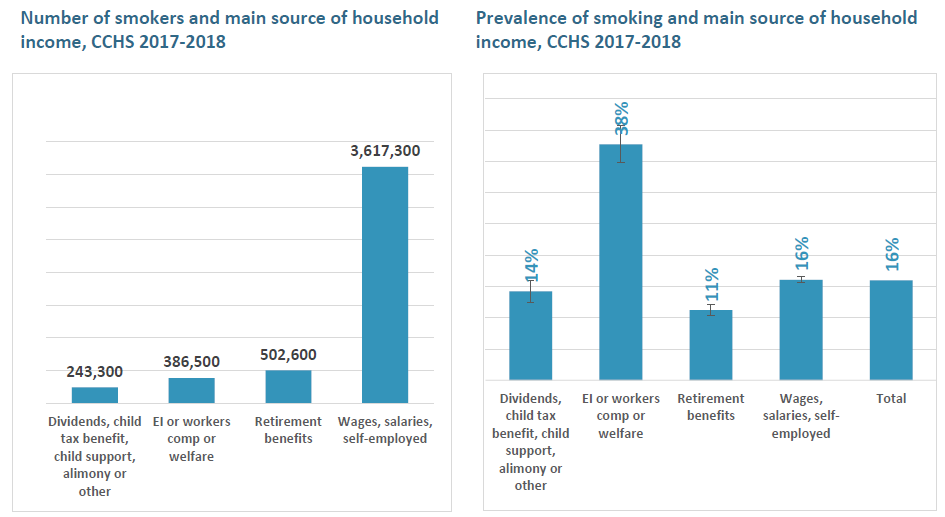
In 2017-2018, the CCHS identified that the main source of income for three-quarters of survey participants (76%), were wages and earnings; that 15% relied on retirement benefits and that fewer than one in five (3%) were dependent on social assistance payments like employment insurance, welfare or workers compensation. Smoking rates in that last category were more than double those of the general population (38% vs 16%). Almost one in ten (8%) of smokers are in receipt of social assistance. 


About the CCHS

The Canadian Community Health Survey is an annual survey conducted by Statistics Canada. Every two years, the Public Use Micro File is made available with information based on surveys of the health behaviours and status of about 100,000 Canadians over the age of 12.

Links to data referred to in this post:

Wednesday, 16 September 2020

Vaping stores launch another constitutional challenge to provincial regulations

This week the CBC reported that earlier this month the Nova Scotia government has been served with a notice from local vaping merchants that they are asking that province's courts to strike down certain vaping regulations. The argument they will present to the court is that sections of the Tobacco Access Act violate the human rights of vapers.

This lawsuit was no surprise. Since late winter, GOFUNDME campaigns had been underway to raise money for this endeavour. The first campaign raised $38,000, and the second raised $107,000. 

Nor is this the first constitutional challenge to provincial restrictions on vaping products. 

In the spring of 2016, the Quebec government faced similar challenges from the Quebec Vaping Association (L'association Québécoise des vapoteries) and the Canadian Vaping Association. Those groups claimed that sections of the Quebec Tobacco Control Act, which had been adopted in November 2015, were in conflict with rights protected under the Quebec and Canadian Charters of Rights.

And it may not be the last! British Columbia's strict regulations, some of which come into force this week, have also been accused of being contrary to Canada's Charter. 

This post presents a brief overview of these legal claims, and of the court decisions to date.

NOVA SCOTIA

The regulations

In 2020, Nova Scotia put in place three major changes to its vaping controls:

Cloud Factory
Dartmouth Location

The legal challenge

Notice of the legal challenge to these measures was filed on September 8, 2020 by Halifax lawyer Michael Scott of Patterson Law on behalf of the Cloud Factory Vape Shop and its part-owner Edward MacEachern. This store does not appear to be a large commercial undertaking, with a small number of outlets located in strip malls in Dartmouth and Fall River, Nova Scotia.  

This document advises the government that the court will be asked to:

  • strike down those sections of the Tobacco Access Act which ban the sale of flavoured e-cigaretets (s. 3(e), 3(ba) and 7)
  • strike down those sections of the Smoke-Free Places Act which ban using vaping products in retail stores (s. 5(a)(j)).
  • strike down those sections of the Revenue Act which impose a tax on vaping liquids (s. 46C-E)
The vape store owner claims that these restrictions run against his right, outlined in section. 7 of Canada's Charter of Rights and Freedoms, to "life, liberty and security of the person."  (The application did not claim that limits on nicotine concentration were unconstitutional.)

Although the details are sketchy (there are only 14 substantive paragraphs in the legal document), some of the arguments that will be made in support of this claim are outlined. These include the claim that bans on flavours  "unreasonably deprive adults of an important part of their smoking cessation method (flavoured vaping liquid)," that the ban on trying vaping products in stores does not protect youth but arbitrarily infringes the rights of adult vapers, and that the tax on vaping products infringes on rights "held by those who legitimately rely on vaping as part of their smoking cessation strategy." 

This will be a two-step legal process. In the first hearing (identified in the documents as being on November 30th), they will be asking for an immediate injunction striking down those sections of the law until their case can be fully heard. For the main trial, which they they could be ready for within a year, they have identified  4 categories of expert witness, and estimate that a 5-day hearing will be required.

QUEBEC

The regulations

Quebec substantially amended its Tobacco Control Act in November 2015 to bring electronic cigarettes and vaping products under many of the same restrictions that were applied to combustible and other tobacco products. As exceptions to the rules for tobacco, these revisions allowed e-cigarettes to be displayed in specialty stores (but not sampled), and allowed e-cigarettes to be sold in flavours. 

The legal challenge

In March and April 2016, both the Association Québécoise des vapoteries  and the Canadian Vaping Association filed separate legal challenges to some of these new measures. These two cases were combined, and an 11-day hearing took place in December 2018. 

The main issues considered by the court were:

  • Does Quebec have a right to legislate in this area when the federal government has adopted different measures?
  • Do restrictions on advertising vaping products infringe the right to security of the person and right to expression provided for in the Canadian and Quebec Charter of Rights and Freedoms?
  • Do prohibitions on trying vaping products in specialty stores infringe the right to security of the person provided for in the Canadian and Quebec Charters?

In May 2019, Justice Dumais of the Quebec Superior Court issued a ruling (2019qccs1644) in which he decided that:
  • The federal Tobacco and Vaping Products Act does not preclude Quebec from passing its own  restrictions in vaping marketing, and the two laws are not incompatible with each other. 
  • Most aspects of the Quebec law do not infringe Charter rights to the security of the person.
  • The restriction on allowing people to try the product in stores did limit the rights of vapers to security of the person and there was no justification for this infringement. (Justice Dumais struck down  s. 2(1) and 2(12) of the Tobacco Control Act)
  • Those provisions of the Quebec law which prohibited advertising vaping products to smokers as a cessation device were also an infringement of expression rights under the Charters, and the infringement was not justified. (He struck down s. 24(4, 8, 9 and paragraph 3 of the Tobacco Control Act and s 6.4(2) of regulations under that act). 
The Quebec government filed an appeal of that ruling in June, 2019, claiming that the judge had made 'palpable and overriding errors'. Among these errors were the judge's view that vaping products were sold as cessation products for smokers only and that they were not also consumer goods targeting the broader population. The appeal also considers that the judge erred in the way he minimized the health risks associated with vaping.

A hearing date for this appeal has apparently not yet been scheduled. The Canadian Cancer Society has been granted intervenor status in the appeal.  

The Quebec government has not modified its law in response to the ruling, nor has it materially strengthened its restrictions on vaping marketing as other provinces have done. Last November, it commissioned a group of experts to provide advice on measures to address vaping, but their report (which was due in April) has not yet been made public. The 5-year review of the Quebec law is due to be submitted to the legislature in November 2020.

Will there be more?

Other provinces have recently introduced restrictions on vaping marketing. This week, for example, British Columbia's restrictions on nicotine levels, packaging and flavours also came into effect. Prince Edward Island has banned flavours in vaping products, effective March 1, 2021. 

These measures may be the subject of additional lawsuits --- or there may be some already filed that have not been made public. Governments are under no obligation to disclose whether their health regulations are being challenged.

Notably absent from the Nova Scotia and Quebec challenges are the multinational tobacco companies, which have historically spearheaded constitutional challenges to health regulations, and which generally sell through convenience stores, not specialty vape shops. 

Friday, 21 August 2020

Latest industry tobacco price increases underscore taxing problems

In mid-August, Imperial Tobacco again raised prices on its tobacco products. As shown in the price list circulated to retailers and pasted below, they are now charging from $2.50 to $4.50 more per carton in Ontario. Price increases in other provinces have not yet been located, but they are usually imposed at the same time.

This is the second major industry price increase this year -- in January prices went up pby $2.50 to $3.60 per carton for Imperial Tobacco brands. The other two major companies (Rothmans, Benson & Hedges and JTI-Macdonald) traditionally follow with identical increases within a week of Imperial's announcement. 

Variable price increases lift profits without reducing sales

The company is continuing a now-familiar pricing strategy: 

  • discourage governments from increasing taxes (by threatening contraband)
  • while taxes are constant, increase corporate profits with a general price increase
  • apply different price increases to different brands and in different provinces, so that price-sensitive smokers are less likely to be affected.
  • maintain discount pricing for certain retailers to ensure that a cheaper source of cigarettes is maintained.

COVID impacts the illegal market 

This year the mainstream tobacco companies have even more pricing room in Ontario, as the COVID-19 pandemic has reduced the number of smokers who go onto Indigenous Territories to purchase cigarettes that are not fully taxed. While there are yet no official reports on tobacco sales volumes this year, The Ontario Convenience Store Association has reported that cigarette sales are up across the province this summer, attributing the increase to reduced contraband sales.

Historic trends show industry revenues are climbing on decreasing sales

Cigarette sales (and smoking) continue on slow downward slope in Canada as they do elsewhere. 

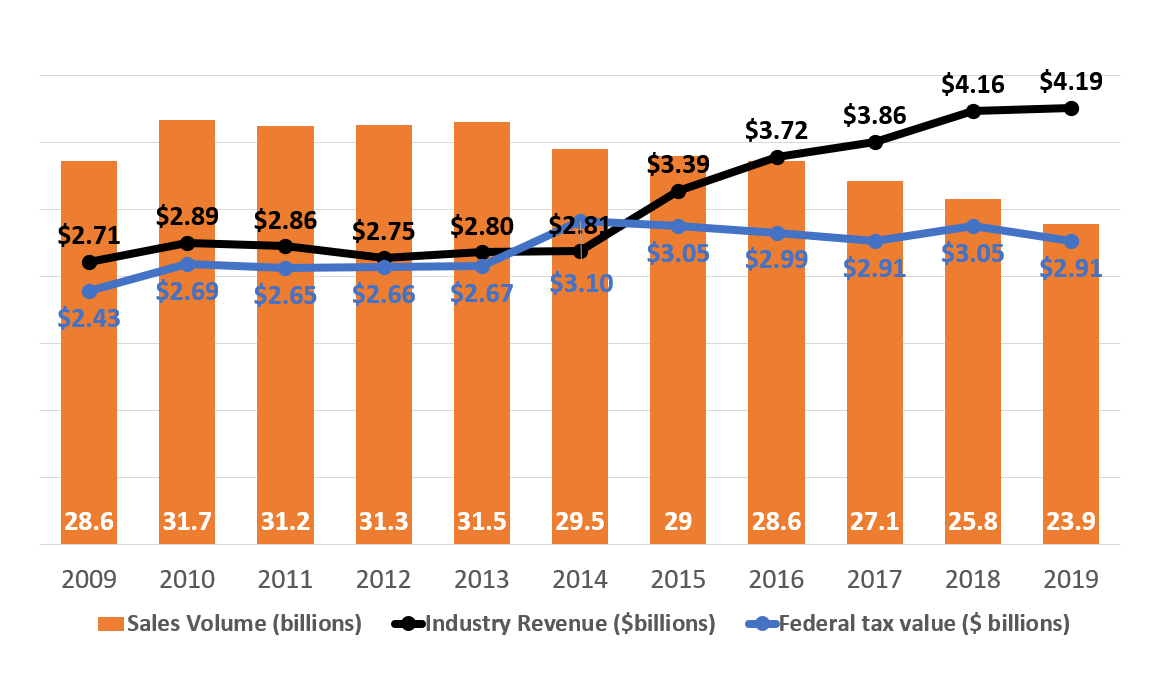
But although the volume of cigarettes sold in Canada declined by 18% over the past 5 years. (from 29 billion to 23.4 billion) and the number of smokers decreased by 12% (from 5.3 million to 4.7 million), tobacco industry revenue increased by 24%. Health Canada has not yet released sales or revenue data for 2020.

Billions of cigarettes sold, federal taxes collected
and industry revenues 2009-2019.

Industry prices go up, but taxes stay stable.

While tobacco companies raise prices every 6 months the Ontario government has not adjusted its tobacco taxes in two and a half years. This year, only a few governments have done so. Both British Columbia and Nova Scotia raised tobacco taxes by $4 per carton, and PEI raised its taxes by $5.00. Manitoba announced a $1 per carton increase in its spring budget, but later deferred imposing it. The federal government imposed an inflation-related increase of $0.46 per carton in April. 

Some countries do not permit unauthorized tobacco price increases. 

Price regulation in other nations requires tobacco companies to seek authority from tax officials before raising their prices. Tobacco Journal International reported this week that Japan Tobacco had received permission this summer. Permission is also required in France for price adjustments to tobacco products.

Updated fact sheets

Imperial Tobacco Ontario Price Increase
August 2020