Wednesday, 30 October 2019

Finland's strong controls on e-cigarettes include a ban on flavours.

Recently the academic journal Tobacco Control published a new study on Finland's experience with banning flavours in e-cigarettes. In this paper, Eeva Ollila of the Cancer Society of Finland analyzed the legal challenges and defiance to the law by manufacturers and retailers, and identified the need for greater controls at the EU and other levels. See you in court: obstacles to enforcing the ban on electronic cigarette flavours and marketing in Finland.

Canadians reading her research may be forgiven for thinking 'we should be so lucky'.

Despite the enforcement challenges, Finland has largely succeeded in protecting its young people from e-cigarette uptake. This is shown in the results from its annual school health survey which were reported in Eeva Ollila's paper. Colour was added for ease of reading.

This data show that, unlike Canada, after Finland legalized e-cigarettes (in 2016), use by early high school students went down (green lines). (Snus - which is illegal in Finland - may be a different issue!).


Finland’s tobacco endgame includes lowering e-cigarette use.

Finland has embedded a tobacco end-game in its national public health strategies and also in its tobacco laws.


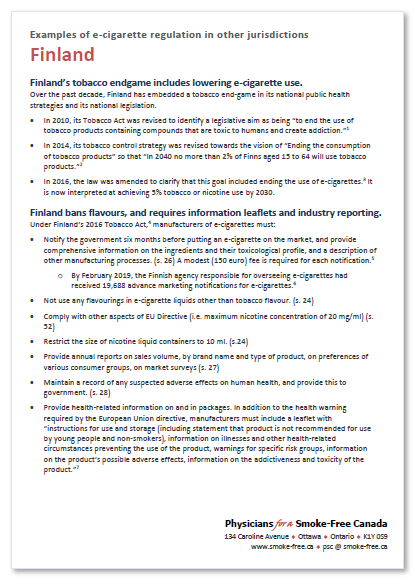
Finland puts limits on nicotine, flavours and ingredients:Under Finland’s 2016 Tobacco Act manufacturers of e-cigarettes must:
  • Not use any flavourings in e-cigarette liquids other than tobacco flavour. (s. 24)
  • Comply with other aspects of EU Directive (i.e. maximum nicotine concentration of 20 mg/ml) (s. 52)
  • Restrict the size of nicotine liquid containers to 10 ml. (s.24)

Finland requires manufacturers to file extensive reports to government.
  • Six months before putting a product on the market, manufacturers must  provide comprehensive information on the ingredients and their toxicological profile, as well as a description of other manufacturing processes. (s. 26) A modest (150 euro) fee is required for each notification. 
  • Manufacturers must provide annual reports on sales volume, by brand name and type of product, on preferences of various consumer groups, on market surveys (s. 27)
  • Manufacturers must maintain a record of any suspected adverse effects on human health, and provide this to government. (s. 28)

Finland requires manufacturers to provide information to consumers.
Manufacturers must provide health-related information on and in packages.
  • In addition to the health warning required by the European Union directive, manufacturers must include a leaflet with “instructions for use and storage (including statement that product is not recommended for use by young people and non-smokers), information on illnesses and other health-related circumstances preventing the use of the product, warnings for specific risk groups, information on the product’s possible adverse effects, information on the addictiveness and toxicity of the product.”

In Finland, tobacco and e-cigarette retailers pay high licensing fees.
Retailers of tobacco and/or nicotine-containing liquids are regulated by Valvira, the National Supervisory Authority for Welfare and Heath. Retailers must:
  • Have a retail licence issued by the local authority.
  • Submit an annual payment at a rate set by local authorities. The maximum is EUR 500 per point of sale (i.e. for each cash register). The maximum for retailers who sell both tobacco products and nicotine-containing liquids is EUR 1,000. 
  • Refrain from displaying tobacco or nicotine products in their stores. Tobacco specialty stores may do so, but not if the displays are visible from outside. Retailers are permitted to show purchasers a catalogue of available products and price list, if they have been asked. Standards for this material is set by regulation.
  • Have one employee designated as a monitor of the store’s compliance with regulations. 

A public register of retail licences and wholesale notices for tobacco and nicotine products is maintained by Valvira. (There are about 7,250 tobacco and nicotine retail licences in Finland (because each point of sale or cashier must be licensed, this means there will be fewer than 7,250 retail outlets). Of these, about 340 sell nicotine liquids. About 2,750 annual visits are made by municipal inspectors to licensed tobacco/e-cigarette retailers.

Finnish health authorities do not promote the use of E-cigarettes as part of a harm-reduction strategy.
The Finnish Institute for Health and Welfare (a government agency) does not promote using e-cigarettes or identify harm reduction as a goal of e-cigarette regulation. The first messages on its web-page on e-cigarettes caution:
  • The nicotine in electronic cigarettes is highly addictive and has its own health effects.
  • The use of electronic cigarettes impairs the normal functioning of the lungs and reduces the function of the lungs.
  • Experimental studies have shown that the use of electronic cigarettes can contribute to the development of cardiovascular changes.
  • cigarette liquids and vapors contain a number of harmful substances, such as PAH and VOC (volatile organic compounds). Some of the compounds are the same, carcinogenic compounds, as in tobacco smoke, but generally in smaller amounts.
  • Silica and metal particles and drug residues have been found in some e-cigarette liquids.
  • Some e-cigarette fluids have caused toxic effects on cells in laboratory tests.

Finland monitors of youth and adult tobacco use on an annual basis.
Finland’s public health monitoring includes annual surveys of school health behaviours, and adult smoking behaviours.

Finland imposes a tax on e-cigarettes (at about one-tenth of that on cigarettes).
Finland's tax on e-cigarettes is EUR 0.30 per ml of liquid. The tax on a typical 2 ml/200 puff pod of nicotine fluid is thus about EUR 0.60 or CAD $0.80. This is equivalent ot the Finnish tax on 2 cigarettes (EUR 0.27 or CAD 0.40 per cigarette).

This information - and references - are available in a downloadable fact sheet.


Monday, 28 October 2019

"The JUUL design seems like a play out of the tobacco industry's playbook" - David Kessler, US FDA Commissioner 1990-1997

Dr. Kessler, former Commissioner of the U.S. Food and Drug Administration was talking to the media this week about the problems with the JUUL vaping product. He predicted that JUUL and other similarly designed vaping products are unlikely to be approved by the FDA. (After May 2020, the FDA will be reviewing each e-cigarette design to decide whether there is a public health benefit to allowing it on the market. There is no such review planned for Canada).

JUUL has been much criticized for its appeal to young people. and has been the subject of repeated hearings by the U.S. Congress. As part of those hearings, Dr. Kessler wrote a letter to Congress officials to describe how the very design of JUUL ensnares youth. 

"The unique design of JUUL may facilitate initiation by young people"
In his analysis, Dr. Kessler reached back into tobacco industry files to find that, as early as 1954, the tobacco industry was experimenting with organic acids to produce nicotine salts which had the effect of lowering the pH of cigarettes, thereby reducing harshness, creating a "smooth" smoke and making tobacco smoke easier to inhale.

He explains how JUUL has revived this organic acid technology with the use of benzoic acid, fullfilling a prediction made by the industry in 1985 that “product design changes which make cigarettes more palatable, easier to smoke, or more addictive are also likely to encourage greater uptake of smoking.”

There are no built-in “speed bumps”
Dr. Kessler compared cigarette initiation to a journey with speed bumps.  A cigarette might last for 10 or 15 puffs, then it must be extinguished before lighting another. As a result, it might take a new teenage smoker days or weeks to to consume the 200 or so puffs in his first pack of cigarettes, slowly traversing the "speed bumps" of lighting another and another along the way.

Today, the new teenage smoker is on a superhighway to addiction. There are no speed bumps to slow him or her down. The JUUL pod contains about 200 puffs and a neophyte smoker might consume the whole thing in just a day or two. Becoming addicted to nicotine, a process that for some would take months or years, can now be accomplished in just days  or weeks.

Dr. Kessler also pointed to other design features which facilitate youth uptake:
  • an increase in nicotine concentration from 1 or 2.4% to a more addictive 5% was made possible because the organic salts made the experience less harsh. 
  • use of flavours like tobacco, mint, fruit and dessert, which mask the off notes and appeal to children with sweetness. (Even though JUUL stopped using some flavours in the USA recently, they have adopted no such policy in Canada.)
  • limited visible vapour emission (to avoid detection).
A important design feature not mentioned by Dr. Kessler is the very shape of JUUL.  It is designed to look like a USB key and to be recharged via the USB port on a portable computer.  USB keys and portable computers are friendly to today's wired generation.

JUUL has spawned copycat designs by other manufacturers - similar look, similar flavours, similar high levels of salted nicotine.  Among the imitation brands sold across Canada are Vype, Logic Compact, STLTH, Myle, MyBlu, and others.

The last word goes to Dr. Kessler (and Addison Yeoman):
"The words Addison Yeoman, the general counsel of the tobacco company, Brown & Williamson wrote in 1963 are equally applicable today, 'we are, then in the business of selling nicotine, an addictive drug...'  A long and tragic history has taught us the nicotine addiction begins as a pediatric disease."

Friday, 25 October 2019

Alberta budget: "The government intends to implement a tax on vaping products."

Yesterday Alberta became the first province to say that it intends to put a tax on vaping products. The measure was announced in the province's annual budget.


What took so long? Why are other governments not taking action?

By any number of criteria, health-oriented taxes and price controls are needed on vaping products, just as they are on alcohol, tobacco, cannabis and other products which cause harm.

E-cigarettes are unhealthily cheap in Canada

Vaping companies currently charge from $9 to $45 for their devices, and from $5 to $6.50 for a dose of nicotine equivalent to a pack of cigarettes. (A list of major products and their prices on the Canadian market can be found here).  Vaping products are cheaper in Canada than in other countries -- for example, BAT charges its U.K. customers $33.40 for an e-pod device that costs $19.99 in Canada (The recommended selling price is $44 in Germany and $50 in the USA - all prices in $Cdn).

Taxes can increase the price of vaping devices, making it less likely that children will try them.

High prices are a barrier to impulsive and planned purchases. Children who might be tempted to buy a vaping product are more likely to do so when they are affordable. Most vaping devices currently market for about $20 Canadian dollars -- roughly the same as a pizza.

Taxes are one way of applying the polluter pay principle to harmful consumer goods.

In Canada, vaping manufacturers and retailers are currently being given a free ride by the same governments that are struggling to manage a crises in youth vaping. Manufacturers and retailers contribute nothing to the significant regulatory costs that their harmful products require - not the costs of oversight (research, enforcement) and not the current and future costs of treating the illnesses caused by their business practices.

Many other countries and U.S. states are taxing e-cigarettes

At least 26 countries and 17 U.S. states have applied taxes to vaping products or nicotine liquids. Information on these is conveniently assembled on the web-site https://vaporproductstax.com, and has been tabulated on a PSC fact sheet. If Canadian provinces taxed nicotine as Minnesotta and Vermont do, the price of a cartridge would increase from $5 to about $8.50.


The World Bank has some advice:

In a paper on e-cigarette taxes released earlier this year, researchers at the World Bank looked at the impact of price differences on youth e-cigarette use, and concluded that they would likely be effective at dissuading many youth from trying these products. The World Bank has researched and championed the use of excise taxes on tobacco products for decades, and this paper concludes that the same benefits could be expected from e-cigarette taxes.

The bank recommends that taxes be applied to three e-cigarette components: the amount of nicotine in the product; the volume of usable liquid product, and the devices or disposable e-cigarettes.

The price of e-cigarettes can be increased significantly and still be lower than cigarettes.

Alberta raised the price of cigarettes by $5 a carton last night, but still has the third cheapest cigarettes in Canada. (Quebec has bizarrely not raised taxes in 5 years). According to Altria, Cigarettes in Canada are among the most affordable in the world.

Even at these low cigarette tax rates, the price of vaping products could be doubled before there was a disincentive for smokers to switch to them. A better option yet would be to impose a significant increase on taxes and to implement standardized pricing to prevent price-promotions.

Wednesday, 23 October 2019

Job not done! Half a million Canadian workers are still exposed to second hand smoke on the job.

This week an updated report on the Burden of Occupational Cancer in Canada was circulated.

The research was prepared by the Occupational Cancer Research Centre with financial support from the Canadian Cancer Society and the Canadian Partnership Against Cancer.

The results on occupational exposure to second hand smoke might surprise those who think that workers are currently protected in Canada. By the CAREX's estimates, over half a million workers continue to be exposed.

Below (with permission) the sections of this report are reprinted.

------------------------------------------------------------

 SECOND-HAND SMOKE


Second-hand smoke is a mixture of solid particles and gases released from burning cigarettes and exhaled cigarette smoke (122). This mixture contains numerous carcinogenic substances such as benzene, formaldehyde, and benzo(a)pyrene (122, 123). Second-hand smoke is a wellestablished lung carcinogen, with limited evidence that it may also cause cancers of the larynx and pharynx (122). A large study that examined the effects of secondhand smoke exposure in workplaces found that the risk of lung cancer increased by 24% among non-smoking workers who were exposed to second-hand smoke. The study also found that among workers who were classified as highly exposed to second-hand smoke, the risk of lung cancer increased by 100% (124). Other health effects associated with exposure to second-hand smoke include heart disease, exacerbation of asthmatic and allergic reactions, and premature death (123, 125, 126). The 2006 United States Surgeon General’s report concluded that any exposure carries some risks to respiratory health (126).


EXPOSURE


All Canadian provinces have smoke-free regulations that restrict smoking in almost all enclosed workplaces, while some provinces allow a separated ventilated room to be built in the workplace (123). Some provinces have made exceptions for certain workplaces. For example, Ontario allows for controlled smoking areas for residents of residential care and psychiatric facilities, facilities for veterans, and hotels, motels or inns (127). In most provinces, the regulations set out permitted distances that smokers may smoke away from building entrances, windows and air intakes, although the distance varies by province, ranging from 5 metres in Alberta (128) to 6 metres in British Columbia (129), and 9 metres in both Ontario and Quebec (127, 130).

Despite a legislated smoking ban in indoor workplaces, CAREX Canada estimates that exposure still occurs and approximately 520,000 Canadian workers are exposed to second-hand smoke in their workplaces (131). The proportion of workers exposed to second-hand smoke varies by occupation (Figure 25). The sectors with the largest number of workers exposed to second-hand smoke include: trades, transport and equipment operations, where approximately 50% of exposure occurs, followed by sales and service industry (13% of all exposed workers). The largest number of exposed workers are employed in Ontario, Quebec and Alberta.


Figure 25
 Number of workers occupationally exposed to
secondhand smoke by level of exposure
and industry in Canada in 2006.


BURDEN


An estimated 130 lung, 35 pharynx and 20 larynx cancers are diagnosed each year in non-smokers in Canada. The attributable fraction of lung cancers due to occupational exposure to second-hand smoke is 0.6%. Most lung cancers due to exposure to second-hand smoke occur in the manufacturing sector and wholesale and retail trade (Figure 26). 


Figure 26
 Industry breakdown of total lung cancers attributed
to occupational exposure to secondhand smoke
in Canada in 2011.

Figure 27 presents the occupational burden of lung cancer attributable to secondhand smoke, by province. In Manitoba and Saskatchewan the attributable fraction is slightly higher, where approximately 0.7% of lung cancers diagnosed are due to occupational exposure to second-hand smoke. Differences in the breakdown of the labour force within provinces likely contributes to variations in attributable fractions across provinces (Figure 27). Burden estimates for second-hand smoke are presented here for non-smokers due to the difficulties in separating the impact of personal smoking and second-hand smoke exposure on cancer risk.


POLICY RECOMMENDATIONS FOR SECOND-HAND SMOKE


The general, overarching policy recommendations, presented later in this report, can be applied to second-hand smoke, in addition to the following specific recommendations: 

Build on successes by strengthening current smoke-free legislation and its enforcement. 

Exposure to second-hand smoke has decreased in recent decades as a result of new legislation, increased awareness of the health effects associated with secondhand smoke exposure, and populationwide changes in smoking behaviour (132). However, workers continue to be exposed, even in workplaces with smokefree policies, indicating that enforcement of existing policies may be an issue (131). Furthermore, the strength of smoke-free legislation varies by province. For example, only Ontario’s legislation specifically states that home health care workers have the right to request that a person refrain from smoking in the health care workers’ presence, and the degree to which this is enforced is unknown (127). Smoking bans have been evaluated as the most effective measure for reducing second-hand smoke exposure (133). Legislation must be expanded across provinces to protect workers who are not covered by current legislation (i.e., outdoor workers, workers providing services in client’s homes). Furthermore, efforts must be jointly taken by agencies responsible for public health and Ministries of Labour to enforce smoke-free legislation in workplaces across all provinces. These efforts could include aligning their regulatory and enforcement strategies to the extent that their individual mandates will allow. 

REFERENCES

122. International Agency for Research on Cancer. IARC monographs on the evaluation of carcinogenic risks to humans. Volume 100E. Part E. A review of human carcinogens. Personal Habits and Indoor Combustions. Lyon, FR: International Agency for Research on Cancer; 2012. 
123. Canadian Centre for Occupational Health and Safety (CCOHS). OSH Answers Fact Sheets. Environmental Tobacco Smoke (ETS) [Internet]. 2017 [cited August 15, 2019]. 
124. Stayner L, Bena J, Sasco AJ, Smith R, Steenland K, Kreuzer M, et al. Lung cancer risk and workplace exposure to environmental tobacco smoke. Am J Public Health. 2007;97(3):545-51. 
125. Leone A, Giannini D, Bellotto C, Balbarini A. Passive smoking and coronary heart disease. Current Vascular Pharmacology. 2004;2(2):175-82. 
126. U.S. Department of Health and Human Services. The Health Consequences of Involuntary Exposure to Tobacco Smoke: A Report of the Surgeon General. Atlanta, GA: U.S. Department of Health and Human Services, Centers for Disease Control and Prevention, Coordinating Center for Health Promotion, National Center for Chronic Disease Prevention and Health Promotion, Office on Smoking and Health; 2006.
127. Government of Ontario. Smoke-Free Ontario Act, 2017, S.O. 2017, c. 26, Sched 3 [Internet]. 2019 
128. Government of Alberta. Alberta Regulation 240/2007, Tobacco and Smoking Reduction Regulation. Edmonton, AB: Alberta Queen’s Printer [Internet]. 2018.
129. Government of British Columbia. B.C. Reg. 232/2007, Tobacco and Vapour Products Control Regulation. Victoria, BC: Queen’s Printer [Internet]. 2019 [cited June 24, 2019]. 
131. CAREX Canada. Second-hand Smoke - Occupational Estimates [Internet]. 2019 [cited June 15, 2019]. 
132. Ontario Tobacco Research Unit. Smoke-Free Ontario Strategy Monitoring Report [Internet]. 2016 [cited August 15, 2019]. 
133. McNabola A, Gill LW. The control of environmental tobacco smoke: a policy review. Int J Environ Res Public Health. 2009;6(2):741-58

Monday, 21 October 2019

Do e-cigarettes beat NRT as cessation aids? A key study provides two opposing results - yet only one was reported.

There are thousands of scientific studies on tobacco use published every month (37,000 so far this year!), but only a few find their way into the mainstream media. Among those, even fewer seem to have real influence on government policies.

In my circles, one of the most influential papers this year was a British study on the effectiveness of e-cigarettes at helping smokers quit. Psychologist Dr. Peter Hajek and his colleagues used the "gold standard" methods of a randomized clinical trial to compare E-cigarettes (consumer products) against NRT (licensed therapies) at as cessation products.

The results of this study were published in the New England Journal of Medicine in January and immediately reported by media outlets across the world. Time magazine said the study showed  "E-Cigs More Effective Than Nicotine Replacements in Helping Smokers Quit", a messages echoed in many Canadian media outlets.

The idea that e-cigs are *twice as good at helping smokers quit* as NRT has now taken root.

Indeed, in some important quarters in Ottawa it seems to have become part of the tobacco control belief system. More than once over the past few months have I have heard this study cited as a reason that governments should continue to allow e-cigarette promotions.

Differing points of view

Yet Dr. Hajek and his team are not the only highly qualified researchers looking into this issue, and theirs is not the only scientific conclusion on offer.

Among other respected public health scientists who have looked at the efficacy of e-cigarettes as cessation products are those at the World Health Organization. This summer, after considering Dr. Hajek's results and others, the WHO concluded:
Although some [Electronic nicotine delivery systems] have been shown to help smokers quit conventional smoking under certain conditions, when used as NRTs the scientific evidence is inconclusive. There have only been a limited number of randomized control trials and longitudinal studies investigating the role of ENDS as potential cessation aids offered to a population, and their conclusions are equivocal.
This is not the only time that Dr. Hajek and the World Health Organization have come to starkly different conclusions about interpreting research findings. In 2014, Dr. Hajek was among a research team which openly criticized the WHO, accusing it of "misleading" the public with the following statements:  "Youth are rapidly adopting e-cigarettes", "the hope that e-cigarettes will reduce harm by delivering 'clean' nicotine will not be realized in continuing dual users" and "E-cigarettes deliver lower levels of toxins that conventional cigarettes, but they still deliver some toxins."

Nor is it the first time that Dr. Hajek has nailed his colours to the mast of e-cigarettes being so safe that their use should be promoted. He was part of the scientific team  that advised Public Health England to promote the idea that the differences in harm between e-cigarettes and cigarettes could be quantified, and that the comparative measure was "95% safer". Canada's Heart and Stroke Foundation and The Lancet are among the many who have criticized the use of the "95% safer" claim.

A second look at the outcomes of Dr. Hajek's experiment.

The data presented in the table below shows a broader range of outcomes from Dr. Hajek's study, drawing data from the NEJM paper and also in a NIHR Health Technology Assessment report published in August, i.e.
  • "The 1-year abstinence rate was 18.0% in the e-cigarette group, as compared with 9.9% in the nicotine-replacement group".   
  • "Among participants with 1-year abstinence, those in the e-cigarette group were more likely than those in the nicotine-replacement group to use their assigned product at 52 weeks (80% [63 of 79 participants] vs. 9% [4 of 44 participants])"
  • "19 participants in the NRT arm using NRT at 12 months ..."
  • "173 participants in the e-cigarette arm using e-cigarettes at 12 months... "
  • "Among the e-cigarette arm abstainers, two were using non-allocated NRT at 12 months, whereas in the NRT arm, nine [abstainers] were using non-allocated e-cigarettes."
(No information was found on the number of people who used both NRT and e-cigarettes. Even if they were some, the results presented below would not differ greatly.)


NRT performed twice as well as E-cigs at achieving nicotine abstinance.

These results support the following statements:
  • Participants in the E-CIG group had almost double the success in stopping using cigarettes (18% vs 9.9%). This is as the media reported.
  • Participants in the NRT group had more than double the success in ending nicotine use (7% vs. 3.2%). This is something the media failed to report. 
  • Participants in the E-CIG group had a much higher risk of becoming dual users (25.1% vs. 15.2%). This is something that the media also failed to report.
Other important conclusions can also be drawn from these outcomes:
  • For people trying to beat nicotine addiction, failure continues to overwhelm success. This should heighten concerns about increase uptake of nicotine use.
  • Those who have the opportunity to use e-cigarettes, including those who are encouraged to use NRT instead, are much more likely to both smoke and vape than they are to only vape. This might dampen enthusiasm that those who try vaping will be able to switch completely.
Higher standards of evidence

Single clinical trials, no matter how well performed or reported, are not usually considered the strongest evidence base for decision making. That distinction is usually reserved for systematic reveiws of multiple studies.


In 2016 two systematic reviews of e-cigarettes as cessation aids were conducted. They did not come to the same conclusion.

One was by the Cochrane reviews (and Dr. Hajek participated in this review.) This panel focused on the results of 2 randomized clinical trials, and concluded that "There is evidence from two trials that ECs help smokers to stop smoking in the long term compared with placebo ECs." The quality of those studies was considered low, and Dr. Hajek's 2019 results will likely strengthen this conclusion in subsequent Cochrane reviews.

The other was a systematic review and meta analysis conducted by U.S. physician Dr. Sara Kalkhoran and Dr. Stanton Glantz.  They looked over the same literature field, and included the same 2 clinical trials as the Cochrane review had. In addition, they considered the results of 20 studies with control groups and other studies. The conclusions from this analysis were that rather than helping smokers quit,  e-cigarettes made it harder for them to do so. The "odds of quitting cigarettes were 28% lower in those who used e-cigarettes compared with those who did not use e-cigarettes."

A Canadian study involving more than 6,000 smokers was included in the Kalkhoran review, but not by the Cochrane team. It was conducted at CAMH, and eventually published both as a conference paper and as a journal article. Those would-be quitters who used e-cigarettes were less likely to succeed in quitting. "E-cig adoption seems to negatively affect cessation outcomes and provides no benefit as a harm reduction tool  ..." 

This year researchers at the Ontario Tobacco Research Unit published a review of "E-Cigarette Use for Smoking Cessation." They found "a wide range of results" and - while clearly open to the idea of using vaping as a cessation tool - nontheless reported that "In general, the scientific literature regarding the effectiveness of e-cigarettes as a smoking cessation aid remains inconclusive."

The Montreal Jewish General is leading a clinical trial on e-cigarettes as cessation devices, partnersing with several hospitals across Canada. Their results are not expected until next year.

Policy implications

Setting policy or clinical practice guidelines on the role of e-cigarettes is challenging in the messy real world of competing evidence, uncertainty, nuance and concious/unconcious bias. And that is before commercial influence and tobacco industry interference is added to the mix!

Currently, smokers who want to quit smoking have a variety of tools available to them, including a variety of licensed NRT therapies, non-licensed e-cigarettes, as well as proven and unproven behavioural supports that range from telephone counselling to hypnotherapy. None of the above has been the choice of most successful quitters.

Smokers (and those who pay for quitting programs) are entitled to know the benefits and the risks of the approaches on offer. In the case of e-cigarettes, Dr. Hajek's paper is presented as evidence that E-cigarettes are a better option than NRT. The same paper also provides evidence that NRT is a better option for those who want to overcome addiction and also for those who want to avoid the additional risks of dual use.

Thursday, 17 October 2019

There ain't no flies on us: BAT-Imperial Tobacco reassures vapers that their products aren't to blame

Are you old enough to remember the Frank statement?  Probably not.

It  was the iconic moment in the 1950s, when tobacco companies begain to speak directly to the public about the growing evidence that smoking caused lung cancer.

This In the subsequent decades it has been denounced by U.S. courts and historians as a PR exercise aimed at reassuring smokers instead of warning them. Canadian companies took a similar strategy of offering reassurance, although their tactics did not involve widely published commitments. These strategies were similarly denounced by courts.

Earlier this week we learned that Canadian Tobacco Companies have engaged PR firms to try to forestall regulations on their products.

In that context, it is interesting to consider more closely the message that BAT/Imperial Tobacco is sending to its customers .

There are echoes of the Frank statement in this communication -- an expression of concern and a pledge to research candy wrapped around a core message of denial (nothing proven!) and deflection of responsibility (THC!).

Move on, customers, nothing to see here!

ICYMI the text  from govype.ca is printed below. 

To Our Customers
Given the recent cases of acute respiratory illness from vaping reported in the US recently, we fully support any measures that will ensure the safety of those consumers who use vaping liquids and devices. As the distributor of Vype vaping products across Canada, Imperial Tobacco Canada takes consumer safety responsibilities very seriously.

Although investigators in the USA have not yet finally determined the cause of all of the recently reported cases, the US Food and Drug Administration is warning that there appears to be a particular danger for people who have bought vaping products on the street (i.e. not sourced from a reputable manufacturer), and for those who vape liquids with oils containing THC or containing an additive called “Vitamin E Acetate”.

Our parent company, British American Tobacco (BAT), has invested billions of dollars in the research and development of their potentially reduced risk products and the ingredients and components used in these products have been scrutinised by the BAT team of 50 toxicologists for their suitability for vaping.

To the best of our knowledge, no Vype products have been identified in any of the US reports to date. We can confirm that oils containing THC and Vitamin E Acetate are not, and have never been, added to our Vype products.

As for the one possible case in Canada, few details have been shared and authorities have not contacted us about it, which suggests it does not involve our product.

UPDATED OCTOBER 11th  
The US Food and Drug Administration (FDA) warns public to stop using Tetrahydrocannabinol (THC)-containing vaping products and any vaping products obtained off the street.

The FDA has issued a recent important consumer guidance on recent vaping illnesses dated 4th October 2019 entitled, “FDA warns public to stop using Tetrahydrocannabinol (THC)-containing vaping products and any vaping products obtained off the street."

Please see the full text of that consumer guidance by clicking the link here.

Tuesday, 15 October 2019

Public Health leaders strengthen their call for action on vaping

The power to speak 

Medical officers of health have special responsibilities and powers in the Canadian health system. Although they work for municipal, provincial and federal governments, many have the authority to speak out about health risks without having to get approval from elected officials.

Federal law, for example, gives Canada's Chief Public Health Officer, Dr. Theresa Tam, the specific authority to "communicate with the public ... for the purpose of providing information or seeking their views about public health issues." This authority continues even during an election period, when the rest of the public service is under 'caretaker' restrictions.

The advice of one Medical Officer of Health is worth noting. The combined advice of all 14 has even greater significance.

Senior MOHs from the provinces, territories and federal system work together through the Council of Chief Medical Officers of Health. This council has spoken out about vaping twice this year - first on April 11 and then again exactly six months later, on Friday October 11.

Comparing these two statements allows us to see how these physician leaders have deepened their understanding of the vaping problem and how they have changed their recommended approach to managing it.

A much-needed statement in April.

Vaping products were legalized in Canada in late spring of 2018, and it was not long before parents, teachers and communities were coming to grips with this new form of drug use. By late winter, the federal government was signalling that it was open to changing the law, but in a cautious way.

In April the Council of Chief MOH seemed willing to speak of the problem with more urgency than Ministers of Health were expressing. "We are seeing an alarming number of youth vaping in Canada," their statement read. "We cannot allow a new generation of Canadians to become dependent on nicotine and develop long-term risks to their health. We all have a role to play in protecting our youth.."

(How welcome this was for those who had been urging parliament to fix the problems with the federal law before the election, or even calling on the Minister of Finance to shoehorn an amendment into the Budget Bill.)

A strong stand in October. 

Only 10 days before the federal election, the Council issued its second statement on vaping. This time, its analysis of the problem had deepened and its call for action was more focused on regulators. In this statement, the Council goes much further than it did in April, and acknowledges for the first time that:
  • vaping is a gateway to tobacco use 
  • independent of tobacco use, vaping causes new public health challenges
  • vapers inhale cancer-causing chemicals
  • the compounds used in vaping products which are safe to eat (i.e. glycerol) may not be safe to inhale
  • Canadians should refrain from using e-cigarettes or vaping products 
  • vaping is not recommended for pregnant women or adults who do not currently use tobacco products. 
  • laws on vaping products should include plain packaging, health warnings and regulations on the marketing and sale of products and flavurings. 
Just as noteworthy were the ideas contained in the April statement which were dropped this month:
  • switching comipletely to vaping is a less harmful alternative to smoking.
  • putting the onus on youth, adults and health educators to manage the problem of youth vaping before putting the responsibility on government.
In its October statement, the Council of Chief Medical Officers of Health is now calling for the same policy changes as health groups have been promoting since the introduction of S-5, the parliamentary bill which became the new Tobacco and Vaping Products Act.  Its warnings against using vaping products are stronger and clearer than those currently communicated to the public by Health Canada.  It has moved away from encouraging smokers to switch to vaping to one of encouraging vapers to quit.

Let's just hope that health ministers and ministries are listening!