Tuesday, 24 November 2020

Innovative proposals for regulating tobacco retail.

This post highlights two recent and innovative government proposals to address tobacco retailing - including a home grown solution for northern Canada!

Curbing retailer incentive programs

Tobacco companies
motivate retailers
with prizes and rewards.
 
One of the more recent marketing strategies of tobacco companies is to offer incentive programs to convenience store owners and sales clerks. In return for selling more product, participating in sales training or otherwise helping promote tobacco products, these workers can earn points which they can redeem for travel, gift items or other benefits. They can also vie for the right to buy tobacco products more cheaply than their competitors.

This is a problem for public health because it puts additional pressure on retailers to sell cigarettes -- lots of them. It drives the price of cigarettes down because those who do not get special prices are pressured to lower their in order to compete with those who do. It gives store employees a personal incentive to sell more products, irrespective of the benefit to their employer. 

To date, Quebec is the only province to have amended its law to address these new promotional programs. In 2015 it amended its Tobacco Control Act to prohibit tobacco companies from "offering rebates, gratuities or any other form of benefit related to the sale or the retail price of a tobacco product to operators of tobacco retail outlets, including their employees." This measure has ended some of these marketing ploys, but has not stopped the companies from rewarding or punishing retailers by adjusting the wholesale prices.

Nunavut is the first Canadian jurisdiction to introduce legislation to directly address the preferential pricing practices and their health impact. Last month, its legislature gave second reading to Bill 57, a proposed new Tobacco and Smoking Act.   This bill contains many important measures and sets a new high standard for Canadian tobacco control laws. Among its innovations are a clear direction to shut down promotions that encourage retailers to sell more tobacco and "smoking" products (including electronic cigarettes).

The proposed measures include:

  • an end to incentives offered to retailers by manufacturers or wholesalers
  • an end to incentives offered to customers by retailers 
  • an end to price signs at retail (price lists can be shown to customers)
  • an end to price reductions for higher volume sales (like bundled packages)
  • an end to price discrimination (offering retailers or customers a better price than to others)
  • the power to regulate prices 
Reducing the density of tobacco retailers

Over the decades, provincial governments have reduced the number of places where tobacco can be sold. Cigarettes can no longer be sold in pharmacies (except in B.C.), in health care settings (except in New Brunswick). Some provinces have also banned sales in restaurants and bars, amusement parks, and through the internet. 

These restrictions have helped drive down the number of tobacco retailers in Canada from over 40,000 in 2000 to about 28,000 today. But to date no Canadian government has set a target to reduce the density or quantity of tobacco retail outlets.


Last week, Netherlands Health Minister Paul Blockhuis outlined his plan to do so for that country. With a long-term goal of restricting tobacco sales to age-restricted stores, his initial 5-year plan will reduce that country's tobacco outlets from 16,000 to about 6,000 after 2024 by ending sales in vending machines, one line and in supermarkets. A review will begin next year on how to transition to tobacco only stores after 2030. 

The Netherlands has roughly half the population of Canada. After 2024 it will have fewer tobacco outlets per capita (34 for 100,000 people) than any other European Country. By way of comparison, Canada currently has 71 tobacco retail outlets per 100,000 people and 26 gas stations or pharmacies for the same population.

This Dutch approach is supported by an economic review and modelling of the impact in which several options were consieered, such as capping density and using licensing conditions. The government estimates that moving towards tobacco-only stores as they are doing will reduce the number of Dutch smokers by 120,000.


Sunday, 15 November 2020

An update on evidence linking teen vaping to cigarette smoking

Earlier this spring, we provided a review of studies into the relationship between young people using e-cigarettes and their subsequent use of tobacco. This post reports on four more large studies which support the general conclusion that young e-cigarette users are three to four times more likely to become tobacco cigarette smokers 

All four studies provide systematic reviews of previous evidence. The most recently published of these studies provides a a new analysis of longitudinal data from the Population Assessment of Tobacco and Health (PATH) survey in the United States. Two others are meta-analyses commissioned by government health agencies – one from Ireland and Australia. One other, from the European Union, reviewed previous studies, meta-analyses, and e-cigarette components particularly attractive to young people.

Evidence from an analysis of longitudinal data from the PATH survey

Smoking Intention and Progression From E-Cigarette Use to Cigarette Smoking was published in the journal Paediatrics in November 2020. Olusegun Owotomo and his colleagues at the University of Texas used data from the Population Assessment of Tobacco and Health (PATH) study to look at changes in adolescent behaviour from 2014-15 to 2015-16. They used a US nationally representative population of adolescents who were 12 to 17 years old at the beginning of the study period to find out whether the teenager's  stated intention to smoke cigarettes or their use of e-cigarettes predicted actual cigarette smoking one year later. There were four previous analyses of PATH data that examined the relationship between e-cigarette use and subsequent smoking, but this was the first to also examine the effect of intention to smoke.  References to these previous studies can be found in the Australian study by Olivia Baenziger and her colleagues.

It turned out that both intention to smoke and e-cigarette use predicted later smoking.. "Among adolescents who had expressed intention to smoke conventional cigarettes at baseline, e-cigarette use did not predict cigarette smoking at follow-up. However, among adolescents without previous intention to smoke conventional cigarettes, e-cigarette use predicted cigarette smoking." 

If teens said they intended to smoke, they were three times more likely to actually become cigarette smokers. Children who smoked e-cigarettes in 2014-15 were 4.6 times more likely to become cigarette smokers by 2015-16, even if they earlier had no intention of becoming cigarette smokers. This latter finding is very much in line with most other studies of same phenomenon, as we shall see in the following sections.

Evidence from meta-analyses performed by the Irish Health Research Board

Electronic cigarette use and tobacco cigarette smoking initiation in adolescents: An evidence review was made public by the Irish Health Research Board in October. It was prepared to respond to Ireland's Department of Health's request for an answer to the question "Does e-cigarette use by adolescents who are cigarette naïve at baseline lead to subsequent cigarette smoking?"

This review predated the Owotomo study discussed above, so the latter was not included among the papers analyzed.
 
The Irish HRB review included 21 studies, up from the 17 included in the meta-analysis reported by Jasmine Kouja and her colleagues a few months earlier. Of these, 15 longitudinal studies reported adjusted odds ratios. The HRB concluded: "We found a four-fold association between ever using e-cigarettes and initiating smoking tobacco cigarettes in adolescents in a combined analysis of nine cohort studies conducted with follow-up periods between 4 and 24 months"

The analysis considered this relationship using different theoretical constructs. "We identified three theories that attempt to explain the move from using e-cigarette use to smoking tobacco cigarettes, and these are: the gateway theory, the common liability theory, and the catalyst model." The HRB recommends that further studies be designed to test these theories.

Evidence from umbrella review and meta analyses of gateway effect and relapse undertaken researchers in Australia 

With support from the Australian Government Department of Health, Olivia Baenziger and her colleagues prepared a report on E-cigarette use and combustible tobacco cigarette smoking uptake among non-smokers, including relapse in former smokers: umbrella review, systematic review and meta-analysis. It was made available in September ahead of peer-review. 

This study included several components. First, they reviewed three previous meta-analyses, "an umbrella review" and noted that all three had similar findings, that young e-cigarette users were 3-4 times more likely to later become cigarette smokers. Secondly, they identified 25 studies as methodologically suitable for inclusion in their own meta-analysis of the the relationship between e-cigarette use and subsequent cigarette smoking. When all were combined in the meta-analysis, it was estimated that e-cigarette users were 3.25 times more likely to become cigarette smokers.

Thirdly, the researchers found three studies that studied whether former smokers who took up e-cigarettes would relapse to cigarettes smoking. This is the first systematic review to consider the relationship of e-cigarette use to smoking relapse. It found former smokers were 2.4 times more likely to relapse to cigarette smoking if they took up e-cigarette use. 

"Our umbrella and systematic review, along with an updated meta-analysis using data from primary studies, shows strong and consistent evidence that never smokers who have "used e-cigarettes are more likely than those who have not used e-cigarettes to try smoking conventional cigarettes and to transition to become regular tobacco smokers."

Evidence reviewed by the European Commission

Another scientific assessment of the role of e-cigarettes in the initiation of smoking was conducted by the European Commission's Scientific Committee on Health, Environmental and Emerging Risks (SCHEER). In February 2019, the Commission requested SCHEER to review the health effects, cessation impact and also "their role as a gateway to smoking." The SCHEER released its Preliminary  opinion on electronic cigarettes in late September and will make public its final version after reviewing comments that were submitted in response. 

In this paper, the SCHEER reported that "Regarding the role of electronic cigarettes as a gateway to smoking/the initiation of smoking, particularly for young people, the SCHEER concludes that there is strong evidence that electronic cigarettes are a gateway to smoking for young people. There is also strong evidence that nicotine in e-liquids is implicated in the development of addiction and that flavours have a relevant contribution for attractiveness of use of electronic cigarette and initiation." (emphasis in original)

The question of causality and the gateway effect

The reviews discussed above took different approaches and applied different models when considering whether smoking is causally related to e-cigarette use. 

* The Health Research Board reported that its study design "does not allow us to say there is a definitive causal relationship, but it does allow us to say that the findings builds a case towards a causal relationship as the findings are consistent across all studies included in the meta-analysis." It recommended further studies to establish "what drives the relationship between e-cigarette and tobacco cigarette use."

* The EU SCHEER committee considered both the gateway hypothesis and the renormalisation hypothesis to explain the relationship between e-cigarette use and later smoking by adolescents. They concluded "that there is strong evidence that electronic cigarettes are a gateway to smoking for young people."

* The Australian team found that the similarity of results in many places suggested a causal link ("... the consistency of findings across multiple studies and settings supports the likelihood of a causal relationship"), but that the cross-sectional observational design of most studies meant they could not yet rule out "the possibility of residual confounding."

* The longitudinal design of the U.S. study (which was not included in the other reviews) adds further evidence to support a causal relationship. The authors' conclusion implies that the results should be treated as support for a causal connection. "Abstinence from e-cigarette use should be framed as an adolescent smoking prevention strategy."

Take-away
  • Multiple studies and multiple meta-analyses from many countries show remarkably consistent results.  Young people who take up using e-cigarettes are 3-4 times more likely to progress to becoming cigarettes smokers than their peers who do not use e-cigarettes. 
  • This risk of becoming a smoker also applies to those young e-cigarette users who declare they have have no intention of becoming smokers.  Despite their intentions, they are over four times more likely to become cigarette smokers.
  • Former smokers who take up e-cigarettes are over twice as likely to relapse to cigarette smoking.

Monday, 9 November 2020

Which Canadian province is doing the best at reducing smoking?

In Canada, tobacco control is an area of shared jurisdiction: both federal and provincial governments have wide authority to regulate the manufacture, promotion, distribution and sale of tobacco products. Although Canada's constitution generally gives provinces control over commercial activities, the Supreme Court long ago recognized the authority of the federal government to also regulate cigarette promotions and products. 

Despite differences in emphasis and intensity, the tobacco control regulations and programs in each province are largely similar. A province that might be "leading the pack" in one aspect (eg flavour restrictions) may not be so far ahead with others (eg taxes). Added to these differences are also demographic and cultural differences across Canada's wide geography.

This post looks at data on smoking behaviour in Canada's provinces, based on 9 cycles of the Canadian Community Health Survey (CCHS) spanning almost 2 decades. The information presented below is for the general population, sex and age disaggregated information is also available on the following interactive tables:

Smoking rates have fallen across the country

Smoking rates across the country have fallen by almost one-half (a 40% reduction) between the first cycle of CCHS (in 2000) and the period for which complete indicators have been released (2017-2018). 

That is to say that each year over the past 2 decades, for each group of 200 Canadians, every year there has been one less person who smokes every day or on occasion. This pattern holds true in most provinces.

The standings between the provinces have not changed greatly in 20 years. The provinces with the lowest smoking rates in 2017-2018 are essentially the same as those with the lowest rates 18 years earlier - British Columbia and Ontario. Although smoking rates have dropped by a greater proportion in some other provinces, they have not yet caught up.

The reduction has been greatest with respect to daily smoking. Since 2000, the percentage of Canadians who smoke daily has fallen by more than 11 percentage points (11 people in 100). The provinces with the largest declines in daily smoking are Quebec and Prince Edward Island (13.5 percentage points). 

There has been very little change in occasional smoking. There are more occasional smokers in 2017-2018 than in 2000 (1.5 million to 1.1 million). The increase in the rate of occasional smoking is slight but statistically significant (from 4.5% to 4.8%). During this period, the overall population grew by over 5 million people. The profile of occasional smokers (and the number who were once daily smokers) will be explored in a future post.

The greatest drop in smoking has been among the youngest Canadians

Current smoking among teenagers has fallen by two-thirds since 2000. Those born in the 1980s were 3 times more likely to smoke as teenagers than those born in the first decade of this century (19% vs 6%). Comparisons among all provinces have become more difficult, as surveyors are unable to find enough young smokers to provide a reliable estimate for the smaller jurisdictions. Among the larger provinces, Quebec rates for teen smoking (age 12 to 19) have fallen from 27% to 8%, compared with Ontario's from 17% to 6%, Alberta's from 18% to 6% and British Coumbia's from 12% to 5%. 

Fewer and fewer Canadians ever try smoking...

As we observed earlier for Canada as a whole, it is the "never smoking" population that is likely driving reductions in smoking. 

This is especially true in some provinces. For example, British Columbia nad Ontario are also the provinces where people are most likely to have never smoked a single cigarette. In Ontario and B.C., one-half of all citizens and 6 in 10 people in their 20's have never smoked a single cigarette (compared with 5 in 10 in the other provinces). 

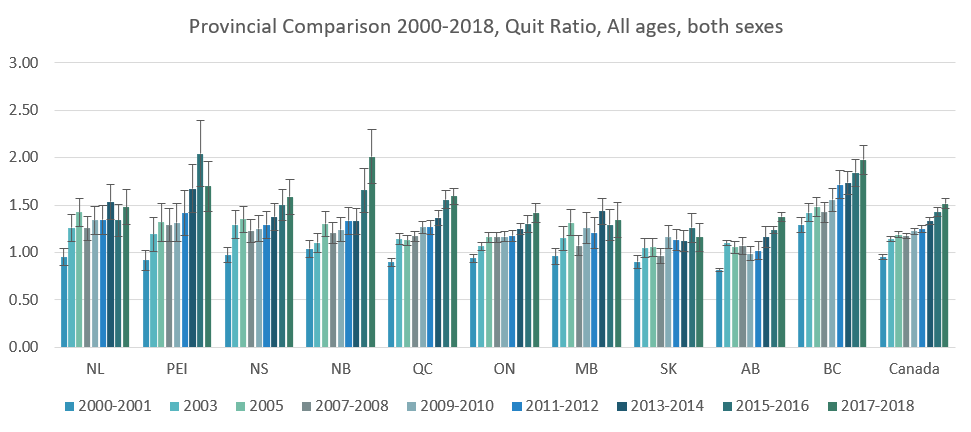
Ontario and Quebec provide an example of this. Although Ontario has a lower smoking rate than Quebec (15% vs 18%), the percentage of Quebec smokers who have quit is no lower: the Quit Ratio of former to current smokers is 1.42 in Ontario and .1.59 in Quebec. Ontario's relative success can be attributed to fewer people having begun smoking. One-half (51%) of Ontarians have never smoked one cigarette, compared 40% of Quebeckers.

... and more smokers have quit.

Overall, the proportion of Canadians who have smoked and then quit has grown slowly, although progress has been uneven across the Country.

British Columbia is also in the lead for this indicator: in that province there are 4 former smokers for every 2 smokers, compared with a national average of 3 former smokers for every 2 smokers. All provinces are doing much better than they were in 2000 - with greater improvements in New Brunswick, Prince Edward Island and New Brunswick. The prairie provinces are doing least well at moving smokers to former smokers. One contributing factor is the relative youthfulness of prairie populations, and the greater likelihood that older smokers will have quit: the median age in the prairies (36) is a full 5 years younger than in B.C. (41).


(Although fewer smokers are quitting every year)

Since 2003, this survey has asked former smokers how long ago they quit. From this we know that the number of Canadian smokers who have quit in the past year has fallen from almost 700,000 in 2003 to 414,000 in 2017-2018. 

This is not unexpected, given that with a falling smoking rate there are fewer remaining smokers year on year. Nonetheless, even as a proportion of remaining smokers, the number of "recent quitters" is not growing. It would appear that in most provinces, smokers are no more likely to quit in 2017-2018 than they were 20 years ago.  

As a result, most former smokers are long-term quitters. Two-thirds of former smokers in Canada quit more than a decade ago, with very few differences across the country.

In fact, death is more responsible for reducing the number of Canadian smokers than quitting. The CCHS shows that for every 10 fewer Canadian smokers in 2018 than there were a decade earlier, there were only 4 more former smokers. The other 6 smokers had disappeared from the CCHS population, mostly likely through death. (During that period, there were 1 million fewer smokers, but only 429,000 more former smokers). 


The takeaway:
  • Individual and community efforts to reduce smoking have succeeded in Canada at a steady if slow pace for the past 20 years.
  • British Columbia has maintained its lead for two decades. Other provinces are generally keeping pace with B.C., and some have made relatively greater progress on some indicators (eg. youth smoking). 
  • Falling smoking rates reflect reduced number of people who start to smoke and increased number of smokers who successfully quit. Some provinces are doing relatively better than others at protecting youth from smoking and from achieving successful population cessation.
  • Demographic differences between the provinces may be responsible for some differences between provincial smoking, starting and quitting rates. 

Friday, 23 October 2020

Post-consumer tobacco waste -- more harmful than plastic straws and stir sticks.

Earlier this month, Jonathan Wilkinson, the minister of Enviornment and Climate Change Canada announced Canada's plans to achieve zero plastic waste within the next decade.  Included in this plan was a ban on 6 categories of single-use plastic items: plastic checkout bags, straws, stir sticks, six-pack rings, cutlery, and food ware made from hard-to-recycle plastics.

While the federal government plans to reduce the use of these plastic products (and eventually also to reduce the use of other food services packages and drink cups), its intentions for tobacco waste are limited to increasing the frequency that these products are recycled or recovered.

The exclusion of tobacco-waste from the proposed ban on single-use plastics is surprising in some ways:

Continued exceptionalism for the tobacco industry?

It has long been observed that tobacco manufacturers are  frequently exempted from regulations that are applied to other industries. In the case of the federal plastics strategy, Environment and Climate Change Canada has made clear the reasons it is exempting cigarette filters from its ban on single use plastics.

The department established 3 criteria to decide which single-use plastics to ban: 1) whether they were found in the environment, 2) whether they were often not recycled and 3) whether they have readily available alternatives. 

It was the department's determination that there are no alternatives to cigarette filters that seems to underpin their decision to implement measures to mitigate the problems caused by post-consumer tobacco and vaping waste, but not to end the use of these harmful plastics. 

The world is moving to banning single use plastics, and the tobacco industry is trying to avoid that impact.

Measures to curb the use of single use plastics are under development in many countries. Last year, the European Union adopted a directive requiring its member states to pass legislation by July 2021 to require tobacco manufacturers to cover the costs of awareness-raising, litter clean-up, data gathering and reporting and waste collection, and also to require waste-related markings on tobacco product packaging. 

Not surprising then, that tobacco companies have accelerated cross-border activities to frame the issue and to influence public policy in ways that would minimize the impact on their business. They focus attention away from their producer responsibilities and instead present tobacco waste as a problem related to smoker behaviour. They frame tobacco waste as a problem caused by user non-compliance, and not the result of manufacturing practices and product design.

Philip Morris International says its objective is to "Prevent littering of our products by promoting appropriate behaviour among adult consumers.”  This year its subsidiary, Rothmans, Benson and Hedges, provided grants to 17 clean-up operations in Canada -- leveraging the work of volunteers to clean up the waste it caused.

British American Tobacco, and its Canadian subsidiary Imperial Tobacco Canada Ltd also promotes measures addressed at consumers, not producers. "BAT acknowledges that cigarette filters provide a waste issue for regulators. However, it believes that the most appropriate solution is promoting the proper disposal of butts so that they don’t pollute the environment." 

These corporate initiatives of the companies are worrisome. Good implementation of the Framework Convention on Tobacco Control would not permit Corporate Social Responsibility initiatives, like RBH's grants to clean-up squads, nor tobacco industry partnerships, like Imperial Tobacco's former sponsorship of municipal ashtray programs.  

The federal government has to date given no signal that it will protect its single use plastics plan from tobacco industry influence. (In its recent roundtable on the topic, the U.K. environment ministry acknowledged these responsibilities.)

Public education is not enough. There are better options to choose from

A number of options for managing tobacco and vaping product waste have been developed by independent researchers and civil society. 

In addition to amplifying existing measures (like smoke-free laws, public education and product labelling), these include:

Considerations for public health regulators

The way in which post-consumer tobacco waste is managed can have an impact on public health. Dr. Stuart Kreisman in Vancouver has pointed out that:

The widespread presence of ashtrays imply tacit government consent, acceptance and even approval of widespread smoking in public. They strengthen the impression that smoking is common, and create smoking zones in public places. Such re-normalization of smoking is directly aligned with the strongest interests of the tobacco industry.

Governmental responsibilities to address tobacco use include environmental objectives AND the obligation to protect these from tobacco industry interference. 

By engaging in the development of federal, provincial and municipal approaches to single-use plastics, health agencies can ensure that these policies support public health objectives. One way to do this is to respond to federal proposals, which are open for comments until December 9, 2020.

A briefing note to assist this process can be found here.

Thursday, 15 October 2020

New longitudinal studies find little support for e-cigarettes as an effective tool for population-level smoking cessation

 About the PATH survey

In May 2020, we reported on a number of studies that analyzed data from the PATH survey. To recap, since 2013, there has been a remarkable survey operating in the United States that has deepened our understanding of tobacco and e-cigarettes use and consequences. It is the Population Assessment of Tobacco and Health Survey (PATH) - a longitudinal, nationally representative survey of 46000 Americans. This survey generates information on tobacco and e-cigarette use behaviours, and with its longitudinal design it interviews the same individuals every year. It is planned that the survey will continue at least until 2024.

Since May, more longitudinal analyses have been published using PATH survey data. Three of these explore the relationship between smoking cessation and e-cigarette use and merit a closer look.

July 2020:
PATH study finds e-cigarettes no more effective at helping smokers quit (but keeps more people using nicotine).

The first of these was published by Rufeng Chen and colleagues in June 2020. They followed a subsample of 2,535 people who were smokers in 2014-15, and who had tried at least once to quit smoking by 2015-16. Their success at quitting smoking was assessed at 2016-17. They found that, among those who used e-cigarettes to help them quit, about 13% were successful. However, this success rate was not significantly different from that achieved by smokers who used other methods to quit smoking. Importantly, two-thirds of successful quitters who used e-cigarettes were still using e-cigarettes by the time of the 2016-17 PATH survey. The authors conclude:

These results suggest e-cigarettes may not be an effective cessation aid for adult smokers and, instead, may contribute to continuing nicotine dependence.

August 2020:
Another PATH study finds quitting is no more likely with e-cigarettes.

Many of the same authors of the paper by Rufeng Chen and colleagues also collaborated on an August 2020 paper by John Pierce and colleagues. Pierce and colleagues used similar methods to those used by Chen and colleagues, but studied a slightly different time period, from 2013 to 2016 instead of 2014 to 2017. Use of e-cigarettes, use of approved pharmacotherapy or use of no product, all resulted in a smoking cessation rate of about 10% 1-2 years later. However, over half of e-cigarette users who successfully quit smoking were still using e-cigarettes at the end of the study period.

The authors concluded:

We found no evidence to support our first hypothesis that ENDS [electronic nicotine delivery systems] would be associated with increased abstinence duration from either cigarette or any tobacco. Twelve-month cigarette abstinence was ~10% and comparable across all methods used to quit, and the finding was robust to sensitivity analyses. Over half of those who used e-cigarettes to try to quit were still using e-cigarettes at the W3 follow-up.

Similarly our results did not support our second hypothesis that daily use of ENDS would be associated with increased cigarette abstinence. 

September 2020:
PATH study finds frequent e-cigarette use helps smokers quit.
 
Alison Glasser and colleagues analyzed three waves of PATH data from 2013 to 2016. They concluded:

This study suggests that consistent and frequent e-cigarette use over time is associated with cigarette smoking cessation among adults in the US.

At first blush, this conclusion seems at odds with the previous PATH studies, but closer inspection shows the results are the same.

In this study, the authors reported only on the frequency and consistency of e-cigarette use with later quitting success. They did not report on the the relationship between all e-cigarette use and smoking cessation, although that relative risk can be calculated from the data presented in the paper. As it turns out, the RR = 1.0, indicating no relationship between all e-cigarette use and 12 months or more of smoking cessation.

Still, there would be encouraging news for e-cigarettes as a possible smoking cessation method if there were a great many "consistent and frequent" users of e-cigarettes. Regrettably this is not the case. Out of 5894 study participants who were e-cigarettes users at the beginning, only 78, just 1%, were "consistent and frequent" users of e-cigarettes. For that 1% of users, quitting with e-cigarettes was more successful.

One might ask how many e-cigarette users who were trying to quit smoking successfully quit both smoking and e-cigarette use by the end of the study period in 2016? Glasser and colleagues do not provide that datum. However, Pierce and colleagues who analyzed the same PATH data sets over the same time period do provide the information. Here is the answer

None in the daily e-cigarette use group (n=56) and 45% (95% CL, 36.8-53.5%) of the no e-cigarette group (n=162) were abstinent from all tobacco [including e-cigarettes] for 12+ months at W3.

In other words, not a single e-cigarette user who was using e-cigarettes to quit was able to quit both combustible cigarette and e-cigarettes after three years.

In general, the PATH analyses show that, at the population level, e-cigarettes are not helpful in smoking cessation and even e-cigarette users who successfully quit smoking will still be addicted to nicotine in their e-cigarettes.

Would the same findings be true in Canada?

There is no ongoing longitudinal monitoring of nicotine use behaviour in Canada that is comparable to the US PATH survey for detail, size and quality. Nevertheless there is some Canadian information available that does offer some limited comparison.

Health Canada has commissioned a return-to-sample (semi-longitudinal) survey of Canadian vapers. Despite its limitations (non-representative sample, 25% response rate at T2, 992 usable responses), this survey has the merit of following the vaping behaviour of the same group of vapers over a one-year period, from 2019 to 2020. The report found that although 11% of vapers had smoked in 2019 but quit using cigarettes by 2020, a larger number (13%) were non-smokers in 2019 but in 2020 were smoking cigarettes.

In other words, the modest amount of quitting behaviour among vapers was more than offset by uptake of smoking in the same population. And one-half of vapers who had never smoked cigarettes at the beginning of the survey were doing so one year later.

So far, the Canadian evidence, like that in the USA, does not support the conclusion that vaping is an effective population-based smoking cessation method. 


Data from Environics Canada.
Vapers Online Survey to Measure Attitudes and Behaviours
Regarding Vaping Over Time (2019 to 2020).
POR 098-19.


Thursday, 8 October 2020

Another look at quitting rates: Insights from the Canadian Community Health Survey

Shortly after Statistics Canada released data from the 2017-2018 Canadian Community Health Survey (CCHS), we reported on the relatively small contribution of quitting to the progress against tobacco use, focusing on population growth and turn-over (deaths) over the past decade. 

This post takes a second look at changes in quitting behaviour over the past 20 years for Canadian men and women at different stages of life. It identifies some of the challenges in using quitting rates or quit ratios as indicators for tobacco control.  

The percentage of Canadians who are former smokers has barely changed since the beginning of the century....

Although the proportion of Canadians who smoke has fallen from one-quarter (26%) in 2000 to one-sixth (16%) in 2018, the share of the population who are former smokers has barely budged - hovering around 25%. As discussed earlier this summer, and shown below it is the growth in "never smokers" that has driven overall smoking rates down. 

Between 2000 and 20018, the number of smokers fell by 1.7 million, but the number of former smokers grew by only 1.2 million. The number of people who had never smoked one cigarette grew by 5 million.


But among Canadian who have ever smoked, a greater proportion have quit 

The slow growth in the number of former smokers can mask progress in the proportion of smokers (instead of the proportion of the whole community) that have stopped smoking.

Looking at the number of Canadians who have quit smoking as a proportion of those who have ever smoked shows that there has been overall growth in quitting. 

The daily smoker Quit Ratio (ratio of former daily smokers to ever daily smokers) has grown from half (51%) in 2000 to two-thirds (66%) in 2018 (shown below). The current smoker Quit Ratio, which includes those who continue to smoke on an occasional basis, has grown somewhat less (from 49% to 61%). The figure is available on the downloadable Excel sheet, linked below. 


Success in quitting comes with age...

Although virtually all smokers start before they are in their early 20s, successful quitting happens at all ages and accumulates as people age. This is illustrated in the chart below, which shows the percentage of ever smokers who have quit in 5 age groups over 2000 to 2018, the years of available CCHS data. 

The proportion of former smokers is particularly high for those over 65, in part because of the early death of smokers.  Those in the numerator live longer than those in the denominator!  (The median age of dying of a tobacco-related disease is in the early 70s.)


... which means an aging population will have more successful quitters

The increased proportion of smokers who have quit may be the result of the natural aging of Canada's population. Canada's population is aging: the median age of Canadians grew from 36.8 to 40.8 between 2000 and 2018. The proportion of Canadians participating in the CCHS who were 45 years or older grew from two-fifths in 2000 (42%) to one-half in 2018 (51%).   

Definitions:

When talking about smoking, we frequently divide Canadians into three groups: those who smoke on a daily or occasional basis ('current smokers'), those who used smoke but who don't any more ('former smokers') and those who have never smoked ('never smokers'). The CCHS is such a large survey (around 100,000 respondents) that it allows for more distinctions to be made: 

  • Current smokers includes:
    • Daily smokers - people who smoke on a daily basis.
    • Occasional smokers - people who report that they smoke, but not every day. 
  • Former smokers:
    • Former daily smokers are those who no longer smoke but who used to smoke every day.
    • Former occasional smokers are those who used to smoke (but not daily) and who no longer do. 
    • Sometimes, this term has been used to include those non-smokers who have never smoked daily and who smoked very little (from 1 to 100 cigarettes in their life).
  • Experimenters is the term now used to describe those who have smoked one cigarette in their life, but have never smoked more than 100 cigarettes and who do not smoke now.
  • Never smokers (or abstainers) are those who have never smoked one whole cigarette.

Download the data!

Excel files for the tables presented above:
Previously released Excel tables:

Tuesday, 6 October 2020

Active and passive smoking increase the risk of breast cancer: Women need to be warned

In 2009, a Canadian expert panel concluded that the relationship between breast cancer and active and passive smoking was "consistent with causality."  Since then the evidence that smoking and passive smoking cause breast cancer has grown stronger.

Breast cancer death and disease from tobacco smoke

In Europe in 2017 3,354 breast cancer deaths could have been avoided if women had not smoked nor been exposed to passive smoking, according to May, 2020 report that tallied these death tolls for all 28 countries of the European Union.

The toll breast cancer disease (but not deaths) takes related to smoking and passive smoking has been estimated for Canada for the year 2015.  In that year, active  smoking was responsible for 1,129 cases of breast cancer and passive smoking for 311 cases.  These two risk factors accounted for 4.6% and 1.3%, respectively, of all breast cancer cases in Canada.

Recent solid science underlies these estimates

In 2015, a respected group of researchers in Lyon, France combined the results of 86 studies on breast cancer and tobacco smoke to demonstrate that active smoking was related to a 9% increase in risk for breast cancer and that passive smoking resulted in a 20% increase in risk.   Information from the Lyon study was then used to produce the estimates of breast cancer death and disease in the European Union and Canada.

The Lyon researchers concluded:

As time passes, the evidence accumulates for considering that active tobacco smoking is associated with a modest, but real increase in the risk of breast cancer. The consistency of findings, the low heterogeneity of results of prospective studies, the dose–response found in prospective studies, the permanent higher risk since the first studies done on the topic, and the absence of influence of major confounders on associations are all indicating that the relationship would be causal. For passive smoking also, the evidence for a modest but real association with breast cancer strengthens with the accumulation of data. In this respect, public health policies should inform women about the risk of breast cancer associated with both active and passive smoking.

Implications for industrial practice and government policy

Two studies that estimated population attributable risk for breast cancer due to active and passive smoking used  different estimates of relative risk and different consequences of breast cancer as their endpoints.  No matter how you slice it, however, both investigative teams agree that breast cancer disease and death are in some measure (2.6% - 5.9%) attributable to active and passive smoking. 

A recent court decision in Quebec has clearly established that tobacco manufacturers have a duty to warn of dangers from using their product and that, according to Quebec law, they cannot omit telling consumers important facts.  That 2 to 6 percent of breast cancer is attributable to active and passive smoking would qualify as an important fact that tobacco companies omit telling consumers.

As shown below (with more illustrations at the end of this post, some governments already require warnings about breast cancer on cigarette packages. Canada is not yet among them.


Over the decades, Health Canada has gradually broadened the scope of health impacts that are communicated through health warning labels on tobacco packaging. Given the evidence reviewed here, one might expect breast cancer to be included in a future revision of regulated health warning labels.

Whatever governments might do or not do about this issue does not negate the tobacco industry's duty to warn.  This is made explicit in Section 16 of the Tobacco and Vaping Products Act. 

For greater certainty, this Part does not affect any obligation of a manufacturer or retailer at law or under an Act of Parliament or of the legislature of a province to warn consumers of the health hazards and health effects arising from the use of tobacco products or vaping products and from their emissions.
 
Tobacco companies should be warning women about the risks of breast cancer from active and passive smoking and they should be doing it now.


(photos courtesy of Rob Cunningham)