Monday, 10 May 2021

Why does British Columbia lag behind when it comes to taking cigarettes out of pharmacies?


More than 30 years ago, Canadian health organizations began to campaign for pharmacies to stop selling cigarettes. One by one, 9 provinces and 3 territories amended their tobacco laws to end this practice. Only one province - British Columbia - has firmly declined to take this step. 

This post looks reviews provincial bans on pharmacy sales of cigarettes, and B.C.'s exceptional position to maintain them.

Selling tobacco products is incompatible with the health care responsibilities of pharmacists. 

Pharmacies have been granted exclusive control over the dispensing of many medications and are part of the health care system. Pharmacists are actively engaged in the health of their community. They provide patient counseling, medication therapy monitoring, and help identify and resolve drug related problems.

  • The sale of tobacco in a health care facility such as a pharmacy gives a false and dangerous credibility to cigarettes, and suggests that their use is compatible with health. 
  • Selling cigarettes (that cause disease) is inherently in conflict with the pharmacist’s role in preventing and treating disease.
  • Domestic and international codes of practice for health professionals call on pharmacists to disengage from tobacco commerce.  
Pharmacists need government support to remove tobacco from drug stores

Recognizing this responsibility, pharmacist organizations (including in British Columbia) have adopted policies to support the removal of tobacco from the stores in which their pharmacy practice is located. Because the owners of these stores are not health professionals, but do have responsibilities to generate revenues, the practice standards of pharmacists have not smoothly transferred to the parts of the drug store that surround the dispensing area.

In 1996, for example, the Quebec College of Pharmacists established that their Code of Ethics required that tobacco sales not take place in a pharmacy. Large pharmacy chains, including Shoppers Drug Mart and Jean Coutu, resisted this and took the Order to court. In 1998, the courts upheld the Code of Ethics,  -- and so did the Quebec legislature, which included the sales ban in the Tobacco Act.  (The history is told here on page 174-175.)

Similarly, the Newfoundland Pharmaceutical Association included a sales ban in its Standards of Practice, but found it difficult to enforce. In 2000 the provincial legislature moved to include the provision in its tobacco sales law.

The same challenges have faced pharmacists in British Columbia. The difference is that the B.C. College was unwilling or unable to enforce professional standards on pharmacy-owners and that the B.C. government was unwilling to step in to help them achieve the goals of this standard.

The College of Pharmacists of British Columbia had formally endorsed an end to tobacco sales since 2000, and in 2014, it proposed that this become a new professional standard. As in other provinces, the big pharmacy chains objected and threatened legal action. But instead of the College and the government staring down these business interests, the initiative was dropped. Since 2015 their strategic plan to end tobacco sales has been put on hold.  

Communities support tobacco-free pharmacies

Other Canadian governments have ended pharmacy sales of tobacco with the urging and support of the health community, and without any negative political, business or community response. 

The B.C. government has similarly been encouraged by organizations like the British Columbia Lung Association, the Heart and Stroke Foundation and the Canadian Cancer Society and others. A recent petition campaign led by Leo Levasseur reflects a citizen's frustration with the government's failure to legislate, while rewarding the pharmacy chain that has worked to block reform.

B.C.'s 'harm reduction' lens on pharmacy-sales is not supported by evidence

 In 2014, then Minister of Health, Terry Lake, defended the government's decision to allow tobacco sales in pharmacies as a sort of "harm-reduction" strategy: “You have the opportunity to interact with a health professional about smoking-cessation programs... some have argued that this is such a dangerous substance that it should be sold only in drugstores.”

The idea that ONLY pharmacies or other health-mandated retailers should sell tobacco products has been proposed elsewhere. While this could be a welcome innovation in Canada, the government of British Columbia has not taken any steps towards such a change in tobacco retailing.

Moreover, to date there is no evidence that allowing cigarette sales in pharmacies reduces any harm or increases support for smokers' quitting. Canadian surveys found that smokers were no more likely to report being counselled by a pharmacists in provinces where they could sell cigarettes. To the contrary, U.S. studies have shown that in areas where there pharmacies stop selling cigarettes, there are greater quit attempts.

A change of government did not change B.C.'s policy

Between 2001 and 2017, the Liberal Party held power in British Columbia. Although it introduced restrictions on tobacco sales in 2007 (including banning their sale in hospitals and other health facilities), that government resisted any restrictions of sales on pharmacies.

The New Democratic Party was in opposition during that period, and several of its members pressed for a ban on tobacco sales in pharmacies, through back-benchers motions and petitions. In 2007, the opposition health critic, Adrian Dix, pressed for British Columbia to join other provinces in banning pharmacy sales. “One of the next steps that's required to protect people from the impacts of cigarette smoke is to make pharmacies, which are a place of health, come forward into the 21st century and not allow the sale of cigarettes in pharmacies," he told the legislature. In the first 3 years as Health Minister, Mr. Dix has introduced other important tobacco control initiatives, but has kept silent on the subject of pharmacy sales of tobacco. 

When it comes to tobacco sales in pharmacies, British Columbia remains the odd-man-out among Canadian health authorities. It continues to be out of step with the advice of health professionals  - and in step with the interests of business. 

Wednesday, 5 May 2021

TAAT: Another challenge for tobacco regulators

What looks like a cigarette, tastes like a cigarette and smells like a cigarette but is not regulated like a cigarette?

Meet TAAT, a hemp-based cigarette look-alike. Made by a Canadian company, designed by Philip Morris International alumni, and now being test-marketed in the U.S.A., TAAT are nicotine-free 'cigarettes' that promise a realistic smoking experience. And, yes, the company has announced its plans to sell them in Canada.

The selling proposition:

No nicotine. All flavour. Beyond tobacco. These cigarettes are marketed to consumers as a celebration of smoking without the head-rush: "Between the tobacco-like taste and smell of the Beyond Tobacco™️ base material, the sight of smoke, the “crackling” sound of TAAT™ burning, and the physical sensations of inhaling and exhaling as well as flicking ashes, no detail has been overlooked in creating a satisfying experience for smokers."


Just as the hemp has been modified to maintain and reinforce the distinctive tobacco smoking experience, the marketing is designed to maintain and reinforce the iconoclastic imagery of cigarette smoking. TAAT's retro-hipster ads evoke a time when cigarettes were uncomplicated by health considerations, and they model defiant attitudes about smoking. 

Another off-shoot of Big Tobacco

TAAT cigarettes blur the lines between cannabis- and tobacco-products. This is not the first company to enter this space. As discussed in a previous post, British American Tobacco is currently test-marketing CBD pods for its vaping products, and Philip Morris has also signalled its intention to go "beyond nicotine" into other (yet unspecified) botanicals. As with these other ventures, TAAT is an expansion of the tobacco trade: The people behind TAAT were until recently developing Philip Morris products and distribution systems

Another 'harm reduction' commercial product

These cigarettes are yet another attempt to gain commercial advantage from harm reduction. Like vaping products, heated tobacco and modern oral, hemp cigarettes (and oral hemp), are marketed as a way for smokers to change their drug use without abandoning it. Commercialized harm reduction is running in two directions: e-cigarette manufacturers make money by encouraging people to access nicotine without tobacco, and TAAT offers hemp for those who want to smoke while avoiding tobacco and nicotine.


Canada's TAAT-friendly regulatory environment

TAAT is headquartered in an industrial park in Toronto (345 Horner Avenue, Toronto, ON M8W 1Z6) and its official address  (Suite 180-789 West Pender Street) is shared with a number of resource extraction and cannabis companies, including its Canadian distribution partner, Christina Lake Cannabis.

Its recent annual report (filed last month with SEDAR) reports that this company was recently grafted onto the roots of a failed venture in resource extraction: "The Company was incorporated on June 5, 2006, in British Columbia under the Business Corporations Act (British Columbia). The Company was historically in the business of exploring for or purchasing economically viable oil and gas resource deposits. On October 31, 2018, the Company suspended substantially all production operations as a result of extreme volatility within the commodity markets, regional supply and demand and decided not to proceed with these leases and as a result the oil and gas operations have been recorded as discontinued operations. In January 2020, the Company ceased to carry on its business as an oil & gas exploration company, and changed its principal business to the manufacturing and distribution of a nicotine-free and tobacco-free alternative to tobacco cigarettes that has been developed to closely mimic the experiential components of smoking legacy tobacco products."

TAAT is listed on the Canadian Stock Exchange, a regulation-light alternative stock market that offers "reduced barriers to listing." Because Canadian security laws make it easier for this company to raise the capital to sell these products, and impose fewer reporting requirements on it. 

Cracks between Health Canada's regulatory systems

Smoking products that do not contain tobacco or nicotine or cannabis (like herbal cigarettes or herbal shisha) are considered consumer products and are subject to the federal Consumer Product Safety Act. Although this law forbids manufacturers from selling products that are "a danger to human health or safety", this prohibition is applied only with respect to immediate danger. (On this basis, the department rejected the 2013 request by Physicians for a Smoke-Free Canada for controls on herbal shisha.)

Herbal cigarettes are regulated by Health Canada - but not in the context of tobacco control. 

Smoking products that do not contain tobacco or nicotine or cannabis (like herbal cigarettes or herbal shisha) are regulated as consumer products and are subject to the federal Consumer Product Safety Act. Although this law forbids manufacturers from selling products that are "a danger to human health or safety", this prohibition is interpreted as causing immediate danger. (In 2013, Physicians for a Smoke-Free Canada provided Health Canada with evidence of the dangers associated with smoking shisha and unsuccessfully requested that the government require the product to be withdrawn from the market.) 

Smoking products that contain hemp are subject to the federal Cannabis Act and its regulations for industrial hemp, and also to any provincial regulations on the sale of hemp products. Christina Lake Cannabis Corporation, which will be developing and distributing TAAT cigarettes in Canada, has informed investors that currently holds the license to do so. "CLC’s status as a Licensed Producer under the Cannabis Act could enable TAAT to be produced and sold in the Canadian market... Although CLC does not presently cultivate hemp, the Company has sourced multiple local growers who can supply high quality, toxin-free hemp biomass."


Herbal cigarettes that are marketed as cessation products are subject to the Natural Health Products Regulations. Because TAAT is marketed as a harm reduction product and not a cessation aid, these regulations are unlikely to apply. 

Health Canada has acknowledged that herbal cigarettes are unsafe products  ("Health Canada does not recommend using these cigarettes as a long-term alternative to tobacco cigarettes due to the danger posed by the inhalation of smoke of any kind.") and reports that it is "tracking the use and sales of these products to determine the level of use, changes over time and whether any action is required."

TAAT's advertisers face few regulatory barriers in Canada.

TAAT products are currently advertised in the USA through lifestyle ads, testimonials and event sponsorships - promotions that are illegal in Canada for cannabis or tobacco products. 

Because they are hemp products, it appears unlikely that TAAT cigarettes will be subject to advertising restrictions, such as those for tobacco products, for non-hemp cannabis products or for therapeutic products. At a federal level, the only prohibition is that they cannot be marketed as having psychoactive properties.  At a provincial level, only Quebec has a tobacco law designed to include products other than tobacco cigarettes. (Regulations under Quebec's Tobacco Control Act establish that "for the purposes of the Tobacco Control Act (chapter L-6.2), any product that does not contain tobacco and is intended to be smoked is considered to be tobacco.")


Tuesday, 4 May 2021

Is there any public health benefit to menthol-flavoured vaping liquids?

This post reviews the rationale for banning menthol flavourings in vaping liquids.

Background and context

Since the legalization of vaping products as unlicensed consumer goods in May 2018, the use of these products by young Canadians has grown rapidly, and concerns have increased about their usefulness as cessation aids or harm reduction products.  

Because flavourings are one of the major reasons young people say they use vaping products, many Canadian governments are considering restricting or banning flavourings in vaping liquids. Five jurisdictions (BC, SK, ON, NS, PEI) have implemented restrictions on flavoured vaping products, and two more (QC, PEI, NWT) have indicated their intention to do so. 

A variety of regulatory approaches are being explored and implemented. These include:

  • Banning characterizing flavours and/or banning specific additives.
    Two provinces (Nova Scotia and Prince Edward Island) ban all flavours except tobacco flavour. Nova Scotia's measures came into force on April 1, 2020 and PEI's came into force in March 2021. The federal Tobacco and Vaping Products Act currently prohibits the promotion or sale of vaping liquids with names that are associated woth confectionary, deserts, cannabis, energy drinks or soft drink. It also bans certain additives in vaping liquids (caffeine, dyes, nutrients, vitamins, glucuronolactone, taurine and probiotics). The federal government has indicated that it will develop additional restrictions on vaping liquids this spring, as has Quebec.
  • Restricting where flavoured vaping liquids can be sold 
    Two provinces (Ontario and Saskatchewan) have adopted policies to allow non-specialty stores to sell only two flavours: tobacco and menthol. One province (British Columbia) allows non-specialty stores to sell only tobacco flavours. The sale of other flavours is permitted on-line or in specialty stores in these 3 provinces.

The number of flavours in youth-friendly products is growing

Unlike other countries (like the European Union), vaping manufacturers are not required to provide notice to the government of the products that they sell. As a result, there is no Canadian inventory of the vaping flavours currently on the market. 

Nonetheless, the product offerings of the 3 multinational companies (JUUL, BAT-VUSE, JTI-Logic) show that for these top-selling youth-friendly products there are a multitude of flavour offerings in each flavour category.  Just as cigarettes are sold in brand extensions (Players, Players Bold, Player's Smooth, etc), vaping products have more than one option in each flavour space. Just as cigarettes were sold with an expanding range of sub-brands, vaping products are sold with an expanding range of sub-flavours

  • BAT sells 22 flavours, including 4 variants of tobacco flavouring and 3 mint-menthol flavours
  • JTI sells 11 flavours, including 2 tobacco flavours and 3 mint-flavours
  • JUUL sells 3 flavours, including 2 tobacco flavours and 1 mint flavour (it withdrew other flavours from Canada in 2020).
The number of flavourings offered by some companies is growing, and is greater in Canada than in other countries for the products sold here

 Menthol is a preferred flavour of young vapers 

Over the past few years, Health Canada has conducted a number of consumer studies on vaping behaviour in Canada. 

  • The Canadian Tobacco and Nicotine Survey, 2020
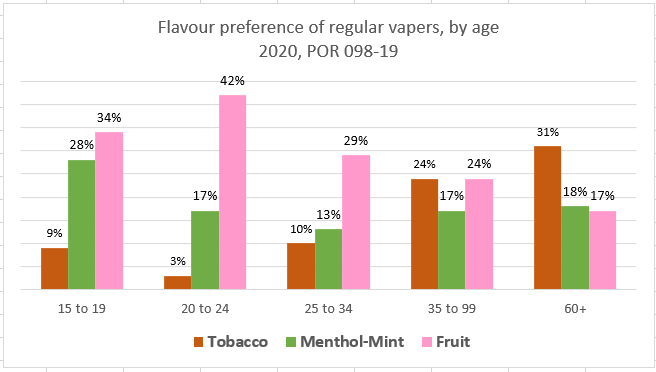
    Data from the first wave of the cross sectional Canadian Tobacco and Nicotine Survey, taken in the fall of 2019, has been made available by Statistics Canada for external analysis (and the second wave is expected to be released later this spring). This survey found that fruit and menthol were the first and second choice flavours for young people. So few young people said they usually smoked tobacco flavour that the results were deemed "unreportable" (#). The selection of menthol by those over 25 years of age was similarly too small to report.  
  • Environics Vaper Panel is an on-line return-to-sample survey commissioned by Health Canada. In the spring of 2020 (POR 098-19) the flavour preferences of regular vapers (those who had vaped at least once a week in the past month) were revisited. Fruit and menthol were found to be the favourite flavours of young people. (Chart below taken from data tables)


  • The Environics research also found some regional differences: Menthol flavourings were more popular in Quebec and Fruit flavourings more popular in the Atlantic Provinces (the survey was taken before Nova Scotia's flavour restrictions were implemented.

  • Research conducted in 2020 and 2021 by Mohammed Al-Hamdani and colleagues with the support of the Lung Association, Heart and Stroke Foundation and provincial tobacco control commissions produced similar results. In an on-line survey of more than 3,000 Canadian youth and young adults, aged 16 to 24, very few identified tobacco as their most used flavour. The most popular flavour categories fruit (berry and mango) and mint-menthol. 

  • Canadian research, as shown above, is consistent that the only flavour not preferred by young people is tobacco flavouring

Menthol-flavouring ingredients make e-cigarettes more addicting.

With the benefit of mandatory European ingredient reporting, Dutch researchers [1] were able to identify which vaping flavours contained chemical menthol and also which additives were included in menthol-flavoured vaping products. This information is helpful to the two main regulatory approaches to restricting flavours: a) prohibiting the use of certain additives (eg. Health Canada), b) prohibiting the use of characterizing flavours (eg Nova Scotia).

From this very European analysis, the 6 major flavourings in vaping liquids labelled as menthol or mint were menthol (59% of liquids; median concentration of 57 mg/10ml), menthone (17%; 23 mg/ml), ethyl maltol (13%; 0.74 mg/10ml), vanillin (12%; 1 mg/10ml), eucalyptol (11.5%; 7 mg/10ml) and peppermint oil (11%; 10 mg/10ml). 

The researchers conclude that these (and other) flavour ingredients are found to increase the addictiveness of e-cigarettes because they   
"enhance the rewarding and reinforcing effects of nicotine in e-cigarettes in young adult smokers. [60, 61] For example, menthol and the green apple flavoring, farnesene, facilitate nicotine dependence through upregulation of nACh receptors in the brain [62,63]. Furthermore, flavorings reduce the nicotine metabolism (e.g., menthol, cinnamaldehyde and benzaldehyde) [64,65] and are known to facilitate inhalation and nicotine uptake due to their cooling and bronchodilating effects (e.g., menthol, theobromine and eucalyptol) [62.] In addition, flavorings such as vanillin, ethyl vanillin, and coumarin inhibit monoamine oxidase enzymes, which results in a delayed degradation of dopamine in the brain, an extended feeling of pleasure, and an increase in reinforcing behavior 66,67. ....In summary, flavors stimulate palatability as well as reward from nicotine in e-cigarettes, and, hence, contribute to nicotine dependence not only through their physical properties (e.g., cooling) but also through their history of associative learning."

Health Canada has previously acknowledged this. When publishing its 2017 regulation to ban menthol in cigarettes, it reported: "Menthol in tobacco products has numerous pharmacological effects, one of them being to mask the irritating effect of tobacco smoke, making it easier to inhale, which facilitates experimentation among novice users. Promoting experimentation among youth increases the potential for continued tobacco use that leads to addiction and an increased risk of tobacco-related diseases."

References:

[1] Erna JZ Krusemann. The role of flavours in attractiveness of electronic cigarettes. PhD Thesis, 2021. 


Friday, 30 April 2021

Conclusions from the EU's scientists and others on whether e-cigarettes help smokers quit

This week the European Union's scientific advisers issued their "Final Opinion on Electronic Cigarettes". This report strengthens concerns about the risks associated with e-cigarette use, while failing to find more than weak evidence that they help smokers quit. 

This post summarizes the findings of this report, and provides a summary of scientific reports published subsequent to the release of the SCHEER's draft opinion last fall.

The EU scientific reaffirms its conclusions on the risks of e-cigarettes

More than two years have passed since the EU's Scientific Committee on Health, Enviornmental and Emerging Risks (SCHEER) was first handed the mandate of assesssing the risks and benefits of e-cigarettes in February 2019. This report is intended to assist the European Union in its upcoming review of its Tobacco Products Directive (now 7 years old). In its assessment, the committee relied on evidence "mainly from review articles published between January 2015 and April 2019 as well as relevant primary sources and literature beyond this period." 

Last September the committee issued its preliminary opinion, following which a consultation paper allowed public comment on their conclusions. Over the past months the SCHEER's working group on e-cigarettes has been reviewing the comments of e-cigarette manufacturers like British American Tobacco and others. (A separate report on that consultation is forthcoming). This week the SCHEER signed off on the final opinion, offering its scientific advice that the:
  • evidence supporting e-cigarettes as an effective smoking cessation device was "weak". 
  • evidence that second-hand exposure to e-cigarette vapour posed risks was "weak to moderate".
  • evidence that e-cigarettes helped smokers cut down on the amount smoked was "weak to moderate".
  • evidence that e-cigarettes could cause cancer in the respiratory tract was "weak to moderate".
  • evidence that e-cigarettes posed risks for coronary disease was "moderate".
  • evidence that e-cigarettes were a gateway to smoking for young people was "moderate"
  • evidence that e-cigarettes with nicotine were addictive was "strong"
  • evidence that flavours in these products contribute to initiation was "strong".

In its revisions to the opinion, the SCHEER clarified that it was cautioning against the use of e-cigarettes as as cessation products outside a clinical intervention: "There is a lack of robust longitudinal data on the effect of electronic cigarettes on smoking cessation. Until such research is available, electronic cigarettes should only be considered to support smoking cessation for a limited time and under supervision." This statement is aligned with the conclusions of other government-mandated reviews(described below).

More studies supporting a cautionary approach

Subsequent to the release of the SCHEER's draft opinion last fall, a number of papers have been released which cast doubt on the usefulness of encouraging the use of e-cigarettes as cessation aids  when purchased as consumer products outside a therapeutic intervention.  

A December 2020 study by Richard Wang and associates  examined e-cigarettes as smoking cessation aids using meta-analyses.[1] The meta-analyses included all pertinent studies published up to January 2020. The meta-analyses performed included 55 observational studies and 9 randomized control trials (RCTs). The study concludes that, overall, e-cigarettes, as consumer products, are not associated with increased smoking cessation in the adult population. In observational studies, whether smokers showed no motivation or some motivation to quit smoking, e-cigarettes were not effective in achieving smoking cessation. Smokers who used e-cigarettes less than daily were less likely to quit smoking. If smokers also used e-cigarettes daily, they were more likely to quit smoking. In randomized control trials, provision of free e-cigarettes as a therapeutic intervention was associated with increased smoking cessation. This study adds to the increasing evidence that e-cigarettes used as consumer products are not effective as smoking cessation devices, while e-cigarettes given therapeutically in controlled clinical settings may help some people quit smoking.

Another similar meta-analysis published in January 2021 found similar results. [2] Zhang and colleagues included fewer studies in their meta-analyses (35), but had similar findings. Intensive use of e-cigarettes and use in randomized control trials in clinical settings were associated with small increases in smoking cessation, described by the authors as having "low certainty." They did not assess persistent use of e-cigarettes among successful quitters. A secondary finding was that adolescent e-cigarette users were three times more likely to become cigarette smokers, consistent with other research.[3,4]

Similar results were reported by McDermott and colleagues and published in March 2021. [5] They analyzed data from a longitudinal survey conducted in the United Kingdom from 2012 to 2017. Daily e-cigarette users were significantly more likely to quit smoking, while non-daily e-cigarette users were significantly less likely to quit smoking. Non-daily use was the more frequent pattern. Non-daily users accounted for 60% of all e-cigarette users.

In October 2020, we reported on studies of the same relationship of e-cigarette use for smoking cessation.[6] Using very different methods - analysis of longitudinal data form the US PATH study - two groups of researchers reached very much the same conclusion as Richard Wang and his colleagues - that e-cigarettes, when used as consumer products are not effective as smoking cessation devices.

Since then another study that used PATH data has been published, concluded that there was some benefit for smoking cessation from e-cigarettes.[7] However, this study's conclusions have been challenged on the basis of methodological flaws in the analysis, which John Pierce and colleagues [8] have described in detail.

Converging conclusions by scientific authorities

Research findings about e-cigarettes, sold as consumer products and used as smoking cessation aids, are converging. Overall, e-cigarettes sold as consumer products are not effective as smoking cessation devices, although benefits were found when they are included as part of a clinical intervention.

In October 2020 a Cochrane Review of randomized control trials of e-cigarettes for smoking cessation was published, and updated in April 2021 [9]. It included a meta-analysis that produced results similar to those produced by Wang et al.'s meta-analysis of 9 RCTs, showing that e-cigarettes have some benefit, similar to other smoking cessation methods, when used in a controlled clinical setting. However, unlike the PATH analyses and the study by Wang et al., the Cochrane review did not provide any information on how e-cigarettes might be used or misused when sold as consumer products. This Cochrane Review has been criticized because it stops short of providing information on what might happen when e-cigarettes are used as consumer products. It has also been criticized because several of the authors were also authors of the studies under review. In addition the RCTs under review were criticized for being are outside the scope of what is considered appropriate use of RCT methodology. Criticisms have been published by researchers in California [10] and Australia.[11]

In January 2021, the United States Preventive Services Task Force recommended against counselling smokers to use e-cigarettes. "The USPSTF concludes that the current evidence is insufficient to assess the balance of benefits and harms of e-cigarettes for tobacco cessation in adults, including pregnant persons. The USPSTF recommends that clinicians direct patients who use tobacco to other tobacco cessation interventions with proven effectiveness and established safety." [12]

In June 2020 the Irish Health Research Board [13] reported that "e-cigarettes were not more effective for smoking cessation than approved nicotine replacement therapies (NRTs), which questions the need for e-cigarettes as a smoking cessation intervention. In the second review, we found that e-cigarettes were associated with initiation of conventional cigarette smoking among adolescents, which identifies a potentially serious harm."

A report by Spain's public health agency [14] concluded in 2020 that "To date, no toxicological or drug studies have been performed on the long-term safety of e-cigarette use in humans; without these data it is impossible to say with certainty that e-cigarettes are safer than cigarettes. With this in mind it is impossible to recommend these devices as a useful tool against the cessation of traditional tobacco consumption." (machine translation)

Reviews on the impact of e-cigarettes on tobacco use conducted for the government of Australia by that country's National Centre for Epidemiology and Public Health [15] concluded that e-cigarettes did not help people quit smoking, but did increase the probability of a young person starting to smoke. 

For the Netherlands government, the Trimbos Institute reviewed the literature [16] and found that e-cigarettes were effective as cessation products for only a small group of smokers, and that success rates were comparable to "regular" methods. Because most e-cigarette users in that country also continued to smoke, it cautioned about the additional risks of dual use. 

Take away

The studies to date, whether longitudinal data analysis, randomized control trials or meta-analysis of e-cigarettes as consumer products, when dual use was assessed, all found high levels of dual use, known to be hazardous, and high prevalence of continuing use of e-cigarettes, even if smokers were successfully able to use them to quit smoking.

Smokers who use e-cigarettes daily are more likely than not to find e-cigarettes helpful in quitting smoking. However, this comes at the cost of likely continuing addiction to e-cigarettes. Among less frequent users of e-cigarettes, e-cigarette use makes smoking cessation less likely.
Daily e-cigarettes increase the likelihood of smoking cessation , but decreases cessation for less-than-daily users of e-cigarettes. Overall, e-cigarettes, when used as consumer products, do not increase smoking cessation rates.

E-cigarettes can be helpful as smoking cessation aids, but only in clinical settings. They are about as effective as other methods, but, unlike other therapeutic methods, they do not pass a test of safety for widespread use. There is a high risk of dual use, a high risk of continuing use, and a high risk of uptake of e-cigarettes by never smokers. Since they are only about as effective as other methods and cannot meet safety tests, it is highly questionable why sales of e-cigarettes as fast moving consumer goods (including to never smokers) should continue to be allowed in preference to imposing the types of restrictions required of other therapeutic products. 


References

[1] Richard J. Wang, Sudhamayi Bhadriraju, and Stanton A. Glantz:E-Cigarette Use and Adult Cigarette Smoking Cessation: A Meta-Analysis. American Journal of Public Health, https://doi.org/10.2105/AJPH.2020.305999

[2] Ying-Ying Zhang, Fan-Long Bu1, Fei Dong, Jian-Hua Wang, Si-Jia Zhu, Xiao-Wen Zhang, Nicola Robinson, Jian-Ping Liu. The effect of e-cigarettes on smoking cessation and cigarettesmoking initiation: An evidence-based rapid review and meta-analysis. Tob. Induc. Dis. 2021;19(January):4 https://doi.org/10.18332/tid/131624.

[3] Physicians for a Smoke-Free Canada. An update on evidence linking teen vaping to cigarette smoking. 15 November 2020. http://smoke-free-canada.blogspot.com/2020/11/an-update-on-evidence-linking-teen_15.html.

[4] John P. Pierce, Ruifeng Chen, Eric C. Leas, Martha M. White, Sheila Kealey, Matthew D. Stone, Tarik Benmarhnia, Dennis R. Trinidad, David R. Strong and Karen Messer. Use of E-cigarettes and Other Tobacco Products and Progression to Daily Cigarette Smoking. Pediatrics January 2021, e2020025122; DOI: https://doi.org/10.1542/peds.2020-025122.

[5] Máirtín S. McDermott, Katherine A. East, Leonie S. Brose, Ann McNeill, Timea R. Partos.The effectiveness of using e‐cigarettes for quitting smoking compared to other cessation methods among adults in the United Kingdom. Addiction. 09 March 2021. https://doi.org/10.1111/add.15474

[6] Physicians for a Smoke-Free Canada. New longitudinal studies find little support for e-cigarettes as an effective tool for population-level smoking cessation. 15 October 2020. http://smoke-free-canada.blogspot.com/2020/10/new-longitudinal-studies-find-little.html.

[7] Allison M. Glasser MPH, Mahathi Vojjala, Jennifer Cantrell, David T. Levy, Daniel P. Giovenco, David Abrams, Raymond Niaura. Patterns of E-cigarette Use and Subsequent Cigarette Smoking Cessation Over 2 Years (2013/2014–2015/2016) in the Population Assessment of Tobacco and Health Study. Nicotine & Tobacco Research, 2020, 1–9. 17 September 2020. doi:10.1093/ntr/ntaa182.

[8] John P. Pierce, Eric C. Leas, Tarik Benmarhnia, Sara B. McMenamin, David R. Strong, Ruifeng Chen, Karen Messer. E-cigarettes and Cessation: The Introduction of Substantial Bias in Analyses of PATH Study.14 November 2020. Nicotine & Tobacco Research, 2020, 1–2 doi:10.1093/ntr/ntaa234.

[9] Jamie Hartmann-Boyce, Hayden McRobbie, Nicola Lindson, Chris Bullen, Rachna Begh, Annika Theodoulou, Caitlin Notley, Nancy A Rigotti, Tari Turner, Ailsa R Butler, Thomas R Fanshawe, Peter Hajek. Electronic cigarettes for smoking cessation. Cochrane Database of Systematic Reviews. 14 October 2020 https://www.cochranelibrary.com/.


Monday, 26 April 2021

Tobacco control innovations in 3 other countries

Earlier this year we reported on the results of the Commonwealth Fund Survey of health behaviours in 11 countries with comparable government structures, economies and cultures. According to the results of this survey, which considered all forms of tobacco use (and not just cigarette smoking), Canada did fairly well. We are ranked fourth, behind New Zealand, Australia and the United States. Other global data sets, such as that prepared by the OECD, consider only daily cigarette smoking only. By this other measure, Canada would also rank 4th, but would be behind Norway, Sweden and the United States.)

Comparing smoking rates among countries that share cultural, political and commercial practices can help inform discussions about tobacco regulation. These 11 peer-group nations have all adopted comprehensive measures to reduce tobacco use, and many are planning additional public measures. There are both small and large differences in the approaches each have taken: In the United States, for example, cigarettes are still displayed in corner stores and do not yet have picture-based warnings. In Australia, vaping products and oral tobacco are not legal for commercial sale. In France, cigarettes may only be sold by stores which are part of a state-controlled retail monopoly. 

This post looks at tobacco control measures that have recently been proposed in three of these countries, and how they compare with the situation in Canada. 

1. New Zealand: an 'Action Plan' to becoming smoke-free by 2025

Ten years ago New Zealand adopted the goal of becoming smoke-free by 2025, which was interpreted as achieving less than 5% prevalence. That deadline is now only a few years way, and the government has been under pressure to up its game to make that goal a reality. Last week the New Zealand associate Health Minister, Dr. Ayesha Verrall, opened consultations on a new Action Plan for tobacco that is designed to meet this goal. 

In presenting a broad set of new measures, the minister was frank that the government needed to do more things and that it needed to do things differently.  "To accelerate progress towards Smokefree 2025, we must change how we tackle smoking. We will not achieve it with a business-as-usual approach." 

In many respects, the tobacco control situations in New Zealand and Canada are very similar. Both countries are among a small group of nations which have liberalized the vaping market as a harm reduction approach. Both countries face similar challenges with respect to the way tobacco drives health inequalities and causes disproportionate harm to indigenous peoples. Both countries share political and many cultural traditions. 

How does this compare with Canada? Dr. Verrall's plan goes well beyond the current strategies of federal and provincial governments. Of her 15 newly-proposed measures, for example, only three are currently included in Canada's Tobacco Strategy, as indicated with an "*" in the list below. 

        Proposals for a Smokefree Aotearoa 2025 Action Plan 

                    Strengthen the tobacco control system 

    • Strengthen Māori governance of the tobacco control programme *
    • Support community action for a Smokefree 2025 
    • Increase research, evaluation, monitoring and reporting *
    • Strengthen compliance and enforcement activity 
                    Make smoked tobacco products less available 
    • License all retailers of tobacco and vaping products 
    • Significantly reduce the number of smoked tobacco product retailers based on population size and density 
    • Restrict sales of smoked tobacco products to a limited number of specific store types 
    • Introduce a smokefree generation policy 
                    Make smoked tobacco products less addictive and less appealing 
    • Reduce nicotine in smoked tobacco products to very low levels 
    • Prohibit filters in smoked tobacco products 
    • Prohibit innovations aimed at increasing the appeal and addictiveness of smoked tobacco products
                    Make tobacco products less affordable
    • Set a minimum price for tobacco 
    • Enhance existing initiatives 
    • Increase investment in mass and social media campaigns 
    • Increase investment in stop smoking services for priority populations *

2. Sweden: Moving beyond tobacco and aiming to reduce all forms of nicotine use

In March, the Swedish Minister of Social Affairs, Lena Hallengren, presented her legislature with a new strategy to address alcohol, drugs, gambling, tobacco and nicotine. One of the key developments in the new strategy is "extending tobacco to also include nicotine products" [free translation].

Sweden's decision to reduce nicotine use is significant given that it is often held up by outsiders (and the tobacco industry) as a model for a harm reduction approach which discourages smoking but which does not discourage nicotine use. Although rates of all tobacco use in Sweden are high, much of the tobacco used is in the form of snus and cigarette smoking rates are lower than in other European countries.  

The Swedish decision to target the use of nicotine was not taken lightly. Last year an expert report was commissioned to review the evidence and make recommendations to government. The 500 pages report, Hårdare regler för nya nikotinprodukter (Stricter rules for new nicotine products) was made public last month. The experts involved in the review considered the expanding range of novel nicotine products, the way these p;roducts attracted young users and the gaps in Sweden's current laws. They recommended that Sweden should aim to limit all use of nicotine, should ban all flavourings other than tobacco flavour in vaping liquids and should put all tobacco-free nicotine products under a similar regulatory frame as tobacco.


How does this compare with Canada?  Sweden is adopting a policy scope that is broader than that in place in Canada. Although our federal government adopted the goal of reducing tobacco use to less than 5% of the population by 2035, it has not stated an intention to reduce overall nicotine use or set any public health goals for vaping rates for adults. The 5% objective is a policy without any legislative basis, and the government opposed a legislated mandate when it was proposed by opposition members of parliament in 2018.  

3) The Netherlands: Reducing retail density and limiting tobacco to specialty stores. 

For the past few years, the Netherlands' approach to tobacco regulation has been guided by the National Prevention Agreement endorsed by the government and more than 70 civil society organizations. This development has spurred the implementation of a number of measures already in place in Canada, including smoke-free spaces, retail display bans and plain packaging. It is also the basis of further restrictions on e-cigarettes: it is currently developing restrictions on flavourings in vaping liquids.

The Dutch government is also planning a major reform in the way tobacco products are supplied.  Last fall, secretary of state Paul Blokhuis informed his legislative colleagues that after reviewing economic studies and consulting with stakeholders, he was moving to remove tobacco from all but specialist stores.  "To prevent young people from smoking and to protect ex-smokers, the government has opted to limit the sale of tobacco and related products to sales channels that usually do not attract children and ex-smokers. In time, these products will only be sold at specialist tobacco shops where only adult smokers come and which focus almost exclusively on the sale of tobacco and related products."

This change will be phased-in over the next decade. The first ban on vending machines will take place in 2022, with on-line sales removed the following year. In 2024, sales will be banned in supermarkets, and in 2030 the remaining restrictions will be imposed. 

How does this compare with Canada?  Over the past decades, provincial governments have adopted regulations that forbid the same of tobacco in some venues (like schools or pharmacies) or which make them less likely to happen (like banning smoking in bars). This and other developments have had the effect of reducing the number of tobacco retailers in Canada from 90,000 in the 1970s to under 30,000 today. No government has set a goal to reduce retail density, as the Netherlands and New Zealand are now doing. (One other European country has limited cigarette and vaping products to adult-only store. In 2013, Hungary asserted control over tobacco retailing and reduced the number of retail outlets to fewer than 20% of the 42,000 retailers that had been in place.)


In a recent presentation to Canadians about developments in the Netherlands, Dr. Marc Willemsen identified other elements that are not currently in place in Canada. The current proposals result from a deliberate campaign to develop a national consensus on priorities and to broaden support across government and civil society for additional reforms. Canada formerly had a National Strategy to Reduce Tobacco Use, which resulted from interprovincial agreements among provinces and civil society organizations. The intersectoral committee that oversaw this strategy was disbanded in the early 2000s and soon after separate federal and provincial tobacco control strategies were established. There is currently no Canadian equivalent to the Netherlands' National Prevention Agreement. 

(Dr. Willemsen's slides from this webinar can be viewed here, and his downloadable book "Tobacco Control Policy in the Netherlands"  details the development of this strategy.)

Wednesday, 21 April 2021

Tobacco tax increases included in 3 (of 14) government budgets

The season for government budgets has come to an end. After a disappointing start, it ended with a strong finish for tobacco control. The first 11 provincial budgets presented this year contained no mention of tobacco. But the most recent 3 budgets (Saskatchewan, the federal government and British Columbia) included measures to address smoking and youth vaping.

On April 9, Saskatchewan announced that it would create new taxes for heat-not-burn (effective June 1, 2021) and vaping products (effective September 1, 2021). This week, the federal budget introduced immediate increases to all tobacco taxes by the equivalent of $4 per carton of cigarettes and set a path for a new tax on vaping liquids to come on line in 2022. The next day, British Columbia announced an even larger increase in cigarette taxes ($6 per carton), as well as similar increases for heat-not-burn, roll-your-own and oral tobacco, to come into effect on July 1, 2021.

B.C. is on track to have the highest cigarette taxes in Canada this summer, narrowly overtaking Nova Scotia, Manitoba and Newfoundland. A typical pack of cigarettes will cost almost $15 in British Columbia, compared with only $10 in Quebec. (The prices shown below assume a $3.50 wholesale price, and a $0.35 retail mark-up). 


Finance Canada's Tax Innovations

The vaping tax that will be established through the federal budget continues a highly-successful innovation first used by Finance Canada for the broad category of manufactured tobacco (essentially all tobacco products other than cigarettes, cigarette sticks and cigars). The federal tax for manufactured tobacco is set at a rate of $9.09 for every 50 grams or portion thereof and the vaping liquid tax will be taxed at $1 for every 10 ml of liquid or portion thereof.  This use of a minimum tax quantity makes small packages of these products relatively expensive, and effectively sets a minimum price for these categories of products.

As the federal budget documents explain, this approach is expected to put a higher relative tax on the pods that are associated with young users. "To illustrate, if a retail package contains four separate pods of 1.0 ml of vaping liquid, each pod would be considered a separate container for the purpose of the duty. The duty would be calculated based on the volume of liquid in each separate pod (i.e., $1.00 per pod, for a total of $4.00 for the retail package), and not on the total volume of liquid in the package. Larger volumes of liquids, a 30 ml container for example, would be subject to excise duties of $3.00, while a 100 ml container would bear an excise duty burden of $10.00."

Not unexpectedly, there have been complaints from manufacturers of oral tobacco and heated tobacco products about the minimum quantity for federal taxes on manufactured tobacco. In Finance Canada's consultation on the new vaping product tax, simlar complaints can be anticipated from the manufacturers of vaping pods. This is also an opportunity for Canadians to remind federal finance officials of their support for measures to protect young people from becoming addicted to tobacco and nicotine products.

A heterogenous tax system

Taxes on tobacco products vary widely among Canada's provinces, and also among the types of products that are sold. There is not even a consistent approach to categorizing the types of tobacco subject to excise tax. Two provinces (British Columbia and Saskatchewan) have established new categories for heat-not-burn tobacco, for example, while most continue to tax them as "other" or "loose" tobacco at the same per-gram tax as pipe tobacco or oral tobacco.

The result is a very uneven application of tax on tobacco products when considered on a per-use basis. More tax is charged on oral tobacco and less is charged for heated tobacco in all provinces. For example, a one-gram pouch of oral tobacco sold in a 34-gram tin in British Columbia will carry 92 cents in combined federal and provincial specific tobacco taxes this summer, compared with 38 cents for one stick of heat-not-burn tobacco or 47 cents for a cigarette. The same pouch of oral tobacco has half as much tax when sold in Ontario (45 cents), and the cigarette sold in Quebec has one-third less tax (29 cents).  


Tobacco companies adjust their pricing policies to tax changes

Within a hairs' breadth of the federal taxes being announced, cigarette manufacturers informed retailers that they would be immediately adding 80 cents to the price of each carton of cigarettes. This long-standing practice of concurrent price and tax increases is good for tobacco shareholders, as it allows them to recoup the money they would otherwise lose when smokers quit or cut down as a result of the tax increase. But it is also good for public health: Canadian economists have repeatedly demonstrated that the higher the price of tobacco, the less that is used.

Another adjustment that the companies are likely to make is bad for public health. They over- and under-shift taxes on different products and reduce the price of their discount brands while making up any losses by increasing the price of their up-scale products. Their ability to do this blunts the health benefits of tobacco taxes. (This is one of many reasons that calls are growing for restrictions on promotional pricing of tobacco).  

Briefing notes and fact sheets:


Monday, 12 April 2021

Tobacco 21 - More evidence on the benefits of a higher minimum legal age

Raising the minimum sale age for tobacco to 21 has emerged as a highly recommended measure for tobacco control systems. More than a year has passed since this measure was in place across the United States (and also in Prince Edward Island

This blog reviews the history of Tobacco 21 measures and the research that has been conducted on the effectiveness of this measure at reducing tobacco or e-cigarette use by young people. (A downloadable version is available here.) 

Tobacco 21 laws help protect young people from nicotine addiction

Almost all people who use tobacco products start doing so as teenagers or as young adults. (A recent study by Statistics Canada found "for both men and women, the age at which they started smoking remained virtually unchanged over the past 80 years", with the "the peak age of initiation was 15 to 17 for women and 16 for men".

Measures which help protect youth and young adults from experimenting with and becoming addicted to tobacco will have long-term benefits for those individuals and for the community. 

Laws which set the minimum legal age for the sale of cigarettes at 21 help protect young people by raising barriers to their accessing tobacco:

  • They establish a new social and legal norm
  • They reduce the ability of younger teenagers to buy from their peer-group, creating a longer age buffer between those who are legally able to purchase and high-school students. 
  • They support policy change by post-secondary education institutions and employers. 

Even those for whom Tobacco 21 laws will only defer the age of initiation can benefit:

  • Those who start smoking at a younger age are more likely to find it difficult to quit.
  • Nicotine use is harmful to the developing brains of young people.

Tobacco 21 laws are emerging as a new global standard

At least 8 countries have set the minimum sale age for tobacco products at 21. The United States changed its Food, Drug and Cosmetic Act to raise the age from 18 to 21 on December 20, 2019. Prior to that date, half the U.S. population lived in the 19 states and 540 cities that had raised the minimum legal age for tobacco purchase to 21. 

Other recent changes took place in the Philippines (early 2020) and Singapore (January 2021). The law was already in palce in Ethiopia (2019), Uganda (2016), Mongolia (2013), Honduras (2010), and Sri Lanka (2006). Countries which have set the age at 20 include Thailand (2017) and Japan (2001).


Canadians and their health leaders support raising the legal minimum age to 21.

Surveys have consistently shown a high level of support for this higher age limit:

Raising the minimum legal age for tobacco and vaping products to 21 is supported by all of the health charities (including the Canadian Cancer Society, the Heart and Stroke Foundation and the Lung Association) and also by nation's chief medical officers of health

Evidence on the benefits of Tobacco 21 laws is growing

Before the United States adopted the measure at a national level, U.S. researchers were able to compare the impact of this measure in the states and municipalities which had adopted it with comparable jurisdictions which had not. 

Recently-published research has shown: