Sunday, 14 November 2021

Doctors' group calls on new Health Ministers to revamp Canada's Tobacco Control Strategy

In advance of the beginning of Canada's 44th parliament, Physicians for a Smoke-Free Canada (PSC) has written the new Minister and Associate Minister of Health to recommend priority actions to reduce tobacco use. The letter can be read here.

The health charity urges the ministers to address two key weaknesses in the federal approach to tobacco control: a) the commercialization of tobacco harm reduction and b) the absence of a plan to phase out the supply and demand for tobacco and nicotine.

PSC's president, Dr. Atul Kapur noted that tobacco industry products continue to be responsible for more deaths in Canada than any other preventable risk. "Because previous ministers of health decided to delay putting adequate regulatory controls on the tobacco industry, more than 50,000 Canadians died from tobacco use this year -- greatly more than deaths from COVID-19 and opioids combined."

Dr. Kapur noted that while past and current efforts to reduce smoking have had good effect, they have failed to prevent the continued epidemic of tobacco in Canada. "Decades after the federal government acknowledged the harms of smoking, there are no laws to forbid tobacco companies from recruiting new users. One-third of Canadians who smoke today -- over 1 million younger adults -- began doing so in this century, after core measures like graphic health warnings, higher taxes and smoke-free places were in effect."

PSC notes that other health agencies and researchers have recently identified deficiencies in Health Canada's tobacco strategy, calling it "incremental, erratic and reactive" and having "no coherent plan to reduce tobacco use ... no milestones, benchmarks or tangible national plans beyond optimistic guidance documents." [1]

In its letter, PSC asks Ministers Duclos and Bennett to engage outside experts, civil society and in the preparation of the review they are obliged by law to provide to Parliament by next spring, and identifies its own priorities for reform. These are:
  1. Preventing future addiction by adopting the policy goal of ending commercial nicotine and tobacco use.
  2. Aligning the supply of tobacco with public health goals by reforming retail distribution, removing commercial incentives for suppliers to recruit new users and requiring manufacturers to meet public health targets, possibly through the use of production caps or other supply controls now used in environmental regulation.
  3. Expanding current demand-reduction measures by fully implementing and scaling up the measures required by the Framework Convention on Tobacco Control, improving the delivery of supports to vulnerable populations,  and developing new and innovative demand-reduction approaches. 
"This government has committed to ending the sale of combustion engines in passenger cars by 2035 - but remarkably has no plan in sight to end the same of combustible cigarettes." PSC's president, Dr. Atul Kapur pointed out. "The 'way'  to end the tobacco pandemic is there - what is needed is the 'will' of ministers of health to make it happen."

Priority measures to reduce addiction and disease caused by commercial tobacco and nicotine products


1. PREVENT FUTURE ADDICTION

Commit to end the harms from commercial tobacco and nicotine.
The federal government should adopt as a policy goal the end of commercial nicotine and tobacco use, [as Finland has done](https://www.finlex.fi/en/laki/kaannokset/2016/en20160549_20161374.pdf). In coordination with other levels of government and civil society, Health Canada should establish a timeframe with specific interim and long-term targets to ensure that new generations are not recruited to commercial tobacco or nicotine use.

2. REFORM TOBACCO SUPPLY

Align the supply of commercial tobacco and nicotine with public health goals.
Currently tobacco and nicotine manufacturers, retailers and other suppliers are motivated and rewarded to maximize economic returns, with many of their business practices guided by economic pressure and corporate law. Key reforms needed are:
  • De-commercialization of harm reduction.
  • Reforming retail distribution and ensuring that tobacco and nicotine products are not sold outside of adult-only specialty stores or by individuals trained and motivated to support cessation.
  • Requiring tobacco companies to contribute to winding down tobacco use and nicotine addiction, for example by obliging them to meet public health targets for production and consumption. Examples of mechanisms that can assist this are found in the federal Climate Action Plan.

3. EXPAND EFFECTIVE EXISTING MEASURES

Maximize the potential for demand-reduction measures
There is an international consensus around a set of demand-side interventions that are embraced by the Framework Convention on Tobacco Control. Canada’s implementation of these measures has not yet optimized their impact. Canada should intensify, scale up or develop innovative approaches to meaures such as the following:
  • End all promotions for consumer (non-therapeutic) tobacco and nicotine products, including  those delivered in bars, through social media or direct-mail, and ban incentive programs and other promotions directed at retailers.
  • Eliminate flavourings in all consumer (non-therapeutic) tobacco and non-tobacco flavourings from nicotine products products,
  • Regulate the market introduction of new tobacco/nicotine products by establishing notification and authorization processes.
  • Raise the legal minimum age to 21 and phase in a smoke-free generation policy.
  • Apply equally stringent regulations to non-therapeutic nicotine products and tobacco.
  • Enhance programming and develop tailored approaches for more vulnerable communities.
  • Increase tobacco prices substantially through tax increases and price regulation (preferably standardized pricing).
  • Accelerate regulation-making and remove structural barriers to timely policy-implementation for tobacco control.
  • Provide international leadership (including financial support for global efforts).
  • Apply the polluter-pay principle, recovering the cost of related Canadian public health interventions from the tobacco and nicotine industries

Monday, 8 November 2021

Guess who's behind Canada's vapers' protest movement?

European journalists recently investigated the relationship between public opposition to e-cigarette regulation and tobacco companies and other corporate interests. Last week their findings were published in the French newspaper of record, Le Monde: VAPING: The real dollars behind fake consumer organisations.

While their focus was mostly on activities in Europe, the report also spotlighted connections between the Canadian Rights4Vapers group and tobacco and other business interests. With additional information from Canadian government agencies it now seems clear that this group is far from independent of the vested interests of tobacco companies.

Follow the money .... 

The investigative team set out to trace the backers for activities organized by the World Vaping Association (including a bus touring across Europe to rallying opposition to e-cigarette regulations) and for other pro-vaping actions - such as those described here a few weeks ago.  

They demonstrated that these activities were executed with the participation of anti-regulatory think tanks like the Consumer Choice Centre, Students for Liberty and the Taxpayers Protection Alliance. And they dug up the financial connection between tobacco companies and the libertarian Koch funders to these think tanks and non-profits. (The figure below is from the Le Monde article).

This media report elaborated on the connections between tobacco companies and the Atlast network of pro-business think tanks that had been documented previously by a research team at Simon Fraser University,

The Canadian operations  ....

The Le Monde investigation noted the parallels with the Canadian pro-vaping rallies of this summer managed by Rights4Vapers.


L-R: Maria Papiannoy, Christina Xydous, Yolanda Watson
Although Rights4Vapers does not pro-actively disclose their budget or source of revenue, it is clear that they have money to spend. This summer (with their Quebec wing, la Coalition des droits des vapoteurs du Québec), they brought a publicity tour through southern Ontario and Quebec. The campaign costs would have been substantial, in addition to travel costs and campaign material, they worked with PR handlers for some events, engaged a videographer and wrapped their campaign bus. 

Rights4Vapers activities are directed by vaping store owners. Those who conducted the protest tour may have volunteered their efforts, but they were not consumer volunteers. The three leaders, shown in their twitter post, are vape store owners and staff (Maria Papiannoy of EcigFlavourium; Christina Xydous of La Vapote and Yolanda Watson of 705 E-liquids). 

The Rights4Vapers Team has additional connections to vaping, tobacco and foreign business interests. As shown in the figure below, the leadership identified on Rights4Vapers website includes several links to tobacco industry funded and associated agencies, including representatives of two foreign lobby bodies.

* Dr. Gopal Bhatnagar founded the 180Smokes chain (with more than 30 vape stores).
Ian Irvineas described earlier, has completed contracts funded by Philip Morris International. 
Michael Landl heads the Consumer Choice Center-associated World Vapers Alliance
David Williams is the head of the U.S.-based Taxpayers Protection Alliance, which is lpart of the Atlas network of tobacco-friendly advocacy groups.

The financial agent for Rights4Vapers is the head of the Vaping Industry Trade Association. Protesting federal regulations during an election period required Rights4Vapers to register with Elections Canada as a third party. In doing so, they revealed that their financial agent was Michael Meathrel, owner of Dvine laboratories and chairman of the Vaping Industry Trade Association.  

The Vaping Industry Trade Association (VITA) represents the interests of multinational tobacco-nicotine companies as well as domestic vaping producers. When it was established in 2019, three of the four founding directors lead the government-public relations operations of the multinational tobacco and nicotine companies. (Two of these companies have since left the organization, one citing policy differences.)


Déja vu all over again

Rights4Vapers is not the first  attempt by corporations to try to influence Canadian health policy by setting up and funding smokers' rights organizations and other fake grass-roots ('astroturf') groups. 

There was the 'Alliance for Sponsorship Freedom" and "Coalition 51" (opposing advertising restrictions), the Smokers' Freedom Society (challenging science on health impact), "My Choice" and the "Fair Air Association" (fighting restrictions on smoking in public place), and "The National Coalition Against Contraband Tobacco" (fighting against regulation and taxes). Usually evidence that these events were established and directed by tobacco companies was only made solid long after the policy-decisions had been made. (Five years ago a BAT document was leaked which showed how they manipulated retailers and municipalities to fuel fears of contraband cigarettes in order to avoid taxes and health regulations.)

The cost of inaction

Rights4Vapers illustrates the weakness of Canada's implementation of Article 5.3 of the Framework Convention on Tobacco Control - the obligation to protect public health policies "from commercial and other vested interests of the tobacco industry."

The Global Center for Good Governance in Tobacco Control recently assessed nations on their efforts to address tobacco industry interference, and this year ranked Canada 28th among 80 countries.

Five years ago, Canadian health groups recommended a number of specific actions to Health Canada to reduce the ability of tobacco companies to reach policy makers through front groups. Despite assurances from then Minister of Health Jane Philpott that Health Canada was looking to develop "domestic policy guidelines on Article 5.3 in collaboration with federal, provincial/territorial and civil society tobacco control partners," no such guidelines were developed. Based on Canada's 2020 report to the FCTC secretariat, this intention has been abandoned.

Greater transparency would allow parliamentarians and other policy makers to distinguish between authentic consumer concerns and industry lobbying. It would allow Elections Canada greater confidence that the prohibitions in Canada's Elections Act on foreign agencies (like the Taxpayers Protection Alliance) participating in third party activities during federal elections, and on foreign funding (like contributions from the Consumer Choice Center) paying for these  election-period activities. It would allow the Commissioner of Lobbying greater confidence that companies are not doing a run-around their obligations to document meetings with policy-makers.


Tuesday, 2 November 2021

Health Canada study following vapers over 2 years found no reduction in tobacco smoking.

Last week the federal government released its most recent consumer research report on Canadian vaping behaviour. The results show that among a group of Canadian vapers, there was no overall decrease in smoking behaviour over the past two-years.

The Vapers Online Survey to Measure Attitudes and Behaviours Regarding Vaping Over Time (2019 to 2021) is a quasi-longitudinal ("return to sample") study conducted by Environics Research. This is the only Canadian government survey to follow the same group of individuals who are using vaping products over time. The baseline report was made available in the fall of 2019 (POR 047-17), with the first and second year results published 12 and 24 months later (POR 098-19POR 113-20). 

There are a number of limitations to how this survey can guide our understanding of whether or not the legalization of the vaping market is reducing population-level harm or whether it is contributing to it. 
  • Because the study participants are drawn from a panel, the results cannot be interpreted as representative of the whole population. (This is a limitation shared by many other behaviour studies).
  • The survey has a very low response rate (25% last year, and 17% this year). 
  • The behaviour is self-reported, and there is no way of confirming whether respondents are under- or over-reporting their smoking and vaping experiences.
  • The survey only follows the behaviour of selected Canadians who were vaping in 2019 -- it does not look at the behaviour of those who entered the vaping market after early 2019.
  • The results have been analyzed at the aggregate level, and there is no attempt to link individual behaviours over time. No conclusions, for example, are offered on whether those vapers who used certain flavours were more or less likely to quit. 
  • The data is not made available to independent researchers for subsequent analysis
Nonetheless, this is the only (and consequently the best) quasi-longitudinal study of adult vaping in Canada. 

Smoking rates have gone up each year.

The results of this report are in the same direction as those of studies published in the peer-reviewed literature: in real-life situations smokers who use vaping products do not show greater (or any) success in quitting smoking.

Among this group of Canadians, there were more smokers at the end of two years than there were at the beginning.  In 2019, 58% of the vapers were also smoking cigarettes (dual users). By 2021, 62% were either dual users or had stopped vaping and only used tobacco products.

Many of these Canadians changed their vaping or smoking behaviour -- half in the first year and one-third in the second. But there were more who relapsed or took up smoking than there were successful quitters. Over the two year period the number of vapers dropped by one third (33%), but the number of smokers increased (by 4%). 

This lack of progress was not because smokers who vaped did not want to quit. Environics reported that "The vast majority of Dual Users are either planning to quit, or already trying to quit smoking; most of those who plan to quit intend to do so within the next six months."


Among those vapers who had never smoked in 2019, more than one-third had done so by 2021.

Among the 337 panelists who agreed to the follow-up study, about one-quarter (24%) had never smoked a cigarette in 2019, but only about 16% were counted as neither a smoker or former-smoker two years later (Report, Table 44). This implies that one-third (8% of 24%) had moved from vaping to smoking at some point over the 24 months.

In last year's report, with results from almost 1,000 panelists, Environics was able to provide sufficient information on the transitions to allow a Sankey illustration of the transitions change over the first year of the study. The smaller sample this year (337) did not allow for such data release. 


Tobacco flavour is the preference of vapers who used to smoke.

Almost one-half (46%) of former smokers who still vape prefer tobacco flavoured vaping products. Overall, tobacco and fruit flavours are equally preferred. Canadian vapers continue to cite a preference for flavours which are not legal for sale in Canada (candy, dessert, cannabis, energy, etc). 


Vapers want to quit

Two-thirds (66%) of those who are vaping are planning to quit, and one-quarter (26%) are currently trying to do so. Most (74%) are turning to some form of cessation-aid, with NRT, cannabis and stop-smoking medications like Zyban most often identified as the method being used.


And more! 

In addition to the web-based survey of panelists, Environics recruited 46 to share their experience and views on vaping and smoking, using this qualitative data to contextualize and amplify their conclusions. The wide range of experiences and views - including some related to the role of flavours and COVID-19 - are best enjoyed by reading pages 40-45 of the report!

Monday, 1 November 2021

New poll shows support for a course correction to Health Canada’s tobacco strategy

Press Release - November 1, 2021


(Ottawa and Montreal) - A poll conducted for Physicians for a Smoke-Free Canada and the Quebec Tobacco Control Coalition shows key elements of Health Canada’s approach to reducing smoking are out of line with public opinion.

“A few years ago the federal government shifted its focus away from regulating tobacco products and towards a vaping market where smokers were encouraged to switch to vaping products but young people were to be discouraged from both smoking and vaping,” explained Cynthia Callard, executive director of Physicians for a Smoke-Free Canada. “The results from this poll show that Canadians want government to not only roll back the vaping market but to beef up controls on tobacco products.”

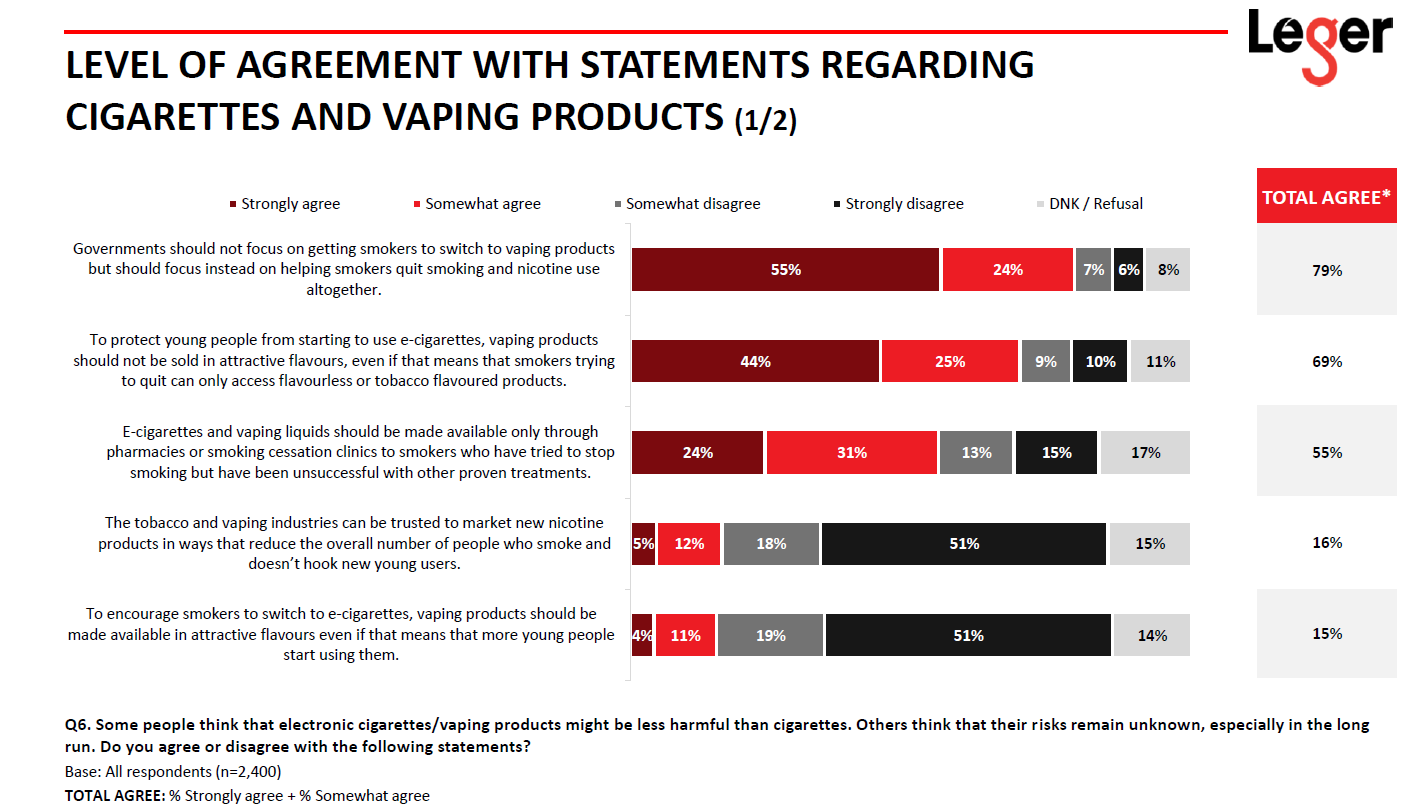
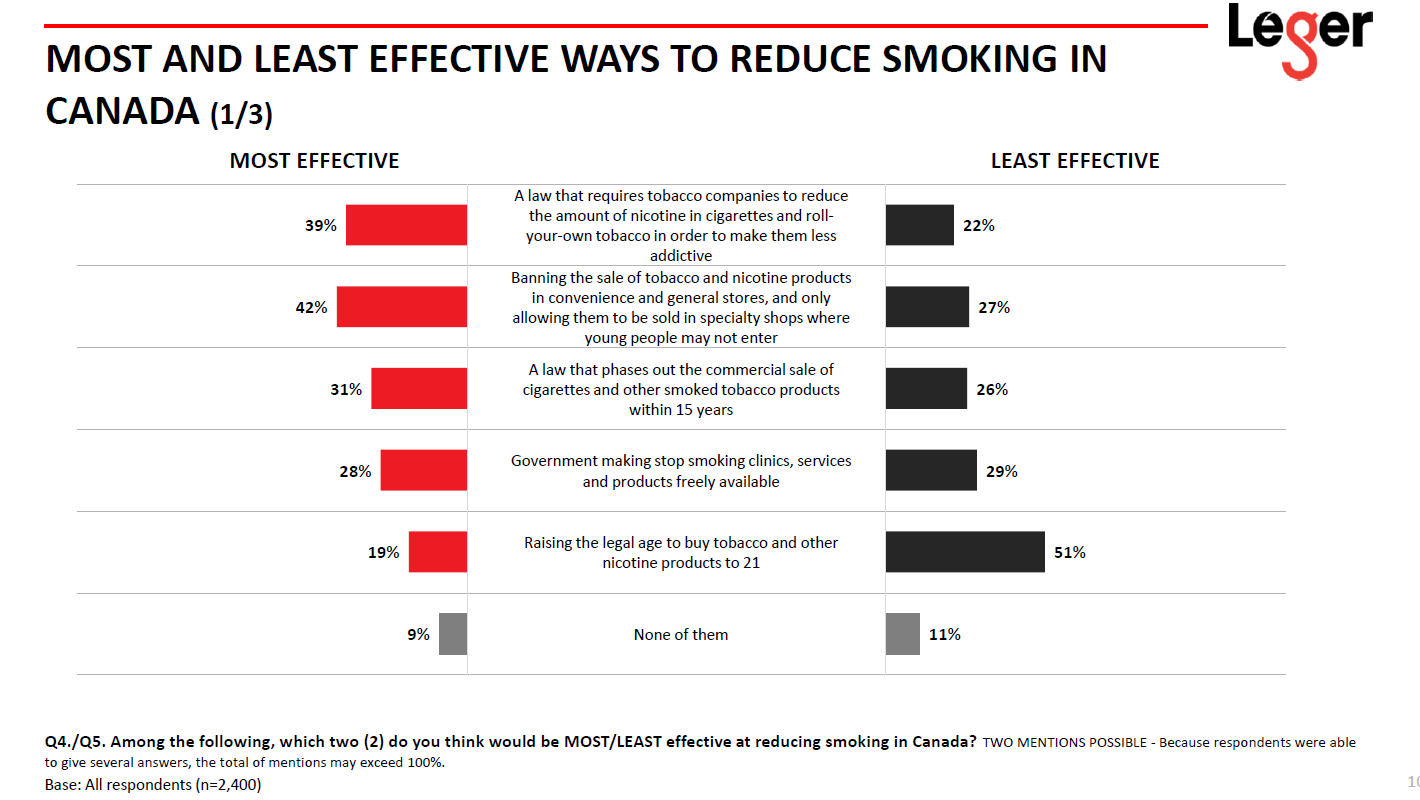
The poll was conducted by Leger between September 29th and October 11th, 2021 among a sample of 2,400 Canadians aged 18 and over. Survey participants were asked about their perspectives on tobacco harm reduction policies. They were also asked to choose from a list of tobacco control measures which they thought would be most and least effective at reducing smoking.

When asked their views on harm reduction approaches, the majority of Canadians surveyed (79%) – including a majority of smokers (75%) – did not support Health Canada policies that are aimed at making e-cigarettes attractive to and widely available for smokers.

The strongest support (79%) was for governments to not focus on getting smokers to switch to vaping products, but to focus instead on helping smokers quit smoking and nicotine use altogether. A clear majority (69%) felt that vaping products should not be sold in attractive flavours even if this resulted in smokers only having access to flavourless or tobacco-flavoured products. In fact, close to a third of adult vapers (29%) favours allowing only tobacco and flavourless e-liquids in order to protect youth. Additionally, a small majority of Canadians (55%) would favour vaping products being removed from convenience stores and vape shops and sold only in pharmacies or smoking cessation clinics.

“The consensus is that Canadians want to reduce the presence of products with nicotine, especially to avoid new young users,” concluded Leger.


Survey respondents were also asked to choose the most and least effective policies from a set of five new regulatory approaches to tobacco products. The policies Canadians thought would have the greatest impact were requiring tobacco companies to make cigarettes less addictive by reducing the amount of nicotine in them and banning the sale of tobacco and nicotine products except in specialty shops where young people may not enter. Interestingly, the policy of raising the minimum legal age to buy tobacco to 21 years was overwhelmingly considered to be least effective of the options offered.

“The measures presented in this survey are among those proposed to governments five years ago when the Canadian tobacco control community met to develop an “Endgame” approach to reducing tobacco use in Canada,” explained Flory Doucas, co-director and spokesperson for the Quebec Tobacco Control Coalition.

“Although all of these suggestions were excluded from the 2018 revision to Health Canada’s tobacco strategy, this poll suggests that the public understands that greater controls on the tobacco industry are needed if smoking rates are to fall. These results should motivate governments and the health community to work for a tighter framework governing which tobacco and nicotine products are allowed for sale as well as where they can be sold.”


Last June, Health Canada tabled draft regulations to restrict flavourings in vaping products, while allowing menthol and mint flavours to be sold even though these are very popular flavours with young Canadians. “The results of this poll should prompt federal and provincial health ministries to ensure a comprehensive ban on all flavours other than tobacco, similar to those already in place in Nova Scotia, Prince Edward Island and New Brunswick,” said Ms. Doucas.

Tobacco use remains the leading preventable cause of death in Canada. In 2019, one in five Canadian deaths (18%, or 51,700 deaths) were a result of using tobacco industry products.

Contact:


Cynthia Callard 613 600 5794
Flory Doucas 514 515 6780


Thursday, 21 October 2021

The pro-vaping assault on the World Health Organization

The Framework Convention on Tobacco Control is the treaty negotiated among members of the World Health Organization to establish international standards for tobacco control interventions. Negotiations began at the turn of the century, and the treaty came into force in February 2005. The vast majority (182 of 194) countries which participate in the World Health Organization have joined this treaty process,

The governments and civil society organizations that are involved in the treaty process are now preparing for the FCTC's 9th Conference of the Parties, which will be held virtually during the second week of November. The item that seems to be gaining the most attention, however, is one that the FCTC Bureau (its management committee) has removed from this year's agenda: discussion of how to manage new nicotine products, like e-cigarettes and heated tobacco products. Removing this issue from the agenda has not, however, stopped the attacks on the WHO for the background work it has done on this topic.

This post reports on some recent activities by the World Health Organization related to electronic nicotine delivery systems (ENDS) and on activities by those opposing these efforts.

1 The action:
WHO's evolving knowledge and recommendations on alternative nicotine products 

The FCTC has grappled with how to address e-cigarettes (electronic nicotine delivery systems, ENDS) for several years, and countries have repeatedly sought advice from WHO on how to respond to the new products. Examples of these are consensus decisions taken in the 2014 and 2016 meetings of the Conference of Parties ( FCTC/COP/6/10 Rev.1FCTC/COP7(9)). 

In 2018, the parties requested WHO to engage independent scientists to study the issue of e-cigarettes and other "novel and emerging tobacco products" and their potential benefits and risks  (FCTC/COP8(22)). They also asked the FCTC secretariat to prepare suggestions on how to adjust the treaty in response to this changing market. It was expected that these documents would provide a foundation for a negotiation during COP 9 (originally scheduled for 2020 and then delayed to 2021) on whether or how to include these products in the treaty.


As requested, the WHO, the secretariat and its advisory committee on tobacco regulation (TobReg) commissioned a series of scientific reviews and hosted a meeting of approximately 50 regulators and experts to discuss the findings (including some from Canada). The meeting took place a year ago (September 28-October 2 2020). The first indication of the advice that would be provided from this review came in an overview of expert meetings that was circulated to WHO's Executive Board in December. (EB148/47). 

The recommendations circulated in advance of this meeting covered two categories of electronic products: heated tobacco products and vapour products. The recommendations for heated tobacco products (such as the IQOS product now sold in Canada) were for them to be regulated as strictly as other tobacco products, that manufacturers be barred from making health claims and that advertisements be banned. Recommendations specific to e-cigarettes included banning open systems (where users can modify the liquids), regulatory requirements which prohibited e-cigarettes from providing more nicotine than conventional tobacco and a prohibition on the sale of other pharmacologically active substances (eg cannabinoids) in vaping liquids. 

In May 2021, the full report of WHO's scientific advisors and the background research was made public. In over 300 pages, this eighth report of the WHO study group on tobacco product regulation (Tob Reg) addressed evidence concerning product toxicants, addictive potential, patterns of use, individual and population risk, flavours and forms of nicotine. In addition to the recommendations that had circulated earlier, there was detailed policy advice in each of the 12 separate chapters.

In July, WHO released its 8th MPOWER report, which included, for the first time, data on e-cigarettes (electronic nicotine delivery systems, ENDS). The report reviewed WHO's involvement in the issue (see figure below), and clearly recommended that e-cigarettes and "new and emerging products should be included in a comprehensive approach to tobacco control". The WHO concludes that children who use ENDS are more likely to later smoke tobacco, and that the "evidence on the potential role for ENDS in cessation is still inconclusive."


Also in July, the FCTC Secretariat provided countries with its assessment of the situation in two background documents. One (FCTC/COP/9/9) outlined the key findings of the 8th TobReg report with respect to heated tobacco products (HTP, eg IQOS). The other (FCTC/COP/9/10), addressed specific challenges in regulation. The Secretariat's unequivocal advice was that HTP products should be regulated in the same way as conventional tobacco products, and that Parties should be mindful of their FCTC obligations in making this happen.

By the time these documents were released, however, the decision had been reached that "substantive discussions" on the topic should be postponed until COP10, likely in 2023.

2. The re-action:
Calls for WHO to be de-funded and for an independent review of its scientific review.  

The circulation of WHO's recommendation on e-cigarettes in December 2020 triggered attacks on the institution in several in important quarters. 

Not "fit for purpose"

United Kingdom politicians working under the banner "All-Party Parliamentary Group for Vaping Inquiry" hosted hearings in the winter, with an objective to "collect evidence and issue a report on the FCTC's Conference of Parties 9". (copinquiry.co.uk) In it's report this unofficial parliamentary committee concluded that the FCTC is " no longer fit for purpose" and called on the British government to cut funding to the WHO unless a more pro-vaping position was adopted. In their report (and subsequent Twitter posts), they have exhorted the United Kingdom to flex its post-Brexit muscle and push for a pro-vaping resolution at COP9. 

The "fit for purpose" attack has been joined by several industry-friendly groups. These include the Consumer Choice Centre, which says the "the FCTC protocol [sic] has become more of a tool for political power and control rather than considerate public health policies."

In a report focused at the upcoming COP, the UK Institute of Economic Affairs repeated this assertion. "The FCTC Secretariat and the COP meetings are not fit for purpose. In their relentless opposition to vaping and other reduced risk products, they have become a threat to global health."  (In support of this position, the IEA directly attributes the decline in smoking in Canada to increased vaping.) 

As COP9 approaches, the campaign to up-end WHO's advice has intensified, with a particular focus on encouraging the U.K. government to flex its post-Brexit independence to influence FCTC decisions.  

In September, the Global Tobacco and Nicotine Forum held a session on "Transforming the FCTC". (The GTNF is an annual meeting established by tobacco companies to promote communication between government and industry)  At a press conference the next day, speakers from the conference accused the WHO of being "negligent and incompetent" and called for the British government to have a “big independent voice” at COP9 and to push for e-cigarettes to be treated as an acceptable tobacco alternative. 

Another event in the pre-COP9 campaign took place this past week, when a letter signed by 100 "experts" was sent to country representatives to the FCTC meeting. Among these were individuals who are known to be funded by the tobacco industry and also some who are known to not be associated with it. These individuals called for an independent audit of WHO's scientific analysis of heated tobacco and ENDS: "Initiate an independent review of WHO and the FCTC approach to tobacco policy ...the interpretation and use of science, the quality of policy advice, stakeholder engagement, and accountability and governance."  

The letter is an apparent follow-up to a letter to WHO leadreship sent on World No Tobacco Day by the same organizers.  

Next week, another pro-industry group, the Global State of Tobacco Harm Reduction, will launch another attack on WHO's approach to e-cigarette and on FCTC decisions. "Fighting the Last War challenges the direction of travel of the Framework Convention on Tobacco Control (FCTC) ahead of the forthcoming Conference of the Parties (COP 9). Over recent years, these meetings have moved away from the fundamental aim of the treaty, which was to prevent disease and death linked to tobacco smoking. Instead, leaders in tobacco control have sought to undermine the growing evidence supporting the efficacy and effectiveness of safer nicotine products and their public health potential."

3. The road ahead

When delegates to COP9 meet in early November, they will do so on computer screens. Face-to-face meetings (with the ability to negotiate in informal settings and to gain information through corridor chats) will be postponed until COP10 in 2023. 

Only a few FCTC members have adopted policies which promote harm reduction and e-cigarette use. The majority of member states see these products as part of the problem, not part of the solution. Many interpret the FCTC obligations in Article 5.2 as guidance to maintain a focus on reducing nicotine addiction, not just tobacco use. (As shown below, parties are obliged to adopt measures for "preventing and reducing tobacco consumption, nicotine addiction and exposure to tobacco smoke.")

Because the FCTC operates by consensus and because a consensus does not appear to be in the cards, there is little advantage for either vaping enthusiasts or vaping doubters to force the issue to come to the floor for discussion.

Meanwhile, tobacco and vaping companies will continue to amplify the voices of those who want a permissive regulatory approach to these products. Less certain is whether the silent majority of governments and tobacco control activists will continue to remain silent as WHO continues to come under attack.


Tuesday, 12 October 2021

Recent events highlight contrasting regulatory approaches for market access: US FDA vs. Canada

This week, the Canadian subsidiary of Philip Morris International (Rothmans, Benson and Hedges) announced the launch of their new vaping product, VEEV. 

On the same day, the U.S. Food and Drug Administration granted permission to Reynolds American (a subsidiary of British American Tobacco) to sell a version of its VUSE e-cigarette in that market.

This post looks at the different regulatory pathways that led to these decisions.

No permission is needed in Canada to launch new e-cigarette designs in Canada.

In Canada, there is no process for tobacco or vaping products to be reviewed by public health officials efore they can be marketed. As long as they meet the requirements set out in the Tobacco and Vaping Products Act and the Canada Consumer Product Safety Act (eg. maximum nicotine concentration and labelling) the company is free to market them.

Canada's open door policy for new tobacco and vaping products is in contrast to that in the United States, where pre-market authorization is now required.

The FDA now controls market access for e-cigarette manufacturers in the USA

When the U.S. federal government adopted the Family Smoking Prevention and Tobacco Control Act in 2009, it included provisions measures to prohibit the sale of any new types of tobacco products which had not been authroized by the Food and Drug Administration (Section 910 of the Federal Food, Drug and Cosmetic Act). The law directs the FDA to authorize these products only if it is determined that doing so is "appropriate for the protection of public health." It also directs the organization to consider whether allowing this product on the market will result in fewer people quitting or more people starting to use tobacco when it makes that decision.

Until this week, the FDA had issued 15 premarket authorizations based on such applications. These were to allow the sale of the IQOS brand of heated tobacco, of a brand of denicotinized cigarettes and some snus brands. (A separate FDA regulatory review is involved if these products are to be marketed as being less harmful - "modified risk" - as has been done for 8 snus products.)

It was only in 2016 that this requirement was extended to manufacturers of e-cigarettes (now considered to be tobacco products under U.S. law). E-cigarettes were already on the market when this happened, and the FDA did not require them to be immediately withdrawn even though no review had been conducted to determine whether their sale was appropriate for the protection of public health.

Instead, despite a series of changing deadlines, it established a market authorization process that culminated last month with millions of products being ordered off the market while others are allowed to remain on sale until the application review process is completed. This week it announced the results of its first completed review.

The first authorization - a tobacco-flavoured Cigalike


FDA's first authorization for e-cigarettes was issued for the VUSE SOLO cigalike and its replacement cartridges. This is a 'cigalike' design that was introduced to the U.S. market by BAT's subsidiary around 2013.

A similar designed product, the VYPE/VUSE e-STICK, was introduced by the Canadian BAT branch in 2018, but which was subsequently withdrawn (presumably because of low sales). It is different than the VUSE ePOD which is the only VUSE product now marketed north of the border.

The FDA explained it decided to permit the sale of this e-cigarette design because it had "determined that the potential benefit to smokers who switch completely or significantly reduce their cigarette use would outweigh the risk to youth."

At this point, only the tobacco-flavoured version is authorized for sale. The FDA turned down the compay's request to sell 20 other flavours and ordered any that were on the market to be withdrawn. The decision on menthol flavourings is pending, and by inference the company can continue to sell that flavour until that happens.

Also pending are the FDA's decisions on JUUL, VUSE ALTO and other e-cigarette products that are closer to those that are currently for sale in Canada. Philip Morris has not yet publicized any agreement with its U.S. partner, ALTRA, for VEEV to be submitted to the FDA for review.

The FDA requires manufacturers to submit massive amounts of information before and after products are marketed

Last week the FDA released requirements for future submissions from manufacturers, including those wanting to introduce a new design (through the Premarket Tobacco Product Application, PMTA process) and those wishing to market a new version of existing design (through the Substantial Equivalent, SE process). Both sets of requirements come into effect next month.

(These rules were originally planned for release in January, but were suspended as a result of the transfer from the Trump to the Biden administrations. This delay resulted in the seemingly odd sequence whereby the FDA announced its new application process AFTER it dispensed with millions of applications and directed manufacturers to remove millions of products from the market.)

The final rules published this week give more indication of the issues that the FDA will consider when assessing whether approving new tobacco products is appropriate for the protection of public health. The list of items that companies are required to submit covers almost 20 pages of small print. Documents that must be submitted for review include:
  • detailed descriptions of the design, manufacture and ingredients
  • details on their marketing plans (and how young people will be protected from them)
  • an environmental impact assessment
  • an assessment of the health risks to users and non-users
  • an assessment of the perception of the product and impact of "human factors" on usage
  • an analysis of the population effect
  • the impact the product will have on other tobacco use.
  • comprehensive results from any studies
Once the U.S. FDA has authorized the sale of a new tobacco product by issuing a "marketing order", it maintains the right to withdraw that order at any time. Manufacturers are obliged to keep records and to file reports with the FDA that will be used to assess their marketing privileges.

The obligations on Philip Morris to continue marketing IQOS, and those for VUSE SOLO, show that these reports cover a wide range of concerns, including:
  • any changes made to the product or manufacturing process and the rationale for each change
  • reports on health impact or related scientific investigations
  • data on sales and distribution
  • demographic characteristics of purchasers
  • information on age verification procedures and their effectiveness
  • summaries of findings from consumer research
  • details on marketing activities, including copies of all advertisements, PR and consumer engagement activities and marketing reach.
Other U.S. government agencies impose reporting requirements on tobacco manufacturers. The U.S. Federal Trade Commission requires reports on commercial activities and earlier this year released a report on cigarette and smokeless tobacco sales and expenditures. It recently ordered 5 e-cigarette manufacturers to also provide such information.

The European Union requires pre-market and post-market information from e-cigarette manufacturers

The European Union Directive on tobacco (Directive 2014/40/EU) requires EU countries to permit the sale of e-cigarettes, and to pass laws which impose certain requirements on manufacturers or products. These include an obligation on manufacturers to give provide post-market information on "sales volumes, preference of various consumer groups and mode of sales" and also on toxicological data. The directive requires that "this information is made available to the general public, taking the need to protect trade secrets duly into account."

In a study to support the European Commission's review of the first 5 years of this process, researchers found that the notification and reporting requirements were costly to enforce.

Many EU countries collaborate in managing these obligations through the EU Joint Action on Tobacco Control (JATC), and the European Union manages a Common entry gate (EU-CEG) for some reporting.

Information provided during pre- and post-market reporting is on (seemingly rare) occasion made public as a result of government agency reports. In France, for example, ANSES (agence nationale de securite sanitaire) allows the public to download data files with the ingredients and other design elements of tobacco products and some information on vaping products. It has published its own analysis of that data in separate reports on tobacco and vaping products. (It also reported significant non-compliance with these reporting obligations).

Canada currently has few pre- or post-market reporting obligations for e-cigarette manufacturers, although post-market reports on tobacco products must be submitted.

E-cigarette manufacturers need only get authorization from the Canadian federal government if they intend to sell vaping products as a cessation aid or other therapeutic product. In such cases, the process is set under the Food and Drugs Act.

Although provincial governments have the constitutional right to control market access for these products, few have chosen to do so. Those which require reporting include British Columbia, [which has required pre-market notification of vaping products for over a year] (https://www2.gov.bc.ca/gov/content/health/keeping-bc-healthy-safe/tobacco-vapour/notice-of-intent-vapour-products) and Nova Scotia, where it is a component of their vaping tax law.

Health Canada has imposed extensive reporting requirements for manufacturers of cigarettes, with somewhat lesser requirements for other tobacco products. The federal Tobacco and Vaping Products Act also gives Health Canada the authority to request similar information from vaping product manufacturers and for the past 4 years the department has indicated that such regulations are in development. Under the Canadian Consumer Product Safety Act, manufacturers are currently required to inform the department of any adverse incidents.
Considerations for Canadian public health

By scrutinizing the marketing plans and designs for e-cigarettes and novel tobacco products before allowing their sale, the United States is pioneering approaches to tobacco regulation that have not yet been tried in Canada. The U.S. experience may provide examples for future approaches in Canada, as may the regulatory requirements in Europe.

Implications for new Canadian regulations:
  • Requiring that new tobacco products be authorized by government health authorities before they can be marketed.
  • Requiring a separate regulatory review for each product before government views on reduced harm can be claimed.
  • Putting the burden of proof on manufacturers to show that their new tobacco products are appropriate for the protection of public health, instead of putting the burden on regulators to say they are not.
  • Requiring extensive reporting by manufacturers both before and after products are marketed.
  • Establishing a common portal for receipt of data by different jurisdictions, and collaboration in the use of the data.


Documents and resources referenced in this post:

1. British Columbia. E-substances Regulation. 2020.
2. Canada. Tobacco Reporting Regulations (SOR/2000-273), 2000.
3. European Commission. Tobacco Products Directive 2014/40/EU b
4. European Commission. Report on the application of Directive 2014/40/EU concerning the manufacture, presentation and sale of tobacco and related products.
5. European Commission: Final report: Support Study to the report on the application of Directive 2014/40/EU.
6. European Union. Joint Action for Tobacco Control
7. France. Agence national de securité sanitaire. Déclaration des produits du tabac et produits connexes en France. Produits du tabac - Bilan 2016-2020
8. France. Agence national de securité sanitaire Déclaration des produits du tabac et produits connexes en France. Produits du vapotage - Bilan 2016-2020
9. United Kingdom: The Tobacco and Related Products Regulations 2016
10. US FDA: Premarket Tobacco Product Applications and Recordkeeping Requirements. Final Rule. 2021
11. US FDA: Content and Format of Substantial Equivalence Reports; Food and Drug Administration Actions on Substantial Equivalence Reports. Final Rules. 2021
12. US FTC. Order to File Special Section 6(b) Report on E-Cigarette Products in Calendar Year 2021
13. USA. Federal Food, Drug and Cosmetic Act, s. 910 Application for Review of Certain Tobacco Products.

Monday, 4 October 2021

Meta-analyses find vaping leads to smoking among young people and former smokers

This post highlights scientific reviews about the relationship between vaping and smoking that have been published since our previous summaries (in January 2021 and April 2021). 

More evidence that vaping puts young people at greater risk of smoking

An Australian team of researchers has provided a new systematic review and meta-analysis of studies exploring whether e-cigarette use is a risk factor for subsequent cigarette smoking in young people. In this study, published in PLOS one last month, Sze Lin Yoong and colleagues restricted their analysis to longitudinal studies only, thus strengthening the certainty of the findings. Their meta-analysis of 17 such studies of e-cigarette use at baseline and subsequent ever cigarette use (published before October 2020) found a relative risk of cigarette uptake of 3.01. All 17 studies showed a positive relationship. 

This study builds on the conclusions of other recent meta-analyses, including those published last year by British researchers (Kouja et al. based on evidence up to November 2018) and another Australian team (Baenziger et al. based on evidence up to April 2020). Multiple studies have now confirmed that adolescents who use e-cigarettes are at least three times more likely to take up smoking than non-users of e-cigarettes.

And newer studies provide consistent results ...

After the October 2020 cut-off date for the Yoong meta-analysis, three more longitudinal studies appeared were published that provide consistent conclusions.

In July 2021, Jeremy Staff and colleagues reported on their study using longitudinal data on British youth who were questioned at age 14 and followed at age 17. They found that young people who were using e-cigarettes at age 14, but not smoking, were more than five times more likely to have started smoking tobacco cigarettes by age 17.  The reverse was true too. Those who started smoking tobacco cigarettes at age 14 were three times more likely take up e-cigarettes by age 17.  Their results counter the proposition that the young people who vape would otherwise be smokers (the 'common liability' theory) as they found distinct risk factors for tobacco-use and vaping.

Also in July 2021, a paper written by the Netherlands' research team lead by Thomas Martinelli  reported on e-cigarette use and tobacco smoking among Dutch-speaking high school students in the Netherlands and Belgium. This longitudinal study collected follow-up information after six and twelve months and found that those who were using e-cigarettes were 5.63 times more likely to be using tobacco a year later.  They also found that those who were smoking tobacco were 3 times more likely to be using e-cigarette at the year's end. These findings are very like those of British youth reported by Staff et al., cited above. 

A few weeks earlier, Elizabeth Hair and colleagues reported on a longitudinal study of youth and young adutls (15-21 year-olds in 2017) who were contacted after one year. This study found that users of e-cigarettes in 2017 were more than three times more likely to become users of cigars, little cigars or cigarillos (CLCCs) by 2018.  Young people who were cigarette smokers or marijuana users in 2017 were also more likely to become users of CLCCs by 2018.

Evidence that vaping puts former smokers at greater risk of relapsing 

Health authorities hold differing views on whether or not e-cigarettes help smokers quit. For example, Health Canada advises that vaping products are "linked to improved rates of success", but U.S. health authorities (eg U.S. Surgeon General) has found there is "inadequate evidence to conclude that e-cigarettes, in general, increase smoking cessation." Since our last review of this topic in April , the Cochrane review has updated its review and concluded there are reasons to be "moderately confident" that e-cigarettes outperformed NRT in helping people quit for at least 6 months. Because this review considered only random clinical trials and did not look at studies of real-world conditions, it is consistent with the conclusions of recent meta-analyses which found e-cigarettes are effective in clinical settings, but not when sold as consumer products.

But what about those who successfully quit smoking and have remained non-smokers for a year or more? Are some of them tempted to try e-cigarettes? If they do so, are they more or less likely to relapse to tobacco use?

These questions were recently addressed by a Brazilian research team led by Laura Barufaldi. Their search for all papers which examined this phenomenon resulted in only three studies which met their inclusion criteria.

The largest (and thus most influential) of these was by American researchers Hongying Dai and Adam Leventhal who used data from the U.S. longitudinal study on smoking behaviour (the Population Assessment of Tobacco and Health, or PATH Study). From this study they identified people who at the time of the interview had quit smoking more than 12 months previously and then looked for their smoking status one year later. They found that those who had taken up vaping after quitting smoking were 2- 4 times more likely to have relapsed to tobacco smoking.

The other papers confirmed and reinforced those conclusions: Smoking relapse was twice as likely among people who had quit smoking but subsequently started using e-cigarettes.


Implications for public health

    Adolescents who never smoked but start vaping are at least three times more likely to start smoking than adolescents who don't try vaping.
  • Some former smokers take up e-cigarettes.  If they do so, they are twice as likely to relapse to smoking as former smokers who don't vape.
  • E-cigarettes may help some people quit smoking as part of a supervised intervention. In the majority of cases, when acquired and used as consumer products, they do not increase the likelihood of successful quitting
Publications cited:

Baenziger ON, Ford L, Yazidjoglou A, et al. E-cigarette use and combustible tobacco cigarette smoking uptake among non-smokers, including relapse in former smokers: umbrella review, systematic review and meta-analysis, BMJ Open 2021
https://bmjopen.bmj.com/content/11/3/e045603

Barufaldi LA, Guerra RL, de Albuquerque RCR, et al. Risk of smoking relapse with the use of electronic cigarettes: A systematic review with meta-analysis of longitudinal studies. Tob Prev Cessat. 2021;29:29. Published 2021 Apr 27. doi:10.18332/tpc/132964

Dai H, Leventhal AM. Association of electronic cigarette vaping and subsequent smoking relapse among former smokers. Drug Alcohol Depend. 2019;199:10-17. 
https://www.ncbi.nlm.nih.gov/pmc/articles/PMC6743978/

Hair EC, Kreslake JM, Mowery P et al. A longitudinal analysis of e-cigarette use and cigar, little cigar or cigarillo initiation among youth and youth adults: 2017–2019. Drug and Alcohol Dependence,
Volume 226, 2021.
https://pubmed.ncbi.nlm.nih.gov/34218009/

Hartmann-Boyce J, McRobbie H, Butler AR, Lindson N, Bullen C, Begh R, Theodoulou A, Notley C, Rigotti NA, Turner T, Fanshawe TR, Hajek P. Electronic cigarettes for smoking cessation. Cochrane Database Syst Rev. 2021 Sep 14;9(9) https://www.cochranelibrary.com/cdsr/doi/10.1002/14651858.CD010216.pub6/full

Khouja JN, Suddell SF, Peters SE, Taylor AE, Munafò MR. Is e-cigarette use in non-smoking young adults associated with later smoking? A systematic review and meta-analysis. Tob Control. 2020 Mar 10;30(1):8–15. doi: 10.1136/tobaccocontrol-2019-055433. https://pubmed.ncbi.nlm.nih.gov/32156694/

Martinelli T, Candel MJJM, de Vries H, et al. Exploring the gateway hypothesis of e-cigarettes and tobacco: a prospective replication study among adolescents in the Netherlands and Flanders. Tobacco Control Published Online First: 05 July 2021. https://tobaccocontrol.bmj.com/content/early/2021/08/18/tobaccocontrol-2021-056528

Staff, J., Kelly, B. C., Maggs, J. L., and Vuolo, M. (2021) Adolescent electronic cigarette use and tobacco smoking in the Millennium Cohort Study. Addiction, https://onlinelibrary.wiley.com/doi/10.1111/add.15645

Yoong SL,  Hall A, Turon H et al. Association between electronic nicotine delivery systems and electronic non-nicotine delivery systems with initiation of tobacco use in individuals aged < 20 years. A systematic review and meta-analysis. Plos One September 8, 2021
https://journals.plos.org/plosone/article/metrics?id=10.1371/journal.pone.0256044