Wednesday, 19 October 2022

BAT's disposable "VUSE GO" arrives in Canada.

This post provides background to development in the Canadian e-cigarette market.

Introducing Vuse Go. 
 
Last week BAT/Imperial Tobacco Canada  began selling the disposable vaping device Vuse Go in Canada. 

From the advertising copy on its website, it appears that this new product is being used to recruit new users:  "Whether you are new to vaping, want to try some new flavours without committing, or simply aren’t sure which device is right for you, disposable vapes could be the option for you!"  (The launch is also supported by a Youtube advertisement.) 

Vuse Go is available in 9 flavours, each with a distinct device colour. Each device contains 2 ml of liquid and 40 mg of nicotine altered with benzoic acid (20 mg/ml). Each device is expected to deliver 500 puffs, and is intended to be thrown out when used up. The lithium battery capacity is 370mAh, and it is not rechargeable. A larger device - the Vuse Go XL - is "coming soon". 

BAT sells the device directly to consumers in provinces where the internet sale of flavoured e-cigarettes is legal. The price is $12.99 per single unit, and less if bought in quantities ($11 per unit for 2 and $10 per unit for 5). Shipping is free. 

No surprises here. 

Although PMI's move to disposable vapes this summer took some by surprises, the launch of Vuse Go in Canada has been foreshadowed for months. 

* This summer, BAT's largest competitor - Philip Morris International - had chosen Canada as the first market for its disposable, Veeba. 

* BAT had already introduced disposable vapes to its other top vaping markets: beginning in May in the United Kingdom, quickly spreading to France (as Vuse PUFF), Germany , Greece , New Zealand, Spain and likely other places. (The product will not likely be sold in the USA in the near future, as the U.S. Food and Drug Authority requires new brands of e-cigarettes to be inspected and authorized before being allowed on the market.)

* BAT had registered 6 versions of the Vuse Go trademark in Canada in the spring (Vuse GO, Vuse GO XL, Vuse GO Pro, Vuse GO Ultra, Vuse Go Max, Vuse Go Extra.

* BAT's CEO had informed investors this summer that the marketing of disposable vapes was being done at an accelerated pace: "We launched Vuse Go our new disposable product in the UK in May. Taking just six months, this is our fastest speed to market launch yet and a great example of our increased speed and agility."

Move over, JUUL. Disposables are the next big thing.

Over the past year, disposable e-cigarettes have rocked the British and American vaping markets - so much so, that even the investment reporters are paying attention. Earlier this month, the Financial Times noted the impact of disposable vapes on the value of the former vape-giant, JUUL: "Disposable vapes are to Juul what TikTok is to Vine: wildly more successful despite being virtually the same in every way. And like Vines, Juuls could be about to go the way of the dinosaurs."

Reuters data cited in the Financial Times

Recent reports from Great Britain and the United States have tracked a dramatic increase in the use of disposable cigarettes by younger people. 

As U.S. state governments describe it, the wave of youth vaping that started in 2017 was a result of the product design and marketing of JUUL. Facing lawsuits and regulatory pressure, JUUL was forced to modify its business practices. The JUUL wave, from an investor's perspective at least, has crashed - but not before it mapped out a path to profits for its imitators.

Just as the first generation of youth vapers were drawn in by JUUL and its imitators, their younger siblings are being hooked by disposable vapes. This next generation product is even more youth-friendly than JUUL: no-charging means greater convenience and no incriminating paraphernalia, low-price means less pain if confiscated and more ability to share with friend. Like JUUL before them - and unlike previous cig-a-like disposables -  these new vapes have the cachet of being the latest teen fad. But like JUUL -- and unlike fidget spinners -- this is a teen fad that can leave lifelong consequences. 

As affordable as fast-food.

These disposable devices are as affordable to young people as a meal at a fast food restaurant: the Vuse GO costs about the same as a McDonald's Big Mac Meal ($12.19). 

The price of PMI's VEEBA
was cut at 180Smoke
the week after
ITL introduced VUSE GO.
The $12.99 price includes the federal excise tax of $1.00, which took effect at the beginning of October. This tax was intended to help curb youth vaping, but without any complementary price regulations to ensure a minimum price or to prevent the manufacturers from altering prices to diminish the effect of the tax.

Other tobacco companies are disposable vapes at even lower prices. The introductory price of PMI's Veeba was $9.99 - but this week -  perhaps in response to the introduction of Vuse GO - the price was lowered to $5.99.

As tasty as food treats

The new disposable vapes are sold in kid-friendly flavours.  Other than one tobacco flavour, most of the other 8 are the "ice" variants of fruit flavourings that have been shown to be particularly popular with young people. (The flavour profile of PMI's Veeba is similar).

But with harms that could go beyond addiction

One of the challenges of establishing the impact of vaping products has been the range of devices and liquids that are used, and the absence of a standardized dose that can be analyzed. Disposable vapes, however, are a standardized product and allow reliable analysis to indicate the chemicals to which a vaper is exposed. Studies of popular American disposable products (Puff Bar) have found excessive levels of  harmful chemicals, particularly those used to produce ice flavours and have raised concerns about respiratory cancer risks. 

The chemical profile of Vuse Go aerosols is not public. Tobacco companies are required by Canadian law to report on the quantities of certain toxins in the emissions from cigarettes, but the government has decided against imposing this requirement for electronic cigarettes. 

Disposable toxic waste.
The US FDA recommends
that e-cigarette devices
and pods be disposed of as 
toxic waste. 

Disposable vaping products intensify concerns about the environmental damage of tobacco and nicotine products. Because of the harmful chemicals in the batteries and liquids, U.S. government agencies urge vaping devices and equipment  to be treated as toxic waste.

A recent investigation by British journalists concluded that the quantity of disposable vapes thrown away in the UK each year contained enough lithium to make roughly 1,200 electric car batteries.

Sensitive to these concerns, BAT/Imperial promotes its "Vuse Take Back" system, and encourages disposable products to be discarded through a "responsible disposal program." To participate in this program, consumers are told they can return their Vuse ePod devices in person to one of two stores (Toronto and Edmonton). As for the disposables -- that is not yet in place ("coming soon".)

In the case of VEEBA, a disposal system for returned products has been implemented by RBH, albeit one that requires some organization and effort by consumers. To participate in this system, consumers must order and print a shipping label, package the used products and schedule a pick up for shipment.

New challenges for health regulators ...

In some countries, disposables have entered the market through cracks in health regulations or weaknesses in enforcement systems. 

It was the U.S. ban on flavourings in JUUL-style products (and uncertainties about the status of synthetic nicotine) that became a springboard for disposable products like Puff Bar.  In the United Kingdom, enforcement did not prevent the marketing of vaping products which broke U.K. regulations on maximum levels for nicotine and liquid volume. Denmark has also found that disposable vapes are being sold in defiance of its ban on flavoured liquids. 

These experiences demonstrate new challenges facing health regulators as a result of increasing innovation in the nicotine market.  A recent review of market trends concluded . The author of a recent review of market trends concluded "These challenges will increase as the tobacco industry continues to diversify its product portfolio, and weaponises ’tobacco harm reduction’ rhetoric to undermine policies limiting marketing, promotion and taxation of tobacco, nicotine and related products."

... Prompting new regulatory actions 

A number of governments have moved to better protect young people and the environment from the marketing of disposable vaping products.

* Last year, the Belgian government indicated its intention to ban disposable vaping products. In the face of trade challenges, the measure has been deferred, but the government says it intends to pursue it. 

* Last week, the Irish Minister of State proposed a ban on disposable vaping devices, possibly as a component of bans on single-use plastics.

* This fall, Denmark has established an inter-ministerial “control task force” to address disposable e-cigarettes that were entering the market in defiance of the ban on flavoured vaping liquids.
 
* In September, Switzerland disclosed that it is considering putting a surtax on disposable devices. 

* Earlier this month, the U.S. FDA has increased its enforcement efforts against Puff Bar and other manufacturers of similar disposable products. 

* In April, the French territory of New Caledonia banned the importation of disposable e-cigarettes. 

In addition, 30 countries aim to protect public health by not permitting the sale of any vaping products, and 8 countries have moved to ban flavourings other than tobacco-flavour or tobacco and menthol.

Health Canada has signalled its intent to curtail flavourings, with draft regulations proposed in the early summer of 2021. In its forward regulatory plan of 2021, the department also identified the need to "impose restrictions on design features that are appealing to youth to prevent their use in the manufacture of vaping products."  There has been no update on the timetable for flavour restrictions, and plans for design regulations were dropped in the spring 2022. 

Will we know if disposables cause problems in Canada?

Federal government surveys of vaping behaviour (like the Canadian Student Tobacco, Alcohol and Drugs Survey, the Canadian Community Health Survey and the Canadian Tobacco and Nicotine Survey) are not designed to monitor the impact of device or brand on consumer behaviour, or to provide quantitative evidence to support policy or regulatory adjustments related to these aspects. They will not track the use of disposable vapes by Canadian youth or adults. (Health Canada's Canadian Cannabis Survey, by contrast, does ask questions about the use of disposable devices). 

Other consumer research commissioned by Health Canada has on occasion provided qualitative insights into the impact of product design. For example, a study by Environics, made public this fall, concluded that "It was notable that, among youth – many of whom were still in high school – many either used disposable vapes such as Ghosts, or would share vaping devices with friends" ... "Participants appreciated their compact nature, the variety of flavours available and their affordability compared to larger vapes, for which pods had become expensive. A few also explained that the nicotine concentration is higher in smaller devices, and they generally taste better." 

Implications for public health

Big Tobacco's involvement in the disposable vape business exposes several vulnerabilities in Canada's public health approach to nicotine. 

Canadian regulators appear unconcerned or unprepared. Although the increased use of disposable vaping products has raised concerns and prompted new actions in other countries, Canadian federal and provincial health regulators have so far been silent about this development. 

Our core health surveillance tools are not designed to assess the impact of specific products. Unlike the U.S. PATH study,  Canadian government surveys do not follow the smoking trajectories of individuals (they are not longitudinal), and they do not gather information on the products used.

Canada has no protective barriers to market access. Unlike the European Union, Canada does not require pre-notification of the introduction of vaping products. Unlike the United States, Canada does not require vaping product manufacturers to receive authorization for new devices or brands.
 
Canada's regulatory system does not provide a timely response to tobacco market developments. Unlike other health protective laws, the federal tobacco law does not authorize the government to implement interim regulations or otherwise reduce the time to respond to urgent concerns. (Three of the 5 tobacco- and vaping-related regulations currently in development were launched more than 5 years ago).

There are no health-protective controls on nicotine prices. Despite the evidence establishing the benefits of higher prices in reducing smoking (and other drug use), governments have been reluctant to impose price controls on tobacco or nicotine products. Taxation helps elevate prices, but does not prevent companies from selling below the cost of production to recruit new users to addictive products. 

Friday, 7 October 2022

With schools 'back to normal' what has happened to youth vaping rates in Canada?


This post provides an update on surveys of tobacco and vaping behaviour of Canadian youth. 

Annual results from U.S. school surveys on tobacco use

This week, American media are reporting monitoring efforts by the Center for Disease Control, which reports 1 in 7 high-schoolers in that country (14%) used a vaping product in the last school year (January to May 2022). Most of those kids  were using disposable devices (67%) with fruit-flavoured liquids. (68.5%) 

The U.S. results are encouraging when compared with the pre-pandemic situation uncovered by the same National Youth Tobacco Survey in 2019, when almost twice as many students were vaping (27.5%). There are no statistically comparable results for the pandemic years because olf methodological changes triggered by school closures. The modified on-line survey conducted in 2021 produced lower estimates of e-cigarette use than the in-class survey in 2022. 

These results are an important way to monitor the impact of a changing policy and evolving business practices. In 2019 and 2020, the U.S. government introduced a number of measures designed to curb youth vaping. These included raising the legal age to purchase vaping or tobacco products to 21 years, and banning the sale of certain types of flavoured products. In response to the results released yesterday, advocates are calling for more comprehesive flavour bans and the marketing of disposable products is coming under increased scrutiny.

Gaps and holes, but Canadian school survey data are on the way ...

The Canadian Student Tobacco, Alcohol and Drug Survey

The most recent national estimate of tobacco use among Canadian school students is now more than 3 years old. Results of the Canadian Student Tobacco Alcohol and Drug Survey (CSTADS) conducted in the 2018-2019 school year were made available in December 2019. The data was alarming - showing that by their senior high school years, 3 in 10 Canadian children were vaping. These results were used by Health Canada as support for its proposals to reduce nicotine levels and restrict flavours in vaping liquids.

Those results were the last assembled by a team at the University of Waterloo, which had administered the survey on behalf of Health Canada for several years. In 2020, a competitive process was launched to selecting a new agency to conduct the survey, causing an interruption to the traditional two-year cycle. No federal school surveys were taken in the 2019-2020 or 2020-2021 school years. In December 2020, a $1 million-dollar contract was awarded to CCI Research to continue the survey in the 2021-2022 school year. 

This cycle of the survey asks no questions about the types of vaping devices or brands that Canadian students are using, although such information had previously been sought.  No date for release of this next wave of survey data has been made public.

Other school-based surveys

Some provincial governments conduct school health surveys which include information on tobacco use:

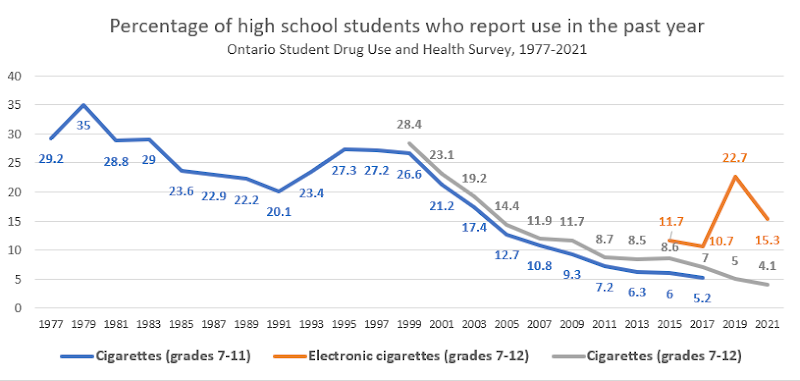
* The bi-annual Ontario Student Drug Use and Health Survey, for example, is the longest ongoing survey of school health. In 2021 it conducted its 4th survey of e-cigarette use, finding a similar trend to that observed in the U.S: a dramatic increase in 2019, with usage falling during the pandemic. 

* B.C. runs an adolescent health survey every five years, with the next cycle in 2023. 

* Results for Quebec's school based health survey addressing tobacco and vaping, among other drug behaviours, were last released for 2019, with another survey on more comprehensive health behaviours in the field this fall.

* Compass is a school-focused health research project led by researchers at the University of Waterloo which provides longitudinal insights into local behaviours. The annual survey provides data that are used to assess factors that contribute to reduced e-cigarette use (i.e. ineffectiveness of school programming, the impact of COVID, relationship to other health behaviours, etc.)

Other (non-school surveys of adolescent health behaviours)

Other efforts to measure vaping by young Canadians include the annual Canadian Tobacco and Nicotine Survey, which was launched in 2019. The most recent results of that survey were released by Statistics Canada last April. The results, shown below, suggest some stability in past-month vaping behaviour over the past three years, but with increased daily vaping (unpublished data show that 1 in 5 Canadians aged 15-24 who had ever tried a vaping device was vaping daily in the winter of 2021-2022). 

Since 2021, the Canadian Community Health Survey includes questions on e-cigarette use. These results have not been proactively released and are not known to have been reported (other than those from a rapid-release component of the survey taken in 2020). Electronic cigarette use is not included among the standard health indicators reported by Statistics Canada from this survey. 

The ITC Youth Tobacco and Vaping Survey conducts annual national surveys in Canada and also in the US and England. This survey asks about the types of vaping products used, allowing comparison of product choices between countries and over time.

Continuing challenges

The long periods between cycles of government surveys, the preference of university-based surveyors for disseminating results through journal publications, the absence of mandatory reporting on manufacturers and the complexities of studying youth behaviours make it challenging for Canadian  health regulators to keep their finger on the pulse of youth nicotine use -- let alone to respond in a timely way.

In the meantime, the data that are available suggests that vaping remains a serious and widespread problem. 

Many upstream measures to protect youth are either not yet in effect (eg tax increases that don't hit retail until January 2023), not yet approved (eg flavour restrictions) or not even on the agenda (eg banning youth-focussed disposable products). Tobacco and nicotine companies continue to experiment: and there is nothing in place to prevent the explosion of disposable vaping products that has driven  increases in youth vaping in the United Kingdom, the United States and elsewhere. 
Until then, this health issue will likely continue to be managed as a downstream policing issue -- with the burden shifted to school administrators and sales-to-minors enforcement officials.  

Tuesday, 30 August 2022

BAT's VUSE in Canada: more flavours and new nicotine strength bands

Screenshot of 45 flavours of
nicotine capsules
sold by BAT in Canada
(August 2022)
Earlier this spring, we reported on hardware and cosmetic changes to the VUSE vaping device sold by British American Tobacco/Imperial Tobacco Canada Ltd (BAT-ITL) was marketing its VUSE brand ePOD vaping device. Among these developments were the ability of consumers (and the company?) to monitor device use and location through internet connections, increased personalization of nicotine delivery and cosmetic elements and the expansion of flagship stores.

This post reports on the further evolution of the company's marketing activities: its continuously expanding flavour range and its introduction of strength bands for nicotine, similar to those in place for its cigarettes.

Background

BAT-ITL currently only sells the cartridge-based ePOD line of vaping devices in Canada. The ePOD device was introduced to Canada at the beginning of 2019 with 5 flavour offerings. In January 2020, the number of flavours offered had grown to 8, increasing to 22 flavours in January 2021 and 30 flavours in January 2022. This month (August 2022) there are more than 40 flavours available for nicotine liquids.

The ePod capsules were originally sold in Canada in 3 nicotine strengths (1.6%, 3% and 5%), but for a year after Health Canada imposed a ceiling on nicotine concentrations in 2021 only one strength (18 mg/ml, 1.6%) was available, in addition to nicotine-free. Today, as discussed below, three nicotine levels are available.

BAT does not sell the same vaping products in all markets, reflecting both regulatory and market differences, as seen in their offerings in its 5 largest vaping markets :  Canada, France, Germany, the UK and the  USA. 

BAT sells fewer devices in Canada. In the United Kingdom and France it also sells the eTank and ePen, and has recently introduced the disposable VUSE GO/PUFF. In the United States, BAT's subsidiary sells the ePOD under the name ALTO as well as three cigalike products (SOLO, CIRO and VIBE).

BAT sells more flavours in Canada. In France, ePod cartridges are sold in 19 flavours, in the United Kingdom, 20 flavours are available and in Germany there are 7 ePOD flavours sold. In the USA, the only flavours sold are tobacco-flavours (of which there are two) and menthol, which is in line with FDA signals that other flavours will not be permitted.

BAT sells higher nicotine in Canada than in Europe. In France and the UK, nicotine concentration is capped at 20 mg/ml as it is in Canada. In those countries, however, BAT offers some much lower nicotine strengths than it does in Canada (e.g. 3 mg/ml and  6 mg/ml) as well as offering 12 mg/ml and 18 mg/ml as it does in Canada and Germany. There is no maximum nicotine concentration in the USA, and the range of nicotine concentrations for ePOD-ALTO capsules include higher but not lower strengths than are sold in Canada (e.g. 18, 24 and 50 mg/ml).

The continuous expansion of flavours

This spring, BAT-ITL passed the '31 Flavour' threshold in Canada, now selling more flavours than leading ice-cream chains. As noted above, the number of flavours has doubled over the past 18 months, and sextupled since the year before. 

Most of the new flavours introduced this summer are in the flavour categories that Health Canada has indicated would be exempted from any flavouring restrictions:  tobacco-flavour and mint-menthol. They are also the flavours that are subject to fewer provincial flavour restrictions. 

Since May 2022, the number of mint-menthol flavours for ePOD capsules has grown from 6 to 13, and the number of tobacco flavours has grown from 7 to 13.


6 mint-flavoured ePOD liquids listed in May 2022: 

13 mint-flavoured ePOD liquids listed in August 2022:


This marketing strategy creates several concerns for public health authorities: 

Promoting flavours helps BAT introduce "new entrants" to nicotine. BAT has reported that the majority of people who use their vaping products are "new entrants", [1] by which they mean they are people who have not previously smoked or used other nicotine products. For these non-smokers, flavours do more than encourage trial, they also mask the bitterness of nicotine.

Continued taste tests help BAT turn experimenters into nicotine addicts. Researchers (including in Canada [2]) have established the brief trajectory from a first cigarette puff to medically-defined dependence. If, as we should expect, the milestones to addiction are similar for vaping products, BAT knows that it needs to encourage users to move beyond a first experimental puff to subsequent experiments and regular use. The strategy based on continued experimentation needs a continuous supply of "new" flavours. 

The focus on flavours interferes with awareness of risks. Directing attention to flavour 'notes' and 'intensity' serves to increase the importance of flavours to the user, and reinforce the pleasurable aspects of the vaping experience. This serves to downplay the inherent health risks of the product.

Flavourings increase the risks of vaping. In addition to their role in attracting new users and establishing addiction, flavourings also make vaping more dangerous by increasing the exposure of users to harmful chemicals and particulates. 

BAT's flavour promotions include the development of a lexicon to discuss flavour experiences. In addition to the the flavour card shown here, the company offers an interactive VUSE IQ on line and in its stores to guide flavour selections.

Nicotine strength bands that echo cigarette marketing

This summer, the company began marketing their e-liquids in Canada in three bands of nicotine strength, in addition to nicotine-free. The salted 1.6% formulation is now labelled "balanced", against which "mellow" and "bold" strength versions are compared.

* BOLD liquids (also sold as V-ULTRA) are made with slightly more nicotine (20 mg/ml instead of 18 mg/ml), and use free-base nicotine which has a stronger throat impact and is less easy to inhale [3]. BAT uses blog posts, social media and direct mail to promote this as "a bold nicotine experience and an intense sensorial kick."

* MELLOW liquids have one-third less salted nicotine than balanced (12 mg/ml or 1.1%). Web promotions, social media and direct mail promote this as "a Mel-low nicotine experience" - "high on flavour, low on nicotine".

This strategy echoes the presentation of BAT cigarettes, such as John Player, as 'mellow', 'smooth', 'rich' and 'bold'. Although the company maintains these descriptors relate to taste, and not nicotine strength, they originate in the era when 'light'/'mellow' cigarettes were promoted as being less harmful or addictive.

Coming soon to Canada? BAT's VUSE disposables:


This summer BAT told investors that the sale of its disposable vape, Vuse GO "will be scaled-up and rolled out into a number of new markets."  [4] 

The launch date in Canada has not yet been made public, although the way has been paved with the registration of several trademarks. (2172906, 2172945, 2181154, 2181167, 2174079, 2172918. 

Canada's second-largest tobacco company launched its disposable VEEBA earlier this summer: BAT's introduction may not be too far away. 
 

Implications for regulators

BAT's marketing strategy may be flying below the public health radar. 

This year BAT has launched new vaping retail outlets, has started connecting vaping devices to monitoring systems, has added jewelry and other cosmetic features to its vaping devices and has greatly expanded the range of flavours and marketing techniques to promote them. Each of these measures appears designed to increase the use of vaping products for pleasure (not cessation). 

None of their actions this year has elicited a response from any of Canada's 14 health regulators. No government has disclosed any system in place to monitor these market changes.  (The regulations proposed by Health Canada this summer do not include any requirements to report on promotional activities.)  Unlike most other countries, there are no requirements for BAT to notify Canadian health authorities before selling vaping liquids and devices, allowing it to use Canada as a proving ground for its global brands.

Proposals to restrict flavourings, currently under review in Canada and elsewhere,  are largely based on research that treats "tobacco flavour" and "menthol flavour" as two flavourings and not two flavour ranges encompassing dozens of flavours. BAT's launch of 26 flavours in these two categories suggests that it is poised to blunt the impact of federal restrictions originally considered to restrict the number of flavourings.
References

[1] BAT Capital Markets Day 2019. Step-Changing New Categories. A very significant growth opportunity. https://www.bat.com/group/sites/UK__9ZTFCM.nsf/vwPagesWebLive/DOBA7JRL/$FILE/Step-Changing_New_Categories_-_A_very_significant_growth_opportunity.pdf?openelement

[2] André Gervais, Jennifer O’Loughlin, Garbis Meshefedjian, Christina Bancej, Michèle Tremblay
Milestones in the natural course of onset of cigarette use among adolescents. CMAJ • August 1, 2006

[3] SohaTalih, Rola Salman, Rachel El‑Hage, Nareg Karaoghlanian, Ahmad El‑Hellani, Najat Saliba and Alan Shihadeh. Effect of free‑base and protonated nicotine on nicotine yield from electronic cigarettes with varying power and liquid vehicle. Nature. (2020) 10:16263

[4] BAT. News Release. Half-Year Report to 30 June 2022.  27 July 2022. https://www.bat.com/group/sites/UK__9D9KCY.nsf/vwPagesWebLive/DOCGKBGW


Friday, 12 August 2022

Update on e-liquid flavour restrictions

Almost 14 months have passed since Health Canada published draft regulations to restrict the flavourings and chemicals that could be used by e-liquid manufacturers. in vaping liquids. This post reports on developments in Canada and elsewhere that are related to restricting e-cigarette flavours. Links to more information are provided at the end of the post.

Lots of noise from the vaping industry

The proposal to limit e-cigarette manufacturers to two flavour categories (tobacco and mint/menthol) was met with significant opposition, much of it managed through campaigns funded by the nicotine industry. 

These campaigns have included street level demonstrations in several Canadian cities, write-in campaigns, and dozens of meetings with elected officials. (Image below shows officially registered lobbying activities since October 2021).

House of Commons Seating Plan
(check mark indicates registered communication on vaping issues since October 2021) 


But mostly silence from Canada's federal government. 

It is difficult to speak with confidence about the future of these regulations, or the likelihood that they will become law in Canada in the near future.

Interpreting the pause in moving them forward is made more difficult by the many factors that may be influencing the process. These include the disruption to the decision-making process that naturally flowed from the federal election held in late September 2021. Although it returned the same party to power, the election nonetheless served to reboot the government process, interrupting progress on many files. It also triggered changes to some of the key decision-makers: a new minister was assigned to tobacco and vaping issues, which also let to a new team of political advisors on the file. 

The election and its aftermath resulted in an evolution of government priorities. Those for the new Parliament were outlined in general terms in a Throne Speech and in more specific detail in the new mandate letters issued to cabinet ministers. Neither of these made any reference to vaping regulations. Nor was there a firm commitment to complete the regulation in the nuanced response of the government party to the election questionnaire circulated by the Heart and Stroke Foundation.

At a political level, the past year has been marked by silence on the topic. No ministerial Tweets. No speeches. No Parliamentary questions, answers or statements.The sole official mention to date is in the background information to a June 2022 news release, which noted that the department is still "reviewing feedback" on the flavour restriction proposal. 

At the departmental level, planning documents suggest some wiggle-room was sought on this file. This year's Departmental Plan, noted that there would be "ongoing work" on the regulations, but did not use the term "finalizing" as it did for some other regulations. Intention to regulate was also identified in the Forward Regulatory Plan published by the department in February but unlike other regulatory proposals, this one included no timeframe for the next step.

Forward movement in some jurisdictions ...

In the year that Ottawa has been  'reviewing feedback', other jurisdictions have moved forward to ban the sale of flavoured e-liquids.

Two more Canadian jurisdictions implement flavour bans

One more province and one more territory have implemented bans on e-liquid flavourings other than tobacco. New Brunswick's restrictions came into force on September 1, 2021 and the Northwest Territories on March 25, 2022. Together with the three other jurisdictions which have adopted this measure (Nova Scotia, April 2020; Prince Edward Island, March 1, 2021, Nunavut, TBD), 5 of 13 provincial or territorial governments  have adopted this policy. 

Two more European countries implement flavour bans

A year ago, only 3 European countries had banned flavourings: two banning all but tobacco (Finland, 2016; Hungary 2020), and one also permitting menthol (Estonia, 2019). Today, flavourings are prohibited in two more countries: on April 1, Denmark implemented its ban on all flavours other than tobacco and menthol and Lithuania's ban on all flavours but tobacco came into force on July 1, 2022.

Two additional European countries have set implementation dates for regulations: the Netherlands proposes to ban flavours as of January 2023, and last December the Ukraine passed a law to implement a flavour ban in July 2023. 

The world's two largest vaping markets clamp down on flavours

A year ago there was little indication that China was intending to clamp down on the e-cigarette market. In a sweeping set of reforms, that country has now imposed controls on this market which include a prohibition on all flavours other than tobacco flavour. These measures will come into force on October 1. 

The United States Food and Drug Authority became responsible for regulating e-cigarettes in 2016, and was required by U.S. law to determine whether the marketing of each individual product was 'appropriate for the protection of public health'. Last August, the FDA began to exert this authority, ordering 55,000 products removed from store shelves. To date, more than 250 manufacturers have been issued marketing denial orders (The FDA's list can be downloaded here). Some flavoured products remain on the market, however, as legal challenges to the FDA's decisions are being reviewed by courts.

Of those products that have received  marketing authorization from the FDA, the only flavour permitted has been tobacco-flavour. The FDA has deferred decisions on menthol-flavourings, but for products on which decisions have been made, no other flavours have received market authorization. The FDA recently explained its rationale: "For flavored ENDS (i.e., ENDS with e-liquid flavors other than tobacco or menthol, such as fruit), there is a known and substantial risk of youth initiation and use; accordingly, an applicant has a higher burden to establish that the likely benefits to adult smokers outweigh that risk. For tobacco-flavored ENDS the risk to youth is lower; accordingly, a lesser showing of benefit may suffice. Assessments for menthol flavored ENDS will be addressed separately. When it comes to evaluating the risks and benefits of a marketing authorization, the assessment for menthol ENDS, as compared to other flavored ENDS, raises unique considerations."

Two more legislatures call on governments to ban flavours

This June, the Joint Committee on Health of Ireland's Oireachtais recommended that the government's proposed Tobacco and Nicotine Inhaling Products bill should be amended to ban flavours: "The Bill should regulate the flavouring of e-cigarettes and all flavours except for tobacco, should be strictly prohibited so as not to entice minors."

In May, Hawaii's State Legislature passed legislation (HB1570) to ban all e-cigarette flavours. This would have made Hawaii the fifth U.S. state to do so (after New York, New Jersey, Massachusetts and Rhode Island), had not the bill been vetoed by the governor in mid-July.

... Backwards movement in others

Over the past year three legislatures have rejected or overturned proposals from health authorities to limit or ban the use of flavourings in e-cigarettes.

In March, the Swedish government introduced legislation ("Stricter rules for new nicotine products") but the section which would have banned all flavours but tobacco was removed from the law during the review by the committee. The bill passed in June without this section. 

The Icelandic legislative committee similarly removed language from the government's proposal for regulatory authority to ban flavourings and the bill was passed in June without this authority.

The Philippines Congress passed a law which overturned a previous ban on e-cigarette flavourings (and also remove other restrictions on the market, including a prohibition on selling to those under 21). The ban on flavourings in the Philippines was in effect from May, when the former law came into effect, until July, when the new law came into force.

More than half world's citizens live in countries whose health authorities do not approve the sale of flavoured e-cigarettes.

The regulatory decisions by the Chinese government and the administrative actions of the U.S. Food and Drug Authority increases the proportion of the global population which lives in countries where flavoured e-cigarettes are not authorized for sale to over 20%. In addition, approximately 40% of the global population lives in countries where e-cigarettes cannot be sold at all as consumer products.


More health agencies call for flavor bans

In all the jurisdictions where e-cigarettes are permitted for sale and where flavour bans has been formally discussed, major health organizations have taken the position that flavourings should restricted. 

In Canada, those in favour of a ban on flavoured e-liquids include: The Association of Local Public Health Agencies (alPHa), Association of Quebec Cardiologists, Association des chirurgiens-dentistes du Québec, Association des intervenants en dépendance du Québec, Association des pédiatres du Québec, Association des pneumologues de la province de Québec, Association pulmonaire du Québec, the Canadian Cancer Society, the Canadian Council of Chief Medical Officers of Health, the Canadian Dental Hygienists Association, the Canadian Lung Association, the Canadian Thoracic Society, the Canadian Medical Association, the Canadian Paediatric Society, Conseil Québécois sur le tabac et la santé, Direction de Santé Publique de la Gaspésie et des ÃŽles de la Madeleine, Heart and Stroke, the Institut national de santé publique du Québec, Middlesex-London Health Unit, New Brunswick Medical Association, Physicians for a Smoke-Free Canada, the Registered Nurses Association of Ontario, Toronto Public Health. 

In the United States, virtually all of the major American health organizations have called for a ban on all flavours but tobacco. These include the American Academy of Family Physicians, the American Academy of Pediatrics, the American Cancer Society, the American Heart Association, the American Lung Association, the American Medical Association, Campaign for Tobacco-Free Kids, CHEST (formerly American College of Chest Physicians), Truth Initiative. 

International health organizations which have called for flavour bans include the Forum of International Respiratory Societies and World Heart Federation, and Cancer Societies and Heart Foundations in several European countries.

Monday, 8 August 2022

ICYMI: selected TC research published in July 2022

This post identifies selected articles and books published in July 2022 that should be of interest to the tobacco regulator and which are available to the general public.

Books:

In Quit Smoking Weapons of Mass Distraction, emeritus professor of Public Health Simon Chapman draws on his decades of experience as a researcher and advocate in tobacco control to offer advice on where our attention should - and should not - be focused. This free e-book offers his analysis of the way in which promotion of assisted quitting has been a distraction from more powerful options for reducing smoking. 

His Australian colleague, Mike Daube recommends: “This is a splendid read for anyone interested in what really works to reduce smoking, and what helps to keep Big Tobacco in business. In Simon Chapman’s typically trenchant style, it tells you everything you want to know (and some people won’t want to know) about the myths and realities of smoking cessation and other aspects of tobacco policy. All this alongside lessons learned from a lifetime’s work on tobacco. Top class – don’t miss it.”

Quit Smoking Weapons of Mass Distraction
Simon Chapman
Sydney University Press, July 2022

---------------------

Oxford University Press published "Policy Success in Canada", an open-access collection of 22 case-studies where Canadian governments and communities have successfully addressed public concerns through policy change. The editorial team that collected these studies was led by Dr. Evert Lindquist of the University of Victoria. The chapter on Canada's Long March Against Tobacco traces events over the past 100 years -- from the first failed attempts to legislate tobacco in the early 1900 to the more recent successes and challenges. 

Policy Success in Canada Cases, Lessons, Challenges
Edited by Evert Lindquist, Michael Howlett, Grace Skogstad, Geneviève Tellier, and Paul t' Hart. 
Oxford University Press (July 30 2022)

---------------------

Articles

Cessation

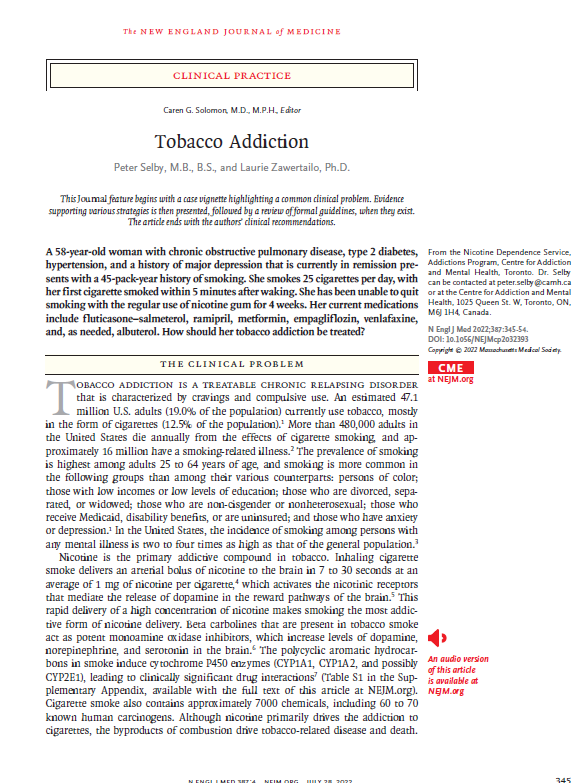
The article on "Tobacco Addiction" written by Dr. Selby and Dr. Zawertailo and published in the New England Journal of Medicine was profiled in a separate post. This review updates advice to physicians to support quit attempts. Accessing the article is free, but requires registration.

Selby, P and Zawertailo, L. Tobacco Addiction
N Engl J Med 2022; 387:345-354

---------------------

The real-life experience of 1,045 English smokers who attempted to quit smoking between 2015 and 2020 was reviewed by a research team lead by Sarah Jackson and the results were published in Real-world effectiveness of smoking cessation aids: A population survey in England with 12-month follow-up. The self-reported success of those who used quitting aids was assessed against that of the 40% who quit on their own. Those who reported using varenicline were more than twice as likely to have quit, but there was no difference for those who used e-cigarettes, prescription NRT, over-the-counter NRT or traditional behavioural support.

Jackson SE, Kock L, Kotz D, Brown J. Real-world effectiveness of smoking cessation aids: A population survey in England with 12-month follow-up, 2015-2020. Addict Behav. 2022 Jul 25;135:107442. doi: 10.1016/j.addbeh.2022.107442. 

---------------------

Smoking and vaping behaviours

Tobacco and cannabis.  Among the many articles published this summer by the ITC consortium was one which suggests that 3 in 10 Canadian daily smokers are regular users of cannabis. Shanon Gravely is lead author on the study which found that smokers who use cannabis more than once a week are also "more likely to be younger, have lower income, be experiencing financial stress ...have depressive symptoms, use alcohol more frequently and binge drink, use other tobacco/nicotine products, and perceive smoking cannabis as low health risk and less harmful than smoking cigarettes."

Gravely S, Driezen P, McClure EA, Hammond D, Michael Cummings K, Chan G, Hyland A, Borland R, East KA, Fong GT, Schauer GL, Quah ACK, Ouimet J, Smith DM. Differences between adults who smoke cigarettes daily and do and do not co-use cannabis: Findings from the 2020 ITC four country smoking and vaping survey. Addict Behav. 2022 Jul 21;135:107434. doi: 10.1016/j.addbeh.2022.107434. 

Gravely et al. 

---------------------

Tobacco and vaping among adolescents. Data from the longitudinal COMPASS survey were used to explore whether the involvement of public health agencies in school-based programming was associated with differences in substance use in those schools. Trish Burnett was the lead author on this report which found that overall there was no difference in smoking and vaping among schools where local health units were involved and those where they weren't, but that some differences were seen in schools with higher or lower rates of use.  

Burnett T, Battista K, Butt M, Sherifali D, Leatherdale ST, Dobbins M. The association between public health engagement in school-based substance use prevention programs and student alcohol, cannabis, e-cigarette and cigarette use. Can J Public Health. 2022 Jul 21:1–10. doi: 10.17269/s41997-022-00655-3. 

---------------------

Vaping among adolescents.
Analysts working at Statistics Canada compiled data from three surveys to identify the circumstances associated with higher rates of e-cigarette use. Michelle Rotermann and her colleague identified social (having friends who vaped), behavioural (having used alcohol, cannabis or tobacco and having worked, school performance), family (having parents who did not know where they were) and demographic (being male and Canadian-born) factors were associated with higher rates of vaping. The study also found that among teenagers who both smoked and vaped, e-cigarettes came first for two-thirds.

Rotermann M, Gilmour H. Correlates of vaping among adolescents in Canada. Health Rep. 2022 Jul 20;33(7):24-35. doi: 10.25318/82-003-x202200700003-eng. PMID: 35862070.

---------------------

Health effects of tobacco use or vaping 

Health effects of tobacco. The Global Burden of Disease project published a review of the burden of chronic obstructive pulmonary disease (COPD), noting that nearly half of smokers world-wide develop COPD. Of the 3.3 million deaths from COPD world-wide in 2019, there were 8,312 in Canada. The data linked to this paper shows that while deaths from tobacco-caused cardiovascular disease have fallen in Canada since 1990, this has not been the case for COPD or cancers.  (Data is available for non-commercial use upon registration)

Safiri S, Carson-Chahhoud K, Noori M, Nejadghaderi SA, Sullman MJM, Ahmadian Heris J, Ansarin K, Mansournia MA, Collins GS, Kolahi AA, Kaufman JS. Burden of chronic obstructive pulmonary disease and its attributable risk factors in 204 countries and territories, 1990-2019: results from the Global Burden of Disease Study 2019. BMJ. 2022 Jul 27;378:e069679. doi: 10.1136/bmj-2021-069679. PMID: 35896191.


IMHE: Global Burden of Disease Study data

---------------------

Health effects of e-cigarettes. Another review of the health effects of e-cigarettes was published, this one focusing on the differing methodologies used by researchers working in this area. With lead author Nargiz Travis, this research team found that many of the studies did not satisfy AMSTAR-2 criteria. Nonetheless, the report  found "that short-term use of e-cigarettes may be associated with acute cardiopulmonary risks, although to a lesser extent than cigarette use. Long-term e-cigarette use may have pulmonary/respiratory benefits in those who switch from chronic cigarette smoking, particularly in individuals with asthma and chronic obstructive pulmonary disease (COPD). Evidence on intermediate and long-term carcinogenic effects is lacking." The authors recommended more consistency of reporting and more research on newer devices.

Travis N, Knoll M, Cadham CJ, Cook S, Warner KE, Fleischer NL, Douglas CE, Sánchez-Romero LM, Mistry R, Meza R, Hirschtick JL, Levy DT. Health Effects of Electronic Cigarettes: An Umbrella Review and Methodological Considerations. Int J Environ Res Public Health. 2022 Jul 25;19(15):9054. doi: 10.3390/ijerph19159054. PMID: 35897421; PMCID: PMC9330875.

Travis et al, 2022

---------------------

Tuesday, 2 August 2022

Updated advice to physicians on how to treat tobacco addiction.

For decades now, smokers have been encouraged to "ask their doctors" for help in quitting smoking. And for almost as long, doctors have been encouraged to "ask, advise, assist" their patients who smoke to take steps towards quitting.

But what advice should doctors give? And has that advice changed in response to the marketing of e-cigarettes?

This post reports on the evolving advice given to Canadian physicians.

Can-Adaptt and beyond ... 

A decade ago, Health Canada funded the development of guidelines through CAN-ADAPTT. These guidelines, published in 2012, were coordinated through the Center for Addictions and Mental Health, and lead by Dr. Peter Selby, and remain available in a variety of user-friendly forms, and provide advice for specific populations.

A decade on, a review and update of these guidelines would be expected. One of the groups that is working on an update is the Canadian Task Force on Preventive Health Care (formerly known as the Canadian Task Force on Periodic Health Examination). This body was created by the federal government and currently operates with the support of the Public Health Agency of Canada. `

For the past 5 years, this task force has been reviewing guidelines for treating Tobacco Smoking in Adults, and 4 years have passed since it  published the protocol for its evidence review. It was anticipated that this review would be done in two stages: the first on existing stop smoking interventions, and the "second stage will involve updating a systematic review on electronic cigarettes." The finalization of this review has been delayed, and is now slated for "2022/2023". 

Meanwhile, Dr. Selby and his CAMH colleague Dr. Zawertailo produced an independent review of the evidence and update of advice to practitioners. 

Last week their results were published in an article "Tobacco Addiction" published last week in the New England Journal of Medicine (access is free, but requires registration). Their review focuses on the effectiveness of well-known therapies (counselling, nicotine replacement, verenicline and burpoprion), while also touching on "second-line" agents like nortriptyline, clonidine or more recently-tested drugs like psilocybin.

The evolution of advice on the effectiveness of vaping to quit.  

This is the first scientific reviews by a leading Canadian expert in smoking cessation since e-cigarettes have been legalized for sale in Canada. 

It is the first published Canadian review since 2018, when Health Canada began to gently encourage smokers to see e-cigarettes as "linked to improved rates of success" in quitting. (Concerns were raised about this advice in the departmental evaluation of the program, and there are plans to update the web-site by the end of this month). 

Practitioners and smokers in Canada continue to get equivocal advice on whether or not e-cigarettes are helpful in quitting. CAMH, for example, counsels that "using e-cigarettes is NOT a proven strategy to help you quit smoking." On the other hand, the Lower-Risk Nicotine Use Guidelines (which were developed with CAMH) recommend that "E-cigarettes with nicotine may be an effective cessation aid for people who use combustible tobacco."

In the NEJM review, Drs. Selby and Zawertailo were unequivocal in their conclusions on this point: "We would recommend against the use of e-cigarettes for smoking cessation given insufficient evidence to support their use." Instead, they recommend that physicians support their patients' quitting attempts by using prescription medications as a first-line treatment, either alone or in combination with  NRT. They recommend that these quit attempts also be supported by counselling and follow-up. 

These conclusions are in line with those published last year by the US Preventive Services Task Force, and the previous year by the U.S. Surgeon General (2020),

Changing products force greater uncertainty

Drs. Selby and Zawertailo identify the "areas of uncertainty" that have cast doubt on previous research findings on e-cigarettes. While there has been "moderate-certainty evidence that nicotine e-cigarettes are more effective than nicotine-replacement therapy" .. the  "trials [which] have involved e-cigarettes that are no longer on the market, and study of newer e-cigarette types (e.g., nicotine salt-pod devices) is warranted."

The same issues were discussed in greater length during a  review conducted for the Australian government and published this spring. This review explained why the results of a few clinical trials with older products do not provide relevant evidence for the use of much-changed devices and liquids.

  • There is limited evidence that, in the clinical context, freebase nicotine e-cigarettes may be more efficacious for smoking cessation than existing NRT, and that nicotine e-cigarettes may be more efficacious than no intervention or usual care. 
  • Trials demonstrating efficacy were limited to products with freebase nicotine concentrations ≤20mg/mL. There is no evidence that nicotine salt products are efficacious for smoking cessation. 
  • There is insufficient evidence that freebase nicotine e-cigarettes are efficacious for smoking cessation, compared to non-nicotine e-cigarettes or that non-nicotine e-cigarettes are efficacious for smoking cessation compared to counselling or approved NRT. 
  • There is insufficient evidence that freebase nicotine e-cigarettes are efficacious outside the clinical setting. 
  • No evidence on nicotine salt products was located and their efficacy for smoking cessation is unknown. 
  • There is limited evidence that use of nicotine e-cigarettes for smoking cessation results in greater ongoing exposure to nicotine than approved NRT, through ongoing exclusive e-cigarette use or dual use if smoking continues

Wednesday, 20 July 2022

Canada's great cigarette recall

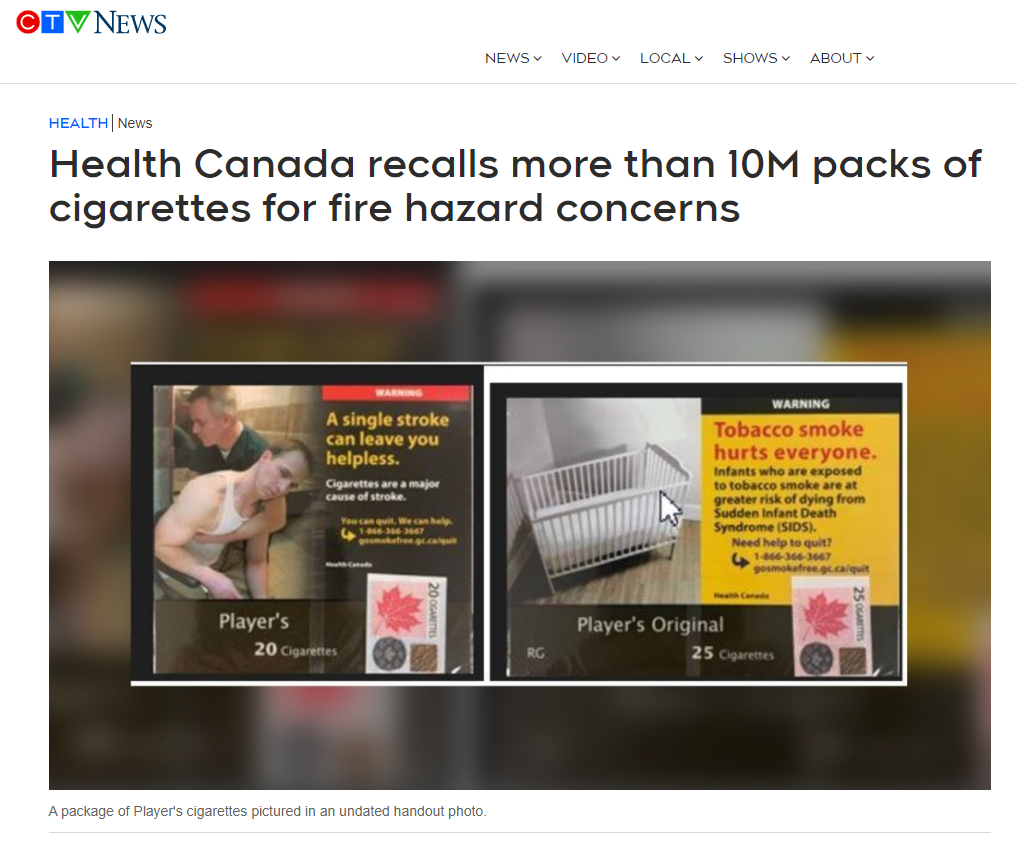
For the third time this year, Health Canada has required British American Tobacco to recall some of the cigarette brands it sells in Canada through its subsidiary Imperial Tobacco Canada. On May 19th, June 6th and July 18th,  the department advised consumers that the cigarette brands in question "do not meet the performance standards required by the Cigarette Ignition Propensity (Consumer Products) Regulations under the Canada Consumer Product Safety Act" and therefore pose an increased fire hazard.

Consumers were given advice on how to protect themselves from this manufacturing defect: "Consumers should immediately stop using the recalled products and contact the distributor, Imperial Tobacco Canada Limited, to return the product for a replacement product."

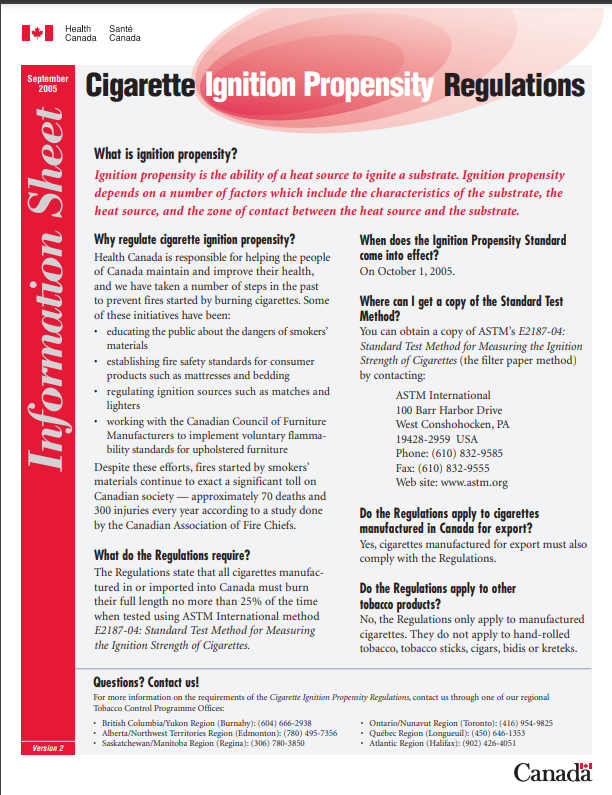
This post provides some background on the fire-safety regulations that led to this recall.


The problem: Cigarette-caused fires are the leading cause of residential fire deaths

For more than a century, smoking materials have been a major cause of home fires. Although the deaths and injuries caused in this way are much less than the impact on deaths from disease, they are large enough to be identified as a major concern for fire officials 

Statistics Canada recently reported that about 200 Canadians die each year in residential fires. The leading identified cause of those residential fires is smoking materials (cigarettes): one fifth of all residential fire deaths, and two-fifths of those where the cause is known.

These fires are thought to typically start when a smoker falls asleep or otherwise leaves a cigarette unattended and in contact with flammable material. Because many smokers are annoyed if they have to re-light their cigarettes, manufacturers traditionally used papers and packing techniques that ensured that the cigarettes would burn completely even when not being smoked. This increased the likelihood that a cigarette dropped by a smoker would smoulder long enough to ignite the material onto which it had been dropped.

The proposed solution: self-extinguishing cigarettes.

Proposals to require manufacturers to make their cigarettes self-extinguish if left unattended were presented to U.S. legislators in the early 1970s, but it took almost three decades before any government agreed to it. In 2000, New York State was the first jurisdiction to regulate fire safety standards, which came into effect in June 2004. In 2001, private members' legislation aiming to require the Canadian government to pass such a standard was introduced to the House of Commons by John McKay (C-260, An Act to Amend the Hazardous Products Act, Fire Safe Cigarettes). 

Over the following three years, John McKay's proposal gained the support of the House and Senate and in 2004 it received Royal Assent. Health Canada duly established regulations the following year, replacing the term 'fire safe' with 'reduced ignition potential'. Initially the regulation was connected with the Tobacco Act, but following a subsequent review by a Parliamentary committee, it was  transferred to Consumer Product Safety Act in 2016, where it remains.

The standard adopted by the regulations is set by the ASTM ( ASTM E2187). The Canadian requirement is not that all cigarettes that are tested by this method self-extinguish before the entire rod burns, but that no more than one-quarter (25%) of them do. 

Following New York State and Canada, a number of other countries similarly adopted similar requirements. In 2014, the World Health Organization reported that "all 50 US states, Australia, Canada, Iceland, South Africa, and all 28 European Union Member States have adopted policies requiring RIP cigarettes. These countries represent approximately 20% of the world’s population, consuming approximately 20% of the world manufactured cigarettes and on the whole are mostly large high income nations."

Initially, Imperial Tobacco met the test

During a review by WHO's advisors on tobacco regulation, data from Canada showed that cigarettes manufactured by Imperial Tobacco consistently met the standard:  fewer than 1 in 10 failed the test. By comparison, cigarettes manufactured by other companies (of which there are very few on the market, and most of which were likely made by Grand River Enterprises), initially failed the test but over time met the standard. 


The results of Health Canada's compliance tests conducted before responsibility for the regulation was transferred to the Consumer Product Safety Branch in 2016 remain available on Health Canada's website. These show that all of the brands manufactured by Imperial Tobacco during this period passed the test. Other products that failed to pass the test (including those manufactured by Lanwest, Dynasty and Grand River) were not subject to recall as this system was not in place at the time.  

Are Imperial Tobacco's production woes the reason for the test failures? 

Under the new administration of the regulations, Health Canada does not appear to report the results of its compliance tests, but it is authorized to require a recall of products that do not meet the standard. 

Imperial Tobacco has not made a public statement about the recall (not even on its Twitter feed). The company did,  however, reveal a potential reason for the change in a filing submitted to the Ontario Court that is managing its insolvency proceedings. (All of the Canadian tobacco companies have received court protection from their creditors, arguing that current and future court-ordered damage awards make them insolvent).

Last September, Imperial reported to the court that the pandemic had caused supply problems in their Mexico factories, and that it had shifted manufacture to South America. "production of cigarettes for sale in Canada commenced in Brazil and Chile in May 2020." These factories generally make cigarettes for countries where reduced ignition propensity regulations are not in force.

The consequences 

Despite the potential for irony in governments encouraging consumers to ask tobacco companies to replace faulty cigarettes with ones that are no less harmful to smoke, there are reasons to welcome the transparent disclosure of the ignition test results. 

The effect of the recall is a little more than a slap on the wrist. In addition to the bad publicity, once these products are recalled the manufacturers and retailers have to remove them from the shelves. This inconvenience may be costly, and a deterrent to future infractions.

But there is another shoe that Health Canada could drop. The Consumer Product Safety Act also provides for hefty fines for companies which break the law or its regulations -- including prison terms. If the wrongdoing was made by the corporation, and not an individual acting independently, directors and officers can also be penalized. 

If, as it turns out, the company was aware that its new production facilities were not capable of producing cigarettes that met the Canada standards, a greater penalty may be justified.