Tuesday, 22 November 2022

The updated Cochrane review of e-cigarettes -- and what it should mean for Canada.

Last week, the UK based health charity, Cochrane, released its sixth report on the evidence on the use of e-cigarettes for smoking cessation. 

This post reflects on how this and other Cochrane conclusions could serve Canadian efforts to reduce smoking at the population and individual levels. In brief:
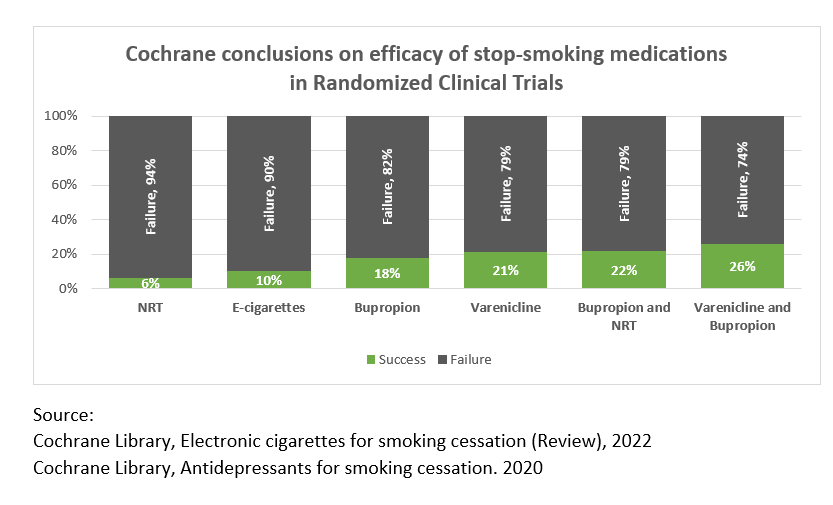
  • Cochrane establishes that in clinical trials, E-cigarettes fail 10 times more often than they succeed (roughly the same as NRT). Other reviews have shown that in real life they are even less successful.
  • The products used in the studies reviewed by Cochrane are different than those on the market in Canada. The U.S. Surgeon General recommends that because of the wide variation in products and usage it is not prudent to draw generalized conclusions about their efficacy as stop-smoking medications
  • Cochrane reviews show that other stop-smoking medications do better in clinical trials. (The ones that, unlike e-cigarettes, have been assessed and authorized on the basis of their safety, efficacy and quality.)
  • Any advice to a smoker to use e-cigarettes to quit smoking (or to reduce the harms from continued nicotine use) should be tailored to individual circumstances and be individually delivered in a therapeutic context. Population-level encouragements for smokers to use e-cigarettes are imprudent. To date these have back-fired in Canada, resulting in more new nicotine addicts than former smokers. 

Next version, much the same as the first...

The Cochrane review on e-cigarettes that was published last week has the same central messages as the versions published in September 2021, the one published in April 2021, and the one published in October 2020. A major difference with earlier versions is the number of studies they accepted for their analysis: three that compared NRT to e-cigarettes were included in 2020, four in 2021 and six this year.

This study was released with considerable fanfare and extensive public relations efforts. Cochrane publishes several reports on tobacco issues (described at the end of this post) - few seem to get the same PR effort. 

The press releases that accompanied the release of the report were clearly designed to encourage e-cigarette use by smokers. The lead author's statement suggested  that e-cigarettes were a highly effective stop smoking medication: "For the first time, this has given us high-certainty evidence that e-cigarettes are even more effective at helping people to quit smoking than traditional nicotine replacement therapies, like patches or gums."

Another PR effort was a linked and coordinated release sent by other British enthusiasts. Professor John Britton was one endorser, and unequivocally presented e-cigarettes as a panacea for smoking cessation: "All smokers should therefore try vaping as a means to end their dependency on smoking tobacco."   (The release made no mention that Dr. Britton has been engaged by  Canadian commercial vaping interests to oppose flavour restrictions in New Brunswick. )

There are many reasons to disagree with these views.

Cochrane has confirmed that in clinical trials, e-cigarettes are NOT very effective at helping smokers quit.

The reviewers memorably present their conclusions in a plain language summary: "For every 100 people using nicotine e‐cigarettes to stop smoking, 9 to 14 might successfully stop, compared with only 6 of 100 people using nicotine‐replacement therapy, 7 of 100 using e‐cigarettes without nicotine, or 4 of 100 people having no support or behavioural support only."

Rather than confirm the superiority of e-cigarettes, these numbers confirm the inadequacy of both vaping products and NRT - even under the best of supervised therapeutic circumstances. 

The Cochrane report on e-cigarettes concluded in effect that 90 of 100 smokers who use e-cigarettes to quit smoking will be smoking again within 6 months, compared with 94 failures for every 100 who use NRT. 

The relative risk for success between E-cigarettes and NRT is 1.63 (10 vs 6 successes per 100 tries). The relative risk for failure between NRT and E-cigarettes is 1.04 (94 vs 90 failures per 100 tries) 

(Simon Chapman provides a good discussion of the high rate of failure in his blog "Would you take a drug that failed with 90% of users? New Cochrane data on vaping “success”)

Cochrane has confirmed that in clinical trials, other stop-smoking medications available in Canada do better than e-cigarettes.

Other Cochrane reviews have assessed the effectiveness of pharmacotherapies for smoking cessation. These include the stop-smoking medications that have been approved by Health Canada following a review of their safety, efficacy and quality. (The safety, efficacy and quality of e-cigarettes is not examined by Health Canada before they are permitted for sale).

Among these medications are prescription medications Varenicline and Bupropion. These drugs do not replace nicotine from tobacco, but instead help the smoker end nicotine addiction by altering the brain's response to it. Varenicline reduces nicotine withdrawal symptoms and diminishes the rewarding effects of cigarettes. Through a different mechanism, Bupropion also decreases nicotine withdrawal symptoms and may diminish the rewarding effects of cigarettes. Other over-the-counter stop-smoking medications authorized for sale  include the natural health product Cytisine and the prescription anti-depressant Nortriptyline.

A 2020 review by Cochrane looked at the effectiveness of some pharmacotherapies, using similar analytic methods to thsoe used in the review on e-cigarettes. This review pharmacotherapies concluded that for every 100 people who tried to quit smoking:

  • 17 to 20 were successful at quitting for at least 6 months if they used Bupropion alone (80 to 83 failed). 
  • 17 to 28 were successful if they used Bupropion and NRT (72 to 83 failed). 
  • 21 were successful if they used Varenicline alone (79 failed). 
  • 20 to 33 were successful if they used Varenicline and Bupropion (67 to 80 failed).


Randomized Clinical Trials are designed for therapeutic medication and are not the right yardstick to assess consumer product use.

In developing its assessment of the effectiveness of e-cigarettes as cessation devices, the Cochrane reviewers considered only clinical trials that used randomized control trials (RCT). This may be the gold standard for assessing medications before granting licensing approval, but it does not reflect the reality of most smokers' quit attempts. 

In RCT's, smokers are engaged and participating in a therapeutic cessation attempt, often using a specified e-cigarette product. In the real world, most try to quit without any external structure or support and use a variety of products. 


This Cochrane review is out of step with other scientific assessments of the usefulness of e-cigarettes as quitting aids.

The Cochrane reviewers are only one of several research groups conducting systematic reviews of e-cigarettes efficacy for smoking cessation. Even among reviews that, like Cochrane, considered only Randomized Control Trials, other scientists have concluded that even on the narrow question of whether e-cigarettes are superior to NRTs, the evidence is not there. 

Reviewers of RCT's on e-cigarettes who came to different conclusions include:

  • An Australian review of RCT's found limited evidence that in the clinical setting freebase nicotine e-cigarettes are efficacious as an aid to smoking, and that they double the likelihood of relapse to resuming smoking, strong evidence that e-cigarettes increase combustible smoking uptake in non-smokers, and insufficient evidence that nicotine e-cigarettes are efficacious outside the clinical setting. (Banks et al, 2022)
  • An Irish review of RCT's found "no clear evidence of a difference of effect" between e-cigarettes and NRT. (Quigley et al. 2021)
  • A review for the US Preventive Services Task Force found "inconsistent" results in RCT's and did not conclude that e-cigarettes were effective as a therapeutic product for smoking cessation. (Patnode et al, 2021)
  • The U.S. Surgeon General found that there was too much variation in the products sold and the way they were used to make generalizations about whether or not they were effective for smoking cessation. (U.S. Surgeon General, 2020).
Reviewers who considered both RCTs and longitudinal or observational studies have found no benefit to quitting with e-cigarettes.
  • Swedish review of RCT's and longitudinal studies found no net benefit to the use of e-cigarettes for quitting smoking was found. (Hedman et al, 2021)
  • American researchers looking at RCT's and observational studies found that although e-cigarettes were found to be effective when used as therapeutic interventions in clinical settings, this was not the case when they were sold as consumer products in the general population. (Wang et al, 2021). 
  • Analysis of American smokers over time found no evidence that higher nicotine e-cigarettes (or lower nicotine cigarettes) improved successful quitting or prevented relapse (Chen et al, 2022)
  • Another study using the same longitudinal study found that dual users were less likely to quit. (Osibogun et al, 2022)
  • * A study conducted by Environics for Health Canada, which followed vapers over a two-year period finding no net reduction in smoking (Environics POR 113-20) 
Outside of the United Kingdom, very few medical bodies recommend e-cigarettes for smoking cessation. Those which advise doctors to refrain from recommending e-cigarettes to smokers include the College of Family Physicians of Canada and U.S. Preventive Services Task Force.  Leading Canadian smoking cessation  specialists Peter Selby and Laurie Zawertailo published a Clinical Practice review on Tobacco Addiction in the New England Journal of Medicine this summer, concluding that even though nicotine e-cigarettes may be more effective than nicotine-replacement therapy "We would recommend against the use of e-cigarettes for smoking cessation given insufficient evidence to support their use."


This Cochrane review did not address the non-clinical (public health) consequences of e-cigarette use

There are a number of aspects of e-cigarette use that were not included in the Cochrane assessment, and harms which were not accepted as "adverse consequences". These include:

  • the increased health risks incurred by smokers who try e-cigarettes, but continue to smoke (dual users), thereby inhaling the different harmful chemicals in each type of product. 
  • the increased health risks incurred by smokers who successfully quit with e-cigarettes, but who continue to use them. (The Hajek research found that those who successfully quit using NRT are half as likely to continue using nicotine as those who used e-cigarettes).
  • the initiation into nicotine use by young people who are influenced by messaging that encourages e-cigarette use.
  • the role of the tobacco industry in designing and supplying both cigarettes and e-cigarettes, and the commercial pressure that encourages them to market these in ways which maintain sales.
In the full (pay-walled) version of their report, the reviewers acknowledge this limitation of their study: "Reviews of ECs for policymaking are often broader in scope than our review, which focuses exclusively on their role in supporting smoking cessation in people who smoke. Outside of smoking cessation, there remain unanswered questions about the impact of EC availability and use on young people; we will be evaluating this in a separate review."

There is no evidence that encouraging smokers to use e-cigarettes has benefitted health in Canada.

The federal policy decision in 2016 to liberalize the sale of vaping products as consumer goods remains controversial. Four years have passed since this policy became law with the 2018 Tobacco and Vaping Products Act)

The impact of this policy change is reflected in federal surveys, which show that the uptake of these products was largely among young people, and not among adult smokers.


Although smoking rates continue to decline, Federal surveys show that this is chiefly due to the growing population of never smokers, and that the quitting rates in Canada have not increased since e-cigarettes were legalized.

Currently in Canada, two-thirds of e-cigarette users either continue to smoke cigarettes (36%) or have never smoked (33%).


Thursday, 17 November 2022

An update on flavoured vaping liquids.

In June 2021 Health Canada said it intended to restrict vaping flavours, and circulated draft regulations which banned sweeteners and flavourings other than tobacco and mint-menthol.  The 75-day consultation period on this proposal ended 14 months ago. 

The absence of signals from the department or Minister about their current intentions were identified in a post last August, as were the activities of vaping industry lobbyists to defeat flavour restrictions in Canada and developments elsewhere. 

Today's post covers provides an update on related events.

1) Industry Actions

In Canada, tobacco and vaping interests continue to gain access to officials and consumers

In the late summer and early fall, Philip Morris' Canadian subsidiary (Rothmans, Benson and Hedges, RBH) was granted meetings with the Prime Minister's office (August 11) and with the chair of the House of Commons Standing Committee on Health (Sept 26). (RBH sells two flavoured vaping systems in Canada.) 

Other multinationals also met with decision-makers. Representatives of JUUL met with the office of the Minister of Mental Health and Addiction, MPS from the New Democratic and Conservative parties and a Senators. (JUUL does not market flavours other than mint and menthol in Canada). 

The possibility of flavour restrictions did not deter BAT-Imperial Tobacco from investing in the disposable vaping market in Canada, as reported here last month.Seven of the 9 flavours would be disallowed under the proposed flavour restrictions.

In November, Rights4Vapers launched its second road tour to "share the facts" about vaping. They characterize flavour bans as  'experimental measures' that are a 'threat to public health'.  Appearances in cities in Quebec and Ontario were scheduled between November 16 and 29.

2) Regulatory Actions

Californians vote for a flavour ban.

During last week's mid-term elections, California voters were also asked to vote on whether flavours shoudl be banned in tobacco products (including e-cigarettes). The 2-to-1 decision was in favour of maintaining the ban that had been adopted by the Legislature 2020. The referendum was the result of an industry-led petitioned to force a plebiscite on the question. Immediately following their referendum loss, RJ Reynolds launched a court challenge to the law, seeking an injunction to delay implementation. (RJ Reynolds is the U.S. branch of British American Tobacco and sells menthol cigarettes and VUSE branded e-cigarettes). 

European Commission bans flavours in heated tobacco. 

On November 3rd, the European Commission published a "delegated directive" which expanded the regional ban on flavourings in tobacco products to include heated tobacco (e.g. IQOS), and to waterpipe tobacco. (Commission Delegated Directive (EU) 2022/2100 of 29 June 2022 amending Directive 2014/40/EU of the European Parliament and of the Council as regards the withdrawal of certain exemptions in respect of heated tobacco products)

The flavouring ban was applied to cigarettes in EU countries in May 2020. The Commission cited the growing use of heated products as a reason for the new regulation. 

Netherlands narrows its list of permitted flavourings to 16. 

Through the EU Technical Regulation Information System (TRIS), this summer the Netherlands circulated a draft Order which set down the 16 flavouring additives it proposed to allow for e-cigarettes.

The comment period for the Netherlands' regulation ended on October 20 - the objections of 22 vaping industry organizations are available as 'contributions' on the EU's TRIS system. 

With 16 authorized chemicals, the Netherlands has the smallest "whitelist" of the three countries that are using the approach of restricting ingredients instead of regulating the "characterizing" flavour that results from the ingredient use. The two other countries are Canada (which proposes to allow more than 80 chemicals), and China, which now allows around 100. There are small differences in how chemicals are categorized between Canada and the Netherlands. 

A comparison of the whitelist of permitted ingredients among China, Canada and the Netherlands can be downloaded here: 


The U.S. FDA finds no public health benefit to menthol flavoured product.

As discussed here earlier nother significant event last week was the announcement by the U.S. Food and Drug Administration that it would not allow the sale of menthol-flavoured Logic vapes. (The Logic device was marketed in Canada, but withdrawn in the summer of 2021 after Canada imposed restrictions on nicotine concentration.)

This was the first decision by the FDA regarding menthol flavourings. Under U.S. law, since September 2020, each product has been separately evaluated before being authorized for sale (although unauthorized products remain widely available). Authorization can only be issued if evidence is provided to the FDA that the product will protect public health - in effect that it will support smoking cessation and will not increase youth use.

Estonia and Latvia identify need for regional cooperation.

Health ministeres in the Baltic are working to cooperate in regulating the vaping market, where restrictions on vaping flavours are a key regulatory concern. Legislation is advancing in Estonia and Latvia. The Latvian legislature is looking at a proposal to ban on all flavours but tobacco. Concerns in Estonia focus on regaining control of a market in which there has been significant illicit sales of flavoured liquids, with a proposed bill that would allow more flavours by only banning sweet and soft-drink flavours. Lithuania has a ban on flavours in place.  

3) Research

Research on the impact of e-liquid flavourings continues to grow. 

This month the journal Tobacco Control published a Supplement edition containing 15 articles on the "Impact of Flavour Restricting Policies on Non-Cigarette Tobacco Products". Among the diverse research findings reported in this supplement are:

* flavour restrictions implemented at the state level are undermined because of non-compliance with regulations, for both youth and adults. 

* many e-cigarette users are willing to purchase flavoured products from illegal sources. 

* commercial producers adapt to flavour restrictions through social media posts, product design and product modification - and DIY flavours can make e-cigarettes as harmful as commercially flavoured products.     

* the number of chemicals used as flavourants is increasing.

* the FDA restrictions on flavours in pod-style products resulted in "few changes in smoking and vaping behaviours" among adults, although there was significant switching among products used.

* adults using e-cigarettes to quit smoking who lived in jurisdictions where flavors were restricted did not differ in their quitting outcomes than those who did not. 


Monday, 7 November 2022

An update on tobacco sales and tax revenues in Canada

This post provides updated information on cigarette sales and tobacco taxes in Canada. Links to Fact sheets with the data reflected in the figures below are provided at the bottom of the post.

1) Total tobacco tax revenues in Canada continue to fall - and more quickly than predicted by tax officials.

Overall, tobacco tax revenues across Canada fell by 6% in 2021-2022 compared with the previous fiscal year.

All of the provinces experienced a decline in tobacco tax revenues, from a provincial total of $4.46 billion in 2020-21 to $3.95 billion in 2021-2022. The drop was greatest in Newfoundland (-21%), New Brunswick (-20%), Alberta (-18%), and Ontario (-16%). It was smallest in British Columbia (-0.4%), Quebec (-5%) and Prince Edward island (-7%).

This was offset by a modest increase in federal tobacco tax revenues (3%), resulting from a $4 per carton tax increase included in the 2021 budget. At that time, Finance Canada predicted that this would increase revenues by $415 million -- but the real increase was just over one-quarter of that prediction.

Almost all (94%) of the federal tobacco tax is collected on manufactured cigarettes, with taxes on cigars and loose tobacco totalling less than $203 million. Provincial governments do not provide detail on revenues from different types of tobacco.


2) Industry revenues from cigarettes continue to climb, even though sales continue to fall.

Tobacco manufacturers are required to report to Health Canada the number cigarettes they sell, and also to report on their wholesale revenues (including federal taxes) from these sales. This data is released by Health Canada in an aggregate form for each calendar year.

From this data a comparison with the revenues to manufacturers and the federal government from cigarette sales during the calendar year can be made. Since 2014, industry revenue has increased by $1.5 billion a year (54%), while federal tax revenues on the same sales have fallen by $190 million (-6%).


3) The average Canadian smoker provided governments with $1,862 in tobacco-specific taxes in 2021

Excise taxes on tobacco products are applied by all provincial and territorial governments, as well as by the federal government. The rate of tax varies across the provinces, as does the practice of applying additional sales taxes to these products.

In 2022, the federal government applied a tax of $29.79 to each carton of cigarettes. Provincial excise taxes ranged from $29.80 per carton (Quebec) to $65.00 (British Columbia and Newfoundland). The Northwest Territories applies the highest tax ($68.80 per carton). Almost two-thirds (64%) of Canada’s smokers live in Quebec and Ontario, where where tobacco taxes are lowest.

In 2021-2022, these taxes resulted in an average of $1,862 in government revenues from tobacco sales to each of Canada’s 3.8 million smokers. The federal government reported $830 in tobacco tax revenue per smoker and provincial governments reported revenues between $627 and $1,862 per smoker. This works out to a total of about $5.10 in tobacco tax per smoker per day.

4) Fifteen cigarettes were reported sold each day for each Canadian smoker in 2021

Across Canada, the number of cigarettes reported sold per smoker ranges from 13 per day in British Columbia to 18 per day in Manitoba and Nova Scotia, with a national average of 15 per day (5,458 per year). If the sale of fine-cut (roll-your-own) is included, the number of cigarettes and hand-rolled cigarettes sold increases by less than 3 cigarettes per smoker per week.

5) Tobacco taxes represent less than 1 cent for every dollar of Canadian tax revenue.

In Canada, tobacco tax revenues generally account for less than 1% of government revenues. The proportion is the lowest in Ontario (0.5%) and highest in Nova Scotia and Newfoundland and Labrador (1.3%).


6) Shifts in reported cigarette sales and tax revenues help assess estimates of contraband and smoking prevalence

Discrepancies between the changes to the number of cigarettes sold and changes to the number of smokers could result from a number of factors, including:

▪ changing patterns of nicotine use (e.g. shifting to or away from e-cigarettes)
▪ variance in the estimates of smoking behaviours
▪ changes in the proportion of the market which is illicit/unreported.
▪ incomplete reporting by manufacturers

Between 2020 and 2021, for example, the change in the number of cigarettes sold and the change in the number of smokers was roughly comparable (-10% and -8%), as shown in the figure below. During the previous year, at the beginning of the COVID pandemic, there was a greater drop in the estimated number of smokers than in reported cigarette sales (-11% vs -3%). This suggests that factors such as the COVID-related changes to survey methods or the decreased availability of contraband may contribute to this discrepancy.

Over the past year there were notable discrepancies in the patterns of cigarette sales and reported smokers in some provinces. In Manitoba, for example, the estimate of the number of smokers fell by a quarter (-28%), while cigarette sales grew by one-tenth (8%). In British Columbia, the number of smokes fell slightly (-3%) in comparison with a large drop in cigarette sales (-12%). (See Fact Sheet for provincial figures).


Downloadable Fact Sheets


Monday, 31 October 2022

Recent reports on the North American vaping market

This post reports on five recent events relevant to regulating vaping products in Canada. 

1) Health Canada inspectors find vape shops are still not following federal law.

This week, Health Canada  released the results of its fourth wave of inspections, finding that 60% of the specialist retail vaping outlets were not obeying the Tobacco and Vaping Products Act.  This report focused on inspections of brick-and-mortar stores conducted between August 2021 and March 2022.

This industry's socks are still around its ankles. In the first two inspection reports (235 stores between July-September 2019 and 845 stores between October and December 2029), Health Canada found more than 8 in 10 stores were breaking the law. During the COVID period (July 2020 to March 2021), inspections were focused on 304 social media accounts, of which more than half displayed illegal promotions. 

Gas and Convenience stores continue to be more compliant than specialist stores, with 11% failing the most recent test, compared with 12% and 14% three years ago.

2) University of Waterloo researchers report on what vape shops are selling

Last week, researchers from the University of Waterloo released their report on the vaping liquids offered for sale in Canada. (Vaping Products in Canada: A Market Scan of E-liquid products, flavours and nicotine content (2021)). 

Their review of bricks-and-mortar shops was conducted between April and May 2021 and the on-line survey was done in January to May 2021. This was a moment in time before federal restrictions on  nicotine content were in place, although they were established in two provinces (British Columbia and Nova Scotia). During this review, a ban on flavours was only in place in one province (Nova Scotia), but two others (British Columbia and Ontario) did not permit the sale in places where young people could enter.

This survey also found high levels of non-compliance. "Many online retailers did not comply with provincial nicotine limits and/or flavour bans. For example, 76% of e-liquids identified online in provinces with a full ban on fruit flavours contained a fruit flavour."

The researchers propose that age verification processes were needed to protect young people from accessing these web-sites in provinces where sales are limited to age-restricted venues.  Health Canada first indicated its intention to establish regulations on age-verification in February 2021, but has not disclosed further details since that time. 

3) Environics finds vapers do not have difficulty overcoming flavour restrictions 

Better age-gating does not address the range of concerns about vaping flavours. The focus of many regulators has now moved from putting in adult-only stores to broader restrictions on flavourings, as the governments of Nova Scotia, Prince Edward Island, Newfoundland, Northwest Territories have alrady done. Other options include prohibiting internet sales of vaping products, as Quebec does. 

Another recently-released report shows that supplier behaviour undermines these regulations. In early 2022, on behalf of Health Canada, Environics Research asked Canadian vapers about the products they used and whether they accessed flavours that were prohibited by provincial regulations. (POR 024-21, Factors Associated with changes in vaping behaviour during 2020). 

They found that adult vapers had little difficulty overcoming the restrictions if they wished to: 

"Youth and, to a lesser extent young adults, in Nova Scotia were most likely to report having been affected by the ban on flavours. Most of them found other ways to get flavours, such as homemade flavours being sold at school, or buying flavours from people at school who ordered them online. Some also reported they would buy flavours from stores that still sold them under the table.

"Adults in Nova Scotia were less affected by the restrictions, since many had previously smoked and preferred tobacco vaping flavour and others procured flavoured products online or by driving to a neighbouring province."

4. U.S. Food and Drug Administration does not yet see a public health benefit to menthol e-cigarettes

Another significant event last week was the announcement by the U.S. Food and Drug Administration that it would not allow the sale of menthol-flavoured Logic vapes. (The Logic device was marketed in Canada, but withdrawn in the summer of 2021 after Canada imposed restrictions on nicotine concentration.)

This was the first decision by the FDA regarding menthol flavourings. Under U.S. law, since September 2020, each product has been separately evaluated before being authorized for sale (although unauthorized products remain widely available). Authorization can only be issued if evidence is provided to the FDA that the product will protect public health - in effect that it will support smoking cessation and will not increase youth use. 

Of those products that have received marketing authorization from the FDA, the only flavour permitted has been tobacco-flavour.  Last year, the FDA recently explained its rationale: "For flavored ENDS (i.e., ENDS with e-liquid flavors other than tobacco or menthol, such as fruit), there is a known and substantial risk of youth initiation and use; accordingly, an applicant has a higher burden to establish that the likely benefits to adult smokers outweigh that risk. For tobacco-flavored ENDS the risk to youth is lower; accordingly, a lesser showing of benefit may suffice. Assessments for menthol flavored ENDS will be addressed separately. When it comes to evaluating the risks and benefits of a marketing authorization, the assessment for menthol ENDS, as compared to other flavored ENDS, raises unique considerations."

In its first decision on menthol, the regulator explained that it was not convinced that the potential benefits of menthol Logic e-cigarettes were greater than those for tobacco-flavoured ones: "the evidence provided within the application does not demonstrate that these menthol-flavored e-cigarettes are more effective in promoting complete switching or significant cigarette use reduction relative to tobacco-flavored e-cigarettes among adult smokers." 

Moreover, it found that menthol presented a higher risk for young people than did tobacco-flavoured: "For non-tobacco-flavored e-cigarettes, including menthol-flavored e-cigarettes, existing evidence demonstrates a known and substantial risk with regard to youth appeal, uptake and use. "

Seventeen months ago, Health Canada took a different view on menthol, concluding that the potential risks to youth could be offset (balanced) by potential benefits for smoking cessation. In the June 2021 Proposed Order Amending Schedules 2 and 3 to the Tobacco and Vaping Products Act the department explained "by prohibiting all flavours with the exception of tobacco and mint/menthol, Health Canada aims to strike a balance between reducing the appeal of vaping products, to protect youth from inducements to use vaping products, and leaving some flavour options for adults who smoke and who have transitioned, or wish to transition, to vaping."  

The consultation period on Health Canada's proposed flavour restrictions ended in early September 2021. The department has not provided an update on its intentions since then.

5. Quebec government survey confirms young people are highly vulnerable to vaping.

Last week the results of the Quebec government's first survey focused on vaping were released. The survey was conducted between July and November 2020 by Quebec's statistical agency. The data were analyzed by the province's public health agency (Institut national de santé publique du Québec, INSPQ), and the results presented in the report l’Enquête québécoise sur le tabac et les produits de vapotage 2020. (The report is available only in French, and a translation of the main conclusions are presented at the end of this post.)

The survey confirms key findings from other survey on smoking and vaping in Canada: vaping has emerged as a nicotine-delivery system with widespread use among youth while cigarettes remain the preferred source by older Canadians. Although young people tend to be exclusive vapers, almost one-third also smoke cigareattes. Vapers older than 25 are as likely as not to continue smoking.  (Translated figure shown below)

Translation of the INSPQ's release "Vaping among Quebecers: data from the 2020 Quebec Survey on Tobacco and Vaping Products"

"Since they appeared on the Quebec market more than a decade ago, vaping products have experienced a dramatic increase in their use among adolescents and young adults. Faced with the emergence of this new mode of nicotine consumption, the Ministry of Health and Social Services mandated the Statistical Institute of Quebec to conduct the Quebec Survey on Tobacco and Vaping Products 2020 This is the first cross-sectional survey of vaping products in Quebec to be conducted among people aged 15 and over, with a second edition scheduled for 2023. Although the survey focused more broadly on the use of tobacco products (cigarettes, cigarillos, cigars, pipes, hookahs, chewing tobacco, heated tobacco), the objective of this document is to describe the use of vaping products and the behaviors associated with them, as well than the perceptions of Quebecers aged 15 and over with regard to the consumption of these products.

Here are the main findings that emerge from the analysis of data from the 2020 Quebec Survey on Tobacco and Vaping Products:

* The prevalence of vaping in the 30 days preceding the survey is 4%. It is higher among adolescents (18%) and young adults (15%) than among those aged 25 and over (2%).

* Among Quebecers who had smoked cigarettes or vaped in the previous 30 days, 11% reported using both traditional cigarettes and electronic cigarettes. This proportion is also higher among those aged 15-24 (21%) than among those aged 25 and over (8%).

* Vaping products are used daily by around one in two vapers (48%), with this frequency of use being more common among vapers aged 25 and over (59%) than among the youngest (37%).

* Less than half (43%) of vapers use liquids whose nicotine concentration exceeds 20 mg/ml, although this practice is much more common among 15‑24 year olds (63%) than among those 25 and over (24 %).

* Nearly two-thirds of vapers (66%) perceive themselves to be slightly or not at all dependent on vaping products, including a higher proportion of 15-24 year olds (75%) than 25 and over (58%).

* Specialty shops are the main source of vaping devices or liquids for about six in ten vapers.

Several events that occurred in 2020 and 2021, such as the various measures put in place to fight the COVID-19 pandemic or the new legislative measures governing the use of vaping products in Canada, could have contributed to changing the portrait of the situation of vaping in Quebec. In this sense, the next cycle of the EQTPV will make it possible to follow the evolution of the use of vaping products within the Quebec population following these changes."


Wednesday, 19 October 2022

BAT's disposable "VUSE GO" arrives in Canada.

This post provides background to development in the Canadian e-cigarette market.

Introducing Vuse Go. 
 
Last week BAT/Imperial Tobacco Canada  began selling the disposable vaping device Vuse Go in Canada. 

From the advertising copy on its website, it appears that this new product is being used to recruit new users:  "Whether you are new to vaping, want to try some new flavours without committing, or simply aren’t sure which device is right for you, disposable vapes could be the option for you!"  (The launch is also supported by a Youtube advertisement.) 

Vuse Go is available in 9 flavours, each with a distinct device colour. Each device contains 2 ml of liquid and 40 mg of nicotine altered with benzoic acid (20 mg/ml). Each device is expected to deliver 500 puffs, and is intended to be thrown out when used up. The lithium battery capacity is 370mAh, and it is not rechargeable. A larger device - the Vuse Go XL - is "coming soon". 

BAT sells the device directly to consumers in provinces where the internet sale of flavoured e-cigarettes is legal. The price is $12.99 per single unit, and less if bought in quantities ($11 per unit for 2 and $10 per unit for 5). Shipping is free. 

No surprises here. 

Although PMI's move to disposable vapes this summer took some by surprises, the launch of Vuse Go in Canada has been foreshadowed for months. 

* This summer, BAT's largest competitor - Philip Morris International - had chosen Canada as the first market for its disposable, Veeba. 

* BAT had already introduced disposable vapes to its other top vaping markets: beginning in May in the United Kingdom, quickly spreading to France (as Vuse PUFF), Germany , Greece , New Zealand, Spain and likely other places. (The product will not likely be sold in the USA in the near future, as the U.S. Food and Drug Authority requires new brands of e-cigarettes to be inspected and authorized before being allowed on the market.)

* BAT had registered 6 versions of the Vuse Go trademark in Canada in the spring (Vuse GO, Vuse GO XL, Vuse GO Pro, Vuse GO Ultra, Vuse Go Max, Vuse Go Extra.

* BAT's CEO had informed investors this summer that the marketing of disposable vapes was being done at an accelerated pace: "We launched Vuse Go our new disposable product in the UK in May. Taking just six months, this is our fastest speed to market launch yet and a great example of our increased speed and agility."

Move over, JUUL. Disposables are the next big thing.

Over the past year, disposable e-cigarettes have rocked the British and American vaping markets - so much so, that even the investment reporters are paying attention. Earlier this month, the Financial Times noted the impact of disposable vapes on the value of the former vape-giant, JUUL: "Disposable vapes are to Juul what TikTok is to Vine: wildly more successful despite being virtually the same in every way. And like Vines, Juuls could be about to go the way of the dinosaurs."

Reuters data cited in the Financial Times

Recent reports from Great Britain and the United States have tracked a dramatic increase in the use of disposable cigarettes by younger people. 

As U.S. state governments describe it, the wave of youth vaping that started in 2017 was a result of the product design and marketing of JUUL. Facing lawsuits and regulatory pressure, JUUL was forced to modify its business practices. The JUUL wave, from an investor's perspective at least, has crashed - but not before it mapped out a path to profits for its imitators.

Just as the first generation of youth vapers were drawn in by JUUL and its imitators, their younger siblings are being hooked by disposable vapes. This next generation product is even more youth-friendly than JUUL: no-charging means greater convenience and no incriminating paraphernalia, low-price means less pain if confiscated and more ability to share with friend. Like JUUL before them - and unlike previous cig-a-like disposables -  these new vapes have the cachet of being the latest teen fad. But like JUUL -- and unlike fidget spinners -- this is a teen fad that can leave lifelong consequences. 

As affordable as fast-food.

These disposable devices are as affordable to young people as a meal at a fast food restaurant: the Vuse GO costs about the same as a McDonald's Big Mac Meal ($12.19). 

The price of PMI's VEEBA
was cut at 180Smoke
the week after
ITL introduced VUSE GO.
The $12.99 price includes the federal excise tax of $1.00, which took effect at the beginning of October. This tax was intended to help curb youth vaping, but without any complementary price regulations to ensure a minimum price or to prevent the manufacturers from altering prices to diminish the effect of the tax.

Other tobacco companies are disposable vapes at even lower prices. The introductory price of PMI's Veeba was $9.99 - but this week -  perhaps in response to the introduction of Vuse GO - the price was lowered to $5.99.

As tasty as food treats

The new disposable vapes are sold in kid-friendly flavours.  Other than one tobacco flavour, most of the other 8 are the "ice" variants of fruit flavourings that have been shown to be particularly popular with young people. (The flavour profile of PMI's Veeba is similar).

But with harms that could go beyond addiction

One of the challenges of establishing the impact of vaping products has been the range of devices and liquids that are used, and the absence of a standardized dose that can be analyzed. Disposable vapes, however, are a standardized product and allow reliable analysis to indicate the chemicals to which a vaper is exposed. Studies of popular American disposable products (Puff Bar) have found excessive levels of  harmful chemicals, particularly those used to produce ice flavours and have raised concerns about respiratory cancer risks. 

The chemical profile of Vuse Go aerosols is not public. Tobacco companies are required by Canadian law to report on the quantities of certain toxins in the emissions from cigarettes, but the government has decided against imposing this requirement for electronic cigarettes. 

Disposable toxic waste.
The US FDA recommends
that e-cigarette devices
and pods be disposed of as 
toxic waste. 

Disposable vaping products intensify concerns about the environmental damage of tobacco and nicotine products. Because of the harmful chemicals in the batteries and liquids, U.S. government agencies urge vaping devices and equipment  to be treated as toxic waste.

A recent investigation by British journalists concluded that the quantity of disposable vapes thrown away in the UK each year contained enough lithium to make roughly 1,200 electric car batteries.

Sensitive to these concerns, BAT/Imperial promotes its "Vuse Take Back" system, and encourages disposable products to be discarded through a "responsible disposal program." To participate in this program, consumers are told they can return their Vuse ePod devices in person to one of two stores (Toronto and Edmonton). As for the disposables -- that is not yet in place ("coming soon".)

In the case of VEEBA, a disposal system for returned products has been implemented by RBH, albeit one that requires some organization and effort by consumers. To participate in this system, consumers must order and print a shipping label, package the used products and schedule a pick up for shipment.

New challenges for health regulators ...

In some countries, disposables have entered the market through cracks in health regulations or weaknesses in enforcement systems. 

It was the U.S. ban on flavourings in JUUL-style products (and uncertainties about the status of synthetic nicotine) that became a springboard for disposable products like Puff Bar.  In the United Kingdom, enforcement did not prevent the marketing of vaping products which broke U.K. regulations on maximum levels for nicotine and liquid volume. Denmark has also found that disposable vapes are being sold in defiance of its ban on flavoured liquids. 

These experiences demonstrate new challenges facing health regulators as a result of increasing innovation in the nicotine market.  A recent review of market trends concluded . The author of a recent review of market trends concluded "These challenges will increase as the tobacco industry continues to diversify its product portfolio, and weaponises ’tobacco harm reduction’ rhetoric to undermine policies limiting marketing, promotion and taxation of tobacco, nicotine and related products."

... Prompting new regulatory actions 

A number of governments have moved to better protect young people and the environment from the marketing of disposable vaping products.

* Last year, the Belgian government indicated its intention to ban disposable vaping products. In the face of trade challenges, the measure has been deferred, but the government says it intends to pursue it. 

* Last week, the Irish Minister of State proposed a ban on disposable vaping devices, possibly as a component of bans on single-use plastics.

* This fall, Denmark has established an inter-ministerial “control task force” to address disposable e-cigarettes that were entering the market in defiance of the ban on flavoured vaping liquids.
 
* In September, Switzerland disclosed that it is considering putting a surtax on disposable devices. 

* Earlier this month, the U.S. FDA has increased its enforcement efforts against Puff Bar and other manufacturers of similar disposable products. 

* In April, the French territory of New Caledonia banned the importation of disposable e-cigarettes. 

In addition, 30 countries aim to protect public health by not permitting the sale of any vaping products, and 8 countries have moved to ban flavourings other than tobacco-flavour or tobacco and menthol.

Health Canada has signalled its intent to curtail flavourings, with draft regulations proposed in the early summer of 2021. In its forward regulatory plan of 2021, the department also identified the need to "impose restrictions on design features that are appealing to youth to prevent their use in the manufacture of vaping products."  There has been no update on the timetable for flavour restrictions, and plans for design regulations were dropped in the spring 2022. 

Will we know if disposables cause problems in Canada?

Federal government surveys of vaping behaviour (like the Canadian Student Tobacco, Alcohol and Drugs Survey, the Canadian Community Health Survey and the Canadian Tobacco and Nicotine Survey) are not designed to monitor the impact of device or brand on consumer behaviour, or to provide quantitative evidence to support policy or regulatory adjustments related to these aspects. They will not track the use of disposable vapes by Canadian youth or adults. (Health Canada's Canadian Cannabis Survey, by contrast, does ask questions about the use of disposable devices). 

Other consumer research commissioned by Health Canada has on occasion provided qualitative insights into the impact of product design. For example, a study by Environics, made public this fall, concluded that "It was notable that, among youth – many of whom were still in high school – many either used disposable vapes such as Ghosts, or would share vaping devices with friends" ... "Participants appreciated their compact nature, the variety of flavours available and their affordability compared to larger vapes, for which pods had become expensive. A few also explained that the nicotine concentration is higher in smaller devices, and they generally taste better." 

Implications for public health

Big Tobacco's involvement in the disposable vape business exposes several vulnerabilities in Canada's public health approach to nicotine. 

Canadian regulators appear unconcerned or unprepared. Although the increased use of disposable vaping products has raised concerns and prompted new actions in other countries, Canadian federal and provincial health regulators have so far been silent about this development. 

Our core health surveillance tools are not designed to assess the impact of specific products. Unlike the U.S. PATH study,  Canadian government surveys do not follow the smoking trajectories of individuals (they are not longitudinal), and they do not gather information on the products used.

Canada has no protective barriers to market access. Unlike the European Union, Canada does not require pre-notification of the introduction of vaping products. Unlike the United States, Canada does not require vaping product manufacturers to receive authorization for new devices or brands.
 
Canada's regulatory system does not provide a timely response to tobacco market developments. Unlike other health protective laws, the federal tobacco law does not authorize the government to implement interim regulations or otherwise reduce the time to respond to urgent concerns. (Three of the 5 tobacco- and vaping-related regulations currently in development were launched more than 5 years ago).

There are no health-protective controls on nicotine prices. Despite the evidence establishing the benefits of higher prices in reducing smoking (and other drug use), governments have been reluctant to impose price controls on tobacco or nicotine products. Taxation helps elevate prices, but does not prevent companies from selling below the cost of production to recruit new users to addictive products. 

Friday, 7 October 2022

With schools 'back to normal' what has happened to youth vaping rates in Canada?


This post provides an update on surveys of tobacco and vaping behaviour of Canadian youth. 

Annual results from U.S. school surveys on tobacco use

This week, American media are reporting monitoring efforts by the Center for Disease Control, which reports 1 in 7 high-schoolers in that country (14%) used a vaping product in the last school year (January to May 2022). Most of those kids  were using disposable devices (67%) with fruit-flavoured liquids. (68.5%) 

The U.S. results are encouraging when compared with the pre-pandemic situation uncovered by the same National Youth Tobacco Survey in 2019, when almost twice as many students were vaping (27.5%). There are no statistically comparable results for the pandemic years because olf methodological changes triggered by school closures. The modified on-line survey conducted in 2021 produced lower estimates of e-cigarette use than the in-class survey in 2022. 

These results are an important way to monitor the impact of a changing policy and evolving business practices. In 2019 and 2020, the U.S. government introduced a number of measures designed to curb youth vaping. These included raising the legal age to purchase vaping or tobacco products to 21 years, and banning the sale of certain types of flavoured products. In response to the results released yesterday, advocates are calling for more comprehesive flavour bans and the marketing of disposable products is coming under increased scrutiny.

Gaps and holes, but Canadian school survey data are on the way ...

The Canadian Student Tobacco, Alcohol and Drug Survey

The most recent national estimate of tobacco use among Canadian school students is now more than 3 years old. Results of the Canadian Student Tobacco Alcohol and Drug Survey (CSTADS) conducted in the 2018-2019 school year were made available in December 2019. The data was alarming - showing that by their senior high school years, 3 in 10 Canadian children were vaping. These results were used by Health Canada as support for its proposals to reduce nicotine levels and restrict flavours in vaping liquids.

Those results were the last assembled by a team at the University of Waterloo, which had administered the survey on behalf of Health Canada for several years. In 2020, a competitive process was launched to selecting a new agency to conduct the survey, causing an interruption to the traditional two-year cycle. No federal school surveys were taken in the 2019-2020 or 2020-2021 school years. In December 2020, a $1 million-dollar contract was awarded to CCI Research to continue the survey in the 2021-2022 school year. 

This cycle of the survey asks no questions about the types of vaping devices or brands that Canadian students are using, although such information had previously been sought.  No date for release of this next wave of survey data has been made public.

Other school-based surveys

Some provincial governments conduct school health surveys which include information on tobacco use:

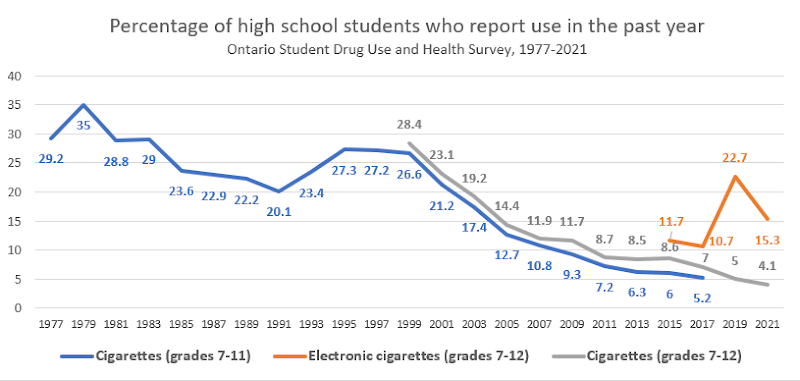
* The bi-annual Ontario Student Drug Use and Health Survey, for example, is the longest ongoing survey of school health. In 2021 it conducted its 4th survey of e-cigarette use, finding a similar trend to that observed in the U.S: a dramatic increase in 2019, with usage falling during the pandemic. 

* B.C. runs an adolescent health survey every five years, with the next cycle in 2023. 

* Results for Quebec's school based health survey addressing tobacco and vaping, among other drug behaviours, were last released for 2019, with another survey on more comprehensive health behaviours in the field this fall.

* Compass is a school-focused health research project led by researchers at the University of Waterloo which provides longitudinal insights into local behaviours. The annual survey provides data that are used to assess factors that contribute to reduced e-cigarette use (i.e. ineffectiveness of school programming, the impact of COVID, relationship to other health behaviours, etc.)

Other (non-school surveys of adolescent health behaviours)

Other efforts to measure vaping by young Canadians include the annual Canadian Tobacco and Nicotine Survey, which was launched in 2019. The most recent results of that survey were released by Statistics Canada last April. The results, shown below, suggest some stability in past-month vaping behaviour over the past three years, but with increased daily vaping (unpublished data show that 1 in 5 Canadians aged 15-24 who had ever tried a vaping device was vaping daily in the winter of 2021-2022). 

Since 2021, the Canadian Community Health Survey includes questions on e-cigarette use. These results have not been proactively released and are not known to have been reported (other than those from a rapid-release component of the survey taken in 2020). Electronic cigarette use is not included among the standard health indicators reported by Statistics Canada from this survey. 

The ITC Youth Tobacco and Vaping Survey conducts annual national surveys in Canada and also in the US and England. This survey asks about the types of vaping products used, allowing comparison of product choices between countries and over time.

Continuing challenges

The long periods between cycles of government surveys, the preference of university-based surveyors for disseminating results through journal publications, the absence of mandatory reporting on manufacturers and the complexities of studying youth behaviours make it challenging for Canadian  health regulators to keep their finger on the pulse of youth nicotine use -- let alone to respond in a timely way.

In the meantime, the data that are available suggests that vaping remains a serious and widespread problem. 

Many upstream measures to protect youth are either not yet in effect (eg tax increases that don't hit retail until January 2023), not yet approved (eg flavour restrictions) or not even on the agenda (eg banning youth-focussed disposable products). Tobacco and nicotine companies continue to experiment: and there is nothing in place to prevent the explosion of disposable vaping products that has driven  increases in youth vaping in the United Kingdom, the United States and elsewhere. 
Until then, this health issue will likely continue to be managed as a downstream policing issue -- with the burden shifted to school administrators and sales-to-minors enforcement officials.