Showing posts sorted by relevance for query hajek. Sort by date Show all posts

Monday, 21 October 2019

Do e-cigarettes beat NRT as cessation aids? A key study provides two opposing results - yet only one was reported.

There are thousands of scientific studies on tobacco use published every month (37,000 so far this year!), but only a few find their way into the mainstream media. Among those, even fewer seem to have real influence on government policies.

In my circles, one of the most influential papers this year was a British study on the effectiveness of e-cigarettes at helping smokers quit. Psychologist Dr. Peter Hajek and his colleagues used the "gold standard" methods of a randomized clinical trial to compare E-cigarettes (consumer products) against NRT (licensed therapies) at as cessation products.

The results of this study were published in the New England Journal of Medicine in January and immediately reported by media outlets across the world. Time magazine said the study showed  "E-Cigs More Effective Than Nicotine Replacements in Helping Smokers Quit", a messages echoed in many Canadian media outlets.

The idea that e-cigs are *twice as good at helping smokers quit* as NRT has now taken root.

Indeed, in some important quarters in Ottawa it seems to have become part of the tobacco control belief system. More than once over the past few months have I have heard this study cited as a reason that governments should continue to allow e-cigarette promotions.

Differing points of view

Yet Dr. Hajek and his team are not the only highly qualified researchers looking into this issue, and theirs is not the only scientific conclusion on offer.

Among other respected public health scientists who have looked at the efficacy of e-cigarettes as cessation products are those at the World Health Organization. This summer, after considering Dr. Hajek's results and others, the WHO concluded:
Although some [Electronic nicotine delivery systems] have been shown to help smokers quit conventional smoking under certain conditions, when used as NRTs the scientific evidence is inconclusive. There have only been a limited number of randomized control trials and longitudinal studies investigating the role of ENDS as potential cessation aids offered to a population, and their conclusions are equivocal.
This is not the only time that Dr. Hajek and the World Health Organization have come to starkly different conclusions about interpreting research findings. In 2014, Dr. Hajek was among a research team which openly criticized the WHO, accusing it of "misleading" the public with the following statements:  "Youth are rapidly adopting e-cigarettes", "the hope that e-cigarettes will reduce harm by delivering 'clean' nicotine will not be realized in continuing dual users" and "E-cigarettes deliver lower levels of toxins that conventional cigarettes, but they still deliver some toxins."

Nor is it the first time that Dr. Hajek has nailed his colours to the mast of e-cigarettes being so safe that their use should be promoted. He was part of the scientific team  that advised Public Health England to promote the idea that the differences in harm between e-cigarettes and cigarettes could be quantified, and that the comparative measure was "95% safer". Canada's Heart and Stroke Foundation and The Lancet are among the many who have criticized the use of the "95% safer" claim.

A second look at the outcomes of Dr. Hajek's experiment.

The data presented in the table below shows a broader range of outcomes from Dr. Hajek's study, drawing data from the NEJM paper and also in a NIHR Health Technology Assessment report published in August, i.e.
  • "The 1-year abstinence rate was 18.0% in the e-cigarette group, as compared with 9.9% in the nicotine-replacement group".   
  • "Among participants with 1-year abstinence, those in the e-cigarette group were more likely than those in the nicotine-replacement group to use their assigned product at 52 weeks (80% [63 of 79 participants] vs. 9% [4 of 44 participants])"
  • "19 participants in the NRT arm using NRT at 12 months ..."
  • "173 participants in the e-cigarette arm using e-cigarettes at 12 months... "
  • "Among the e-cigarette arm abstainers, two were using non-allocated NRT at 12 months, whereas in the NRT arm, nine [abstainers] were using non-allocated e-cigarettes."
(No information was found on the number of people who used both NRT and e-cigarettes. Even if they were some, the results presented below would not differ greatly.)
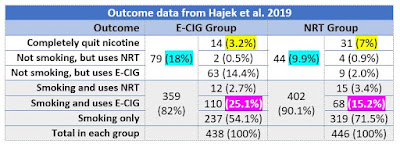


NRT performed twice as well as E-cigs at achieving nicotine abstinance.

These results support the following statements:
  • Participants in the E-CIG group had almost double the success in stopping using cigarettes (18% vs 9.9%). This is as the media reported.
  • Participants in the NRT group had more than double the success in ending nicotine use (7% vs. 3.2%). This is something the media failed to report. 
  • Participants in the E-CIG group had a much higher risk of becoming dual users (25.1% vs. 15.2%). This is something that the media also failed to report.
Other important conclusions can also be drawn from these outcomes:
  • For people trying to beat nicotine addiction, failure continues to overwhelm success. This should heighten concerns about increase uptake of nicotine use.
  • Those who have the opportunity to use e-cigarettes, including those who are encouraged to use NRT instead, are much more likely to both smoke and vape than they are to only vape. This might dampen enthusiasm that those who try vaping will be able to switch completely.
Higher standards of evidence

Single clinical trials, no matter how well performed or reported, are not usually considered the strongest evidence base for decision making. That distinction is usually reserved for systematic reveiws of multiple studies.


In 2016 two systematic reviews of e-cigarettes as cessation aids were conducted. They did not come to the same conclusion.

One was by the Cochrane reviews (and Dr. Hajek participated in this review.) This panel focused on the results of 2 randomized clinical trials, and concluded that "There is evidence from two trials that ECs help smokers to stop smoking in the long term compared with placebo ECs." The quality of those studies was considered low, and Dr. Hajek's 2019 results will likely strengthen this conclusion in subsequent Cochrane reviews.

The other was a systematic review and meta analysis conducted by U.S. physician Dr. Sara Kalkhoran and Dr. Stanton Glantz.  They looked over the same literature field, and included the same 2 clinical trials as the Cochrane review had. In addition, they considered the results of 20 studies with control groups and other studies. The conclusions from this analysis were that rather than helping smokers quit,  e-cigarettes made it harder for them to do so. The "odds of quitting cigarettes were 28% lower in those who used e-cigarettes compared with those who did not use e-cigarettes."

A Canadian study involving more than 6,000 smokers was included in the Kalkhoran review, but not by the Cochrane team. It was conducted at CAMH, and eventually published both as a conference paper and as a journal article. Those would-be quitters who used e-cigarettes were less likely to succeed in quitting. "E-cig adoption seems to negatively affect cessation outcomes and provides no benefit as a harm reduction tool  ..." 

This year researchers at the Ontario Tobacco Research Unit published a review of "E-Cigarette Use for Smoking Cessation." They found "a wide range of results" and - while clearly open to the idea of using vaping as a cessation tool - nontheless reported that "In general, the scientific literature regarding the effectiveness of e-cigarettes as a smoking cessation aid remains inconclusive."

The Montreal Jewish General is leading a clinical trial on e-cigarettes as cessation devices, partnersing with several hospitals across Canada. Their results are not expected until next year.

Policy implications

Setting policy or clinical practice guidelines on the role of e-cigarettes is challenging in the messy real world of competing evidence, uncertainty, nuance and concious/unconcious bias. And that is before commercial influence and tobacco industry interference is added to the mix!

Currently, smokers who want to quit smoking have a variety of tools available to them, including a variety of licensed NRT therapies, non-licensed e-cigarettes, as well as proven and unproven behavioural supports that range from telephone counselling to hypnotherapy. None of the above has been the choice of most successful quitters.

Smokers (and those who pay for quitting programs) are entitled to know the benefits and the risks of the approaches on offer. In the case of e-cigarettes, Dr. Hajek's paper is presented as evidence that E-cigarettes are a better option than NRT. The same paper also provides evidence that NRT is a better option for those who want to overcome addiction and also for those who want to avoid the additional risks of dual use.


Tuesday, 22 November 2022

The updated Cochrane review of e-cigarettes -- and what it should mean for Canada.

Last week, the UK based health charity, Cochrane, released its sixth report on the evidence on the use of e-cigarettes for smoking cessation

This post reflects on how this and other Cochrane conclusions could serve Canadian efforts to reduce smoking at the population and individual levels. In brief:
  • Cochrane establishes that in clinical trials, E-cigarettes fail 10 times more often than they succeed (roughly the same as NRT). Other reviews have shown that in real life they are even less successful.
  • The products used in the studies reviewed by Cochrane are different than those on the market in Canada. The U.S. Surgeon General recommends that because of the wide variation in products and usage it is not prudent to draw generalized conclusions about their efficacy as stop-smoking medications
  • Cochrane reviews show that other stop-smoking medications do better in clinical trials. (The ones that, unlike e-cigarettes, have been assessed and authorized on the basis of their safety, efficacy and quality.)
  • Any advice to a smoker to use e-cigarettes to quit smoking (or to reduce the harms from continued nicotine use) should be tailored to individual circumstances and be individually delivered in a therapeutic context. Population-level encouragements for smokers to use e-cigarettes are imprudent. To date these have back-fired in Canada, resulting in more new nicotine addicts than former smokers. 

Next version, much the same as the first...

The Cochrane review on e-cigarettes that was published last week has the same central messages as the versions published in September 2021, the one published in April 2021, and the one published in October 2020. A major difference with earlier versions is the number of studies they accepted for their analysis: three that compared NRT to e-cigarettes were included in 2020, four in 2021 and six this year.

This study was released with considerable fanfare and extensive public relations efforts. Cochrane publishes several reports on tobacco issues (described at the end of this post) - few seem to get the same PR effort. 

The press releases that accompanied the release of the report were clearly designed to encourage e-cigarette use by smokers. The lead author's statement suggested  that e-cigarettes were a highly effective stop smoking medication: "For the first time, this has given us high-certainty evidence that e-cigarettes are even more effective at helping people to quit smoking than traditional nicotine replacement therapies, like patches or gums."

Another PR effort was a linked and coordinated release sent by other British enthusiasts. Professor John Britton was one endorser, and unequivocally presented e-cigarettes as a panacea for smoking cessation: "All smokers should therefore try vaping as a means to end their dependency on smoking tobacco."   (The release made no mention that Dr. Britton has been engaged by  Canadian commercial vaping interests to oppose flavour restrictions in New Brunswick. )

There are many reasons to disagree with these views.

Cochrane has confirmed that in clinical trials, e-cigarettes are NOT very effective at helping smokers quit.

The reviewers memorably present their conclusions in a plain language summary"For every 100 people using nicotine e‐cigarettes to stop smoking, 9 to 14 might successfully stop, compared with only 6 of 100 people using nicotine‐replacement therapy, 7 of 100 using e‐cigarettes without nicotine, or 4 of 100 people having no support or behavioural support only."

Rather than confirm the superiority of e-cigarettes, these numbers confirm the inadequacy of both vaping products and NRT - even under the best of supervised therapeutic circumstances. 

The Cochrane report on e-cigarettes concluded in effect that 90 of 100 smokers who use e-cigarettes to quit smoking will be smoking again within 6 months, compared with 94 failures for every 100 who use NRT. 

The relative risk for success between E-cigarettes and NRT is 1.63 (10 vs 6 successes per 100 tries). The relative risk for failure between NRT and E-cigarettes is 1.04 (94 vs 90 failures per 100 tries) 

(Simon Chapman provides a good discussion of the high rate of failure in his blog "Would you take a drug that failed with 90% of users? New Cochrane data on vaping “success”)

Cochrane has confirmed that in clinical trials, other stop-smoking medications available in Canada do better than e-cigarettes.

Other Cochrane reviews have assessed the effectiveness of pharmacotherapies for smoking cessation. These include the stop-smoking medications that have been approved by Health Canada following a review of their safety, efficacy and quality. (The safety, efficacy and quality of e-cigarettes is not examined by Health Canada before they are permitted for sale).

Among these medications are prescription medications Varenicline and Bupropion. These drugs do not replace nicotine from tobacco, but instead help the smoker end nicotine addiction by altering the brain's response to it. Varenicline reduces nicotine withdrawal symptoms and diminishes the rewarding effects of cigarettes. Through a different mechanism, Bupropion also decreases nicotine withdrawal symptoms and may diminish the rewarding effects of cigarettes. Other over-the-counter stop-smoking medications authorized for sale  include the natural health product Cytisine and the prescription anti-depressant Nortriptyline.

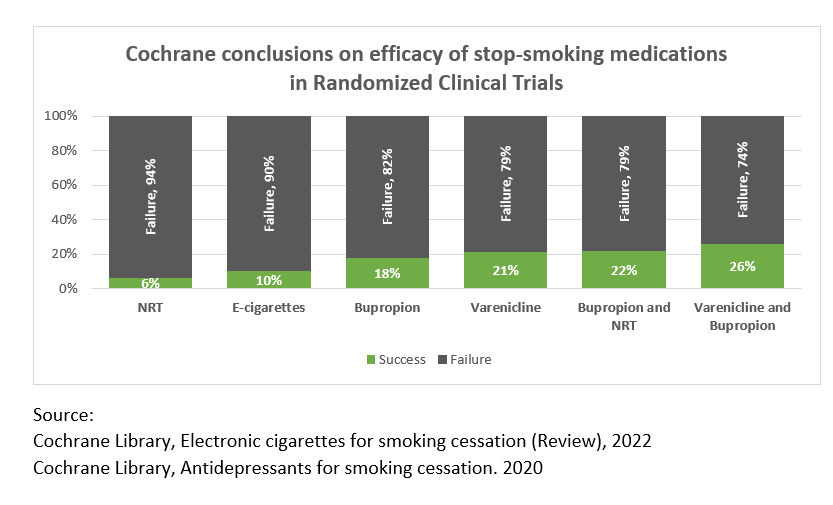
A 2020 review by Cochrane looked at the effectiveness of some pharmacotherapies, using similar analytic methods to thsoe used in the review on e-cigarettes. This review pharmacotherapies concluded that for every 100 people who tried to quit smoking:

  • 17 to 20 were successful at quitting for at least 6 months if they used Bupropion alone (80 to 83 failed). 
  • 17 to 28 were successful if they used Bupropion and NRT (72 to 83 failed). 
  • 21 were successful if they used Varenicline alone (79 failed). 
  • 20 to 33 were successful if they used Varenicline and Bupropion (67 to 80 failed).


Randomized Clinical Trials are designed for therapeutic medication and are not the right yardstick to assess consumer product use.

In developing its assessment of the effectiveness of e-cigarettes as cessation devices, the Cochrane reviewers considered only clinical trials that used randomized control trials (RCT). This may be the gold standard for assessing medications before granting licensing approval, but it does not reflect the reality of most smokers' quit attempts. 

In RCT's, smokers are engaged and participating in a therapeutic cessation attempt, often using a specified e-cigarette product. In the real world, most try to quit without any external structure or support and use a variety of products. 


This Cochrane review is out of step with other scientific assessments of the usefulness of e-cigarettes as quitting aids.

The Cochrane reviewers are only one of several research groups conducting systematic reviews of e-cigarettes efficacy for smoking cessation. Even among reviews that, like Cochrane, considered only Randomized Control Trials, other scientists have concluded that even on the narrow question of whether e-cigarettes are superior to NRTs, the evidence is not there. 

Reviewers of RCT's on e-cigarettes who came to different conclusions include:

  • An Australian review of RCT's found limited evidence that in the clinical setting freebase nicotine e-cigarettes are efficacious as an aid to smoking, and that they double the likelihood of relapse to resuming smoking, strong evidence that e-cigarettes increase combustible smoking uptake in non-smokers, and insufficient evidence that nicotine e-cigarettes are efficacious outside the clinical setting. (Banks et al, 2022)
  • An Irish review of RCT's found "no clear evidence of a difference of effect" between e-cigarettes and NRT. (Quigley et al. 2021)
  • A review for the US Preventive Services Task Force found "inconsistent" results in RCT's and did not conclude that e-cigarettes were effective as a therapeutic product for smoking cessation. (Patnode et al, 2021)
  • The U.S. Surgeon General found that there was too much variation in the products sold and the way they were used to make generalizations about whether or not they were effective for smoking cessation. (U.S. Surgeon General, 2020).
Reviewers who considered both RCTs and longitudinal or observational studies have found no benefit to quitting with e-cigarettes.
  • Swedish review of RCT's and longitudinal studies found no net benefit to the use of e-cigarettes for quitting smoking was found. (Hedman et al, 2021)
  • American researchers looking at RCT's and observational studies found that although e-cigarettes were found to be effective when used as therapeutic interventions in clinical settings, this was not the case when they were sold as consumer products in the general population. (Wang et al, 2021). 
  • Analysis of American smokers over time found no evidence that higher nicotine e-cigarettes (or lower nicotine cigarettes) improved successful quitting or prevented relapse (Chen et al, 2022)
  • Another study using the same longitudinal study found that dual users were less likely to quit. (Osibogun et al, 2022)
  • * A study conducted by Environics for Health Canada, which followed vapers over a two-year period finding no net reduction in smoking (Environics POR 113-20
Outside of the United Kingdom, very few medical bodies recommend e-cigarettes for smoking cessation. Those which advise doctors to refrain from recommending e-cigarettes to smokers include the College of Family Physicians of Canada and U.S. Preventive Services Task Force.  Leading Canadian smoking cessation  specialists Peter Selby and Laurie Zawertailo published a Clinical Practice review on Tobacco Addiction in the New England Journal of Medicine this summer, concluding that even though nicotine e-cigarettes may be more effective than nicotine-replacement therapy "We would recommend against the use of e-cigarettes for smoking cessation given insufficient evidence to support their use."


This Cochrane review did not address the non-clinical (public health) consequences of e-cigarette use

There are a number of aspects of e-cigarette use that were not included in the Cochrane assessment, and harms which were not accepted as "adverse consequences". These include:

  • the increased health risks incurred by smokers who try e-cigarettes, but continue to smoke (dual users), thereby inhaling the different harmful chemicals in each type of product. 
  • the increased health risks incurred by smokers who successfully quit with e-cigarettes, but who continue to use them. (The Hajek research found that those who successfully quit using NRT are half as likely to continue using nicotine as those who used e-cigarettes).
  • the initiation into nicotine use by young people who are influenced by messaging that encourages e-cigarette use.
  • the role of the tobacco industry in designing and supplying both cigarettes and e-cigarettes, and the commercial pressure that encourages them to market these in ways which maintain sales.
In the full (pay-walled) version of their report, the reviewers acknowledge this limitation of their study: "Reviews of ECs for policymaking are often broader in scope than our review, which focuses exclusively on their role in supporting smoking cessation in people who smoke. Outside of smoking cessation, there remain unanswered questions about the impact of EC availability and use on young people; we will be evaluating this in a separate review."

There is no evidence that encouraging smokers to use e-cigarettes has benefitted health in Canada.

The federal policy decision in 2016 to liberalize the sale of vaping products as consumer goods remains controversial. Four years have passed since this policy became law with the 2018 Tobacco and Vaping Products Act)

The impact of this policy change is reflected in federal surveys, which show that the uptake of these products was largely among young people, and not among adult smokers.


Although smoking rates continue to decline, Federal surveys show that this is chiefly due to the growing population of never smokers, and that the quitting rates in Canada have not increased since e-cigarettes were legalized.

Currently in Canada, two-thirds of e-cigarette users either continue to smoke cigarettes (36%) or have never smoked (33%).


Monday, 17 April 2023

The continuing divide on E-cigarettes for smoking cessation: Part 1 - research findings


One of the few agreements about e-cigarettes is that there is still no consensus about the role they play in helping smokers quit.

This post reports on the conflicting (and missing) evidence on the effects of using e-cigarettes for smoking cessation. A subsequent post will look at the conflicting (and missing) approaches to promoting e-cigarettes for quitting that have been recently adopted by health authorities.
More evidence that reviewers disagree

At the beginning of this month, yet another review of evidence on e-cigarettes as cessation devices was published. This umbrella review of the health outcomes of e-cigarettes [1] was conducted by a team headed by Dr. Banks, and is the a journal version of a study commissioned by the Australian government. [2]
  • there was limited evidence that using freebase nicotine e-cigarettes with clinical support was more effective than NRT or nothing, 
  • there was insufficient evidence that freebase nicotine e-cigarettes were effective when used outside a clinical context.
  • there was no evidence on the impact of nicotine salt products (found in capsule and disposable cigarettes) for cessation.
  • there was insufficient evidence that free-base  nicotine e-cigarettes were more effective than those with no nicotine.
Banks et al conclusions on e-cigarettes for cessation


There are now more than a dozen systematic reviews and meta-analyses looking at a smaller number of randomized control trials comparing e-cigarettes with NRT or no intervention to help smokers quit. (A list of these reviews can be downloaded here.) In this case, the hierarchy of evidence looks more like a cube than a pyramid!

Generally these reviews concur that e-cigarettes in clinical settings (often with counselling or other support) have performed as well or better than NRT. They often disagree about how strong this evidence is, or its generalizability to real-world circumstances, or the usefulness of these experiments for clinicians, policy-makers or and smokers.

Among these, the greatest enthusiasm is expressed by the Cochrane Tobacco Addiction Group.[3] Where the Australians and others have concluded there is "limited evidence" that e-cigarettes outperform NRT, the Cochrane group finds "high certainty evidence". (Our report on their review can be found here).

In addition to the Banks' team review, the three other reviews published over the last year were much more cautious. A French research team noted that "there have only been few studies carried out, which does not allow for an affirmation and recommendation of practice." [4] A Chinese research team characterized the evidence on the effectiveness of e-cigarettes as "low certainty." [5]

Explaining the difference

How can similarly-trained researchers consider the same body of evidence and produce such different conclusions? Factors that may play a role are the independence of the reviewers, their choice of studies to include and exclude, the role of the tobacco industry, the preferences of publishers, and geography.

Independence from primary studies

Dr. Banks' team explained its concerns with the Cochrane analysis: "We rated it less independent than other reviews because four of its authors were also investigators in the included trials ... The review inclusion criteria were broader than ours, including self‐reported cessation outcomes and trials not published as peer‐reviewed articles, and the authors generally rated risk of bias in individual trials lower than we did."

This polite wording points to concerns others have raised about the personal connection of the Cochrane reviewers to the original studies and also their inclusion of a study conducted by tobacco companies.

The Cochrane group selected only five studies for its meta-analysis, three of which they had conducted themselves and one of which was paid for by an e-cigarette manufacturer. Shown below is a table taken from the pay-walled full version of the Cochrane report which has been annotated to identify those studies which were authored by Cochrane reviewers and those which were industry funded.


Independence from tobacco industry

More than one-third of the results of the Cochrane meta-analysis are derived from two arms of a study conducted by the U.K.-based Centre for Substance Use Research (CSUR). This firm is funded by tobacco and nicotine companies. A core part of its business is supporting applications to the FDA related to market authorization for e-cigarettes.

The study in question has not yet been published in any journal. Its results are available only in the form of an abstract (PH 353) presented at the 2021 SRNT Conference.[6] The abstract acknowledges funding to the "E-cigarette/Alternative nicotine products Industry". The device tested in the trial (myBlu) is manufactured by Fontem, which is a division of the world's fourth largest tobacco company, UK-based Imperial Brands.

It seems probable that the study was conducted to support an application to the US FDA for permission to market myBlu. Shortly after the results were shared at the 2021 SRNT conference, the U.S. FDA issued a marketing denial order for myBlu. The letter sent by the FDA to Imperial Brands e-cigarette division (FONTEM) provides the reasons for denying the application, but does not identify any studies by name.

In addition to being industry-funded and unpublished, there is another red-flag attached to this study. CSUR failed to prospectively register its trial of myBlu. All those who conduct clinical trials are expected to register them in advance in order to reduce the likelihood that only positive results will be shared. The duty to register is no minor obligation - the World Health Organization describes it as a "scientific, ethical and moral responsibility". The Cochrane organization (which oversees the Cochrane Tobacco Addiction Group) also expects prospective registration of all trials.

Systemic influences on favourable results for e-cigarettes

Mexican researchers recently reviewed almost 700 articles on electronic cigarettes, assessing the relationship between reported conflicts of interest and the research conclusions of each paper. Their results were published last summer in the Journal of the Pan American Health Organization. [7]. This paper did not consider results of unpublished research like the CSUR study included in the Cochrane review.

This study found that articles in which any conflict of interest was reported were almost 5 times more likely to find a positive result for vaping (OR 4.7; 95% CI 2.89-7.65). Papers that were funded by tobacco companies were 30 times more likely to have positive results (OR 29.95; 95% CI 9.84 - 90.98).

They also found other patterns related to geography and editorial selection: papers published in England had more than twice the rate of positive results as those published elsewhere. These results are shown in the table below.

Factors associated with a positive result
of vaping studies, Vidana-Perez et al, 2022


And what about the unpublished results of other trials?

The number of RCT's comparing the use of e-cigarettes for quitting smoking published by 2021 hovers around a dozen (see, for example, the list collected by the Irish Research Board).[8] But there are a great number of unpublished trials registered - some of which are newly started, but many of which have been underway for several years. The absence of any reports on these trials raises concerns about publication bias.

These unpublished results include trials conducted by the tobacco-industry funded team in Italy. (NCT01979796, registered in 2013; NCT02124187, registered in 2014), as well as a study by Cochrane Tobacco Addiction Group member Peter Hajek (NCT01842828, registered in 2013). A Canadian trial of e-cigarettes for inner-city substance users was registered in 2017 and has also seemingly dropped from view (NCT03249428).

Other large trials in Europe have been completed or are close to completion, but the results are not yet shared. These include the Swiss ESTxENDS trial of 1,246 would-be quitters (NCT03603340), the French ECSMOKE trial of 650 comparison e-cigarettes with varenicline (NCT03630614) and a similar trial of 450 middle-aged heavy smokers in Finland (NCT03235505). A study comparing e-cigarettes and NRT with telephone quitline support among 926 Australians is expected to finish data collection this summer. (ACTRN12619001787178).

And there is more to come. Many new trials have recently been registered. Included in these is a study with 800 Canadian smokers which will compare e-cigarettes with varenicline (NCT05715164).

The results of these trials may contribute to a consensus among independent reviewers of the efficacy of e-cigarettes to help people quit in the short term. They are not designed to address questions about long-term impact.

Clinical trials, real-world experience, professional concerns of health practitioners

E-cigarettes are sold worldwide as consumer products, and nowhere yet are they authorized as medicines or therapeutic devices. The RCTs discussed above focus only using these products in structured clinical settings. Other approaches (longitudinal studies, cross sectional studies) are designed to assess real-world outcomes outside the clinical setting or in the natural history of nicotine use.

Many real-world studies have been conducted and a handful of systematic reviews of these studies have also been published. [9, 10, 11] These reviewers generally concur with the findings of Banks et al, discussed above, that there is insufficient evidence to conclude that e-cigarettes are effective in non-clinical circumstances. The results of cohort studies, shown below, is taken from a meta-analysis conducted by a Swedish research team.


Hedman et al. 
Electronic cigarette use and smoking cessation
 in cohort studies and randomized trials:
A systematic review and meta-analysis


Evidence based medicine relies on approved products

Using a system designed to assess therapeutic drugs to evaluate consumer product use creates additional complexities. In many countries, clinicians are bound by codes of practice which require them to recommend drugs whose safety and efficacy has been established by health authorities. This is not the case with e-cigarettes. (Australia's requirement for e-cigarette prescription is based on that country's special rules for "unapproved therapeutic goods").

In short - the evidence in support of clinical use of e-cigarettes is of limited value to clinicians who are professionally obligated to recommend medications that have been evaluated and authorized and for whom evidence for different formulations and dosages is expected .

This may contribute to the assessment by the leading health agencies that e-cigarettes should not be recommended as smoking cessation interventions. This is the advice of the World Health Organization, the U.S. Surgeon General, the U.S. National Institute on Drug Abuse, U.S. Centre for Disease Control and Prevention, Direccion General de Salud Publica (Spain), Haut Conseil de la Santé Publique (France), the Instituto Nacional de Salud Pública (Mexico) and many others. A list of statements by these and the organizations shown below can be downloaded here. This week another organization - the Academy of American Pediatrics- joined the list.

PSC Presentation on Evidence of e-cigarettes
for cessation, April 2023

Monday, 4 October 2021

Meta-analyses find vaping leads to smoking among young people and former smokers

This post highlights scientific reviews about the relationship between vaping and smoking that have been published since our previous summaries (in January 2021 and April 2021). 

More evidence that vaping puts young people at greater risk of smoking

An Australian team of researchers has provided a new systematic review and meta-analysis of studies exploring whether e-cigarette use is a risk factor for subsequent cigarette smoking in young people. In this study, published in PLOS one last month, Sze Lin Yoong and colleagues restricted their analysis to longitudinal studies only, thus strengthening the certainty of the findings. Their meta-analysis of 17 such studies of e-cigarette use at baseline and subsequent ever cigarette use (published before October 2020) found a relative risk of cigarette uptake of 3.01. All 17 studies showed a positive relationship. 

This study builds on the conclusions of other recent meta-analyses, including those published last year by British researchers (Kouja et al. based on evidence up to November 2018) and another Australian team (Baenziger et al. based on evidence up to April 2020). Multiple studies have now confirmed that adolescents who use e-cigarettes are at least three times more likely to take up smoking than non-users of e-cigarettes.

And newer studies provide consistent results ...

After the October 2020 cut-off date for the Yoong meta-analysis, three more longitudinal studies appeared were published that provide consistent conclusions.

In July 2021, Jeremy Staff and colleagues reported on their study using longitudinal data on British youth who were questioned at age 14 and followed at age 17. They found that young people who were using e-cigarettes at age 14, but not smoking, were more than five times more likely to have started smoking tobacco cigarettes by age 17.  The reverse was true too. Those who started smoking tobacco cigarettes at age 14 were three times more likely take up e-cigarettes by age 17.  Their results counter the proposition that the young people who vape would otherwise be smokers (the 'common liability' theory) as they found distinct risk factors for tobacco-use and vaping.

Also in July 2021, a paper written by the Netherlands' research team lead by Thomas Martinelli  reported on e-cigarette use and tobacco smoking among Dutch-speaking high school students in the Netherlands and Belgium. This longitudinal study collected follow-up information after six and twelve months and found that those who were using e-cigarettes were 5.63 times more likely to be using tobacco a year later.  They also found that those who were smoking tobacco were 3 times more likely to be using e-cigarette at the year's end. These findings are very like those of British youth reported by Staff et al., cited above. 

A few weeks earlier, Elizabeth Hair and colleagues reported on a longitudinal study of youth and young adutls (15-21 year-olds in 2017) who were contacted after one year. This study found that users of e-cigarettes in 2017 were more than three times more likely to become users of cigars, little cigars or cigarillos (CLCCs) by 2018.  Young people who were cigarette smokers or marijuana users in 2017 were also more likely to become users of CLCCs by 2018.

Evidence that vaping puts former smokers at greater risk of relapsing 

Health authorities hold differing views on whether or not e-cigarettes help smokers quit. For example, Health Canada advises that vaping products are "linked to improved rates of success", but U.S. health authorities (eg U.S. Surgeon General) has found there is "inadequate evidence to conclude that e-cigarettes, in general, increase smoking cessation." Since our last review of this topic in April , the Cochrane review has updated its review and concluded there are reasons to be "moderately confident" that e-cigarettes outperformed NRT in helping people quit for at least 6 months. Because this review considered only random clinical trials and did not look at studies of real-world conditions, it is consistent with the conclusions of recent meta-analyses which found e-cigarettes are effective in clinical settings, but not when sold as consumer products.

But what about those who successfully quit smoking and have remained non-smokers for a year or more? Are some of them tempted to try e-cigarettes? If they do so, are they more or less likely to relapse to tobacco use?

These questions were recently addressed by a Brazilian research team led by Laura Barufaldi. Their search for all papers which examined this phenomenon resulted in only three studies which met their inclusion criteria.

The largest (and thus most influential) of these was by American researchers Hongying Dai and Adam Leventhal who used data from the U.S. longitudinal study on smoking behaviour (the Population Assessment of Tobacco and Health, or PATH Study). From this study they identified people who at the time of the interview had quit smoking more than 12 months previously and then looked for their smoking status one year later. They found that those who had taken up vaping after quitting smoking were 2- 4 times more likely to have relapsed to tobacco smoking.

The other papers confirmed and reinforced those conclusions: Smoking relapse was twice as likely among people who had quit smoking but subsequently started using e-cigarettes.


Implications for public health

    Adolescents who never smoked but start vaping are at least three times more likely to start smoking than adolescents who don't try vaping.
  • Some former smokers take up e-cigarettes.  If they do so, they are twice as likely to relapse to smoking as former smokers who don't vape.
  • E-cigarettes may help some people quit smoking as part of a supervised intervention. In the majority of cases, when acquired and used as consumer products, they do not increase the likelihood of successful quitting
Publications cited:

Baenziger ON, Ford L, Yazidjoglou A, et al. E-cigarette use and combustible tobacco cigarette smoking uptake among non-smokers, including relapse in former smokers: umbrella review, systematic review and meta-analysis, BMJ Open 2021
https://bmjopen.bmj.com/content/11/3/e045603

Barufaldi LA, Guerra RL, de Albuquerque RCR, et al. Risk of smoking relapse with the use of electronic cigarettes: A systematic review with meta-analysis of longitudinal studies. Tob Prev Cessat. 2021;29:29. Published 2021 Apr 27. doi:10.18332/tpc/132964

Dai H, Leventhal AM. Association of electronic cigarette vaping and subsequent smoking relapse among former smokers. Drug Alcohol Depend. 2019;199:10-17. 
https://www.ncbi.nlm.nih.gov/pmc/articles/PMC6743978/

Hair EC, Kreslake JM, Mowery P et al. A longitudinal analysis of e-cigarette use and cigar, little cigar or cigarillo initiation among youth and youth adults: 2017–2019. Drug and Alcohol Dependence,
Volume 226, 2021.
https://pubmed.ncbi.nlm.nih.gov/34218009/

Hartmann-Boyce J, McRobbie H, Butler AR, Lindson N, Bullen C, Begh R, Theodoulou A, Notley C, Rigotti NA, Turner T, Fanshawe TR, Hajek P. Electronic cigarettes for smoking cessation. Cochrane Database Syst Rev. 2021 Sep 14;9(9) https://www.cochranelibrary.com/cdsr/doi/10.1002/14651858.CD010216.pub6/full

Khouja JN, Suddell SF, Peters SE, Taylor AE, Munafò MR. Is e-cigarette use in non-smoking young adults associated with later smoking? A systematic review and meta-analysis. Tob Control. 2020 Mar 10;30(1):8–15. doi: 10.1136/tobaccocontrol-2019-055433. https://pubmed.ncbi.nlm.nih.gov/32156694/

Martinelli T, Candel MJJM, de Vries H, et al. Exploring the gateway hypothesis of e-cigarettes and tobacco: a prospective replication study among adolescents in the Netherlands and Flanders. Tobacco Control Published Online First: 05 July 2021. https://tobaccocontrol.bmj.com/content/early/2021/08/18/tobaccocontrol-2021-056528

Staff, J., Kelly, B. C., Maggs, J. L., and Vuolo, M. (2021) Adolescent electronic cigarette use and tobacco smoking in the Millennium Cohort Study. Addiction, https://onlinelibrary.wiley.com/doi/10.1111/add.15645

Yoong SL,  Hall A, Turon H et al. Association between electronic nicotine delivery systems and electronic non-nicotine delivery systems with initiation of tobacco use in individuals aged < 20 years. A systematic review and meta-analysis. Plos One September 8, 2021
https://journals.plos.org/plosone/article/metrics?id=10.1371/journal.pone.0256044

Friday, 30 April 2021

Conclusions from the EU's scientists and others on whether e-cigarettes help smokers quit

This week the European Union's scientific advisers issued their "Final Opinion on Electronic Cigarettes". This report strengthens concerns about the risks associated with e-cigarette use, while failing to find more than weak evidence that they help smokers quit. 

This post summarizes the findings of this report, and provides a summary of scientific reports published subsequent to the release of the SCHEER's draft opinion last fall.

The EU scientific reaffirms its conclusions on the risks of e-cigarettes

More than two years have passed since the EU's Scientific Committee on Health, Enviornmental and Emerging Risks (SCHEER) was first handed the mandate of assesssing the risks and benefits of e-cigarettes in February 2019. This report is intended to assist the European Union in its upcoming review of its Tobacco Products Directive (now 7 years old). In its assessment, the committee relied on evidence "mainly from review articles published between January 2015 and April 2019 as well as relevant primary sources and literature beyond this period." 

Last September the committee issued its preliminary opinion, following which a consultation paper allowed public comment on their conclusions. Over the past months the SCHEER's working group on e-cigarettes has been reviewing the comments of e-cigarette manufacturers like British American Tobacco and others. (A separate report on that consultation is forthcoming). This week the SCHEER signed off on the final opinion, offering its scientific advice that the:
  • evidence supporting e-cigarettes as an effective smoking cessation device was "weak". 
  • evidence that second-hand exposure to e-cigarette vapour posed risks was "weak to moderate".
  • evidence that e-cigarettes helped smokers cut down on the amount smoked was "weak to moderate".
  • evidence that e-cigarettes could cause cancer in the respiratory tract was "weak to moderate".
  • evidence that e-cigarettes posed risks for coronary disease was "moderate".
  • evidence that e-cigarettes were a gateway to smoking for young people was "moderate"
  • evidence that e-cigarettes with nicotine were addictive was "strong"
  • evidence that flavours in these products contribute to initiation was "strong".

In its revisions to the opinion, the SCHEER clarified that it was cautioning against the use of e-cigarettes as as cessation products outside a clinical intervention: "There is a lack of robust longitudinal data on the effect of electronic cigarettes on smoking cessation. Until such research is available, electronic cigarettes should only be considered to support smoking cessation for a limited time and under supervision." This statement is aligned with the conclusions of other government-mandated reviews(described below).

More studies supporting a cautionary approach

Subsequent to the release of the SCHEER's draft opinion last fall, a number of papers have been released which cast doubt on the usefulness of encouraging the use of e-cigarettes as cessation aids  when purchased as consumer products outside a therapeutic intervention.  

A December 2020 study by Richard Wang and associates  examined e-cigarettes as smoking cessation aids using meta-analyses.[1] The meta-analyses included all pertinent studies published up to January 2020. The meta-analyses performed included 55 observational studies and 9 randomized control trials (RCTs). The study concludes that, overall, e-cigarettes, as consumer products, are not associated with increased smoking cessation in the adult population. In observational studies, whether smokers showed no motivation or some motivation to quit smoking, e-cigarettes were not effective in achieving smoking cessation. Smokers who used e-cigarettes less than daily were less likely to quit smoking. If smokers also used e-cigarettes daily, they were more likely to quit smoking. In randomized control trials, provision of free e-cigarettes as a therapeutic intervention was associated with increased smoking cessation. This study adds to the increasing evidence that e-cigarettes used as consumer products are not effective as smoking cessation devices, while e-cigarettes given therapeutically in controlled clinical settings may help some people quit smoking.

Another similar meta-analysis published in January 2021 found similar results. [2] Zhang and colleagues included fewer studies in their meta-analyses (35), but had similar findings. Intensive use of e-cigarettes and use in randomized control trials in clinical settings were associated with small increases in smoking cessation, described by the authors as having "low certainty." They did not assess persistent use of e-cigarettes among successful quitters. A secondary finding was that adolescent e-cigarette users were three times more likely to become cigarette smokers, consistent with other research.[3,4]

Similar results were reported by McDermott and colleagues and published in March 2021. [5] They analyzed data from a longitudinal survey conducted in the United Kingdom from 2012 to 2017. Daily e-cigarette users were significantly more likely to quit smoking, while non-daily e-cigarette users were significantly less likely to quit smoking. Non-daily use was the more frequent pattern. Non-daily users accounted for 60% of all e-cigarette users.

In October 2020, we reported on studies of the same relationship of e-cigarette use for smoking cessation.[6] Using very different methods - analysis of longitudinal data form the US PATH study - two groups of researchers reached very much the same conclusion as Richard Wang and his colleagues - that e-cigarettes, when used as consumer products are not effective as smoking cessation devices.

Since then another study that used PATH data has been published, concluded that there was some benefit for smoking cessation from e-cigarettes.[7] However, this study's conclusions have been challenged on the basis of methodological flaws in the analysis, which John Pierce and colleagues [8] have described in detail.

Converging conclusions by scientific authorities

Research findings about e-cigarettes, sold as consumer products and used as smoking cessation aids, are converging. Overall, e-cigarettes sold as consumer products are not effective as smoking cessation devices, although benefits were found when they are included as part of a clinical intervention.

In October 2020 a Cochrane Review of randomized control trials of e-cigarettes for smoking cessation was published, and updated in April 2021 [9]. It included a meta-analysis that produced results similar to those produced by Wang et al.'s meta-analysis of 9 RCTs, showing that e-cigarettes have some benefit, similar to other smoking cessation methods, when used in a controlled clinical setting. However, unlike the PATH analyses and the study by Wang et al., the Cochrane review did not provide any information on how e-cigarettes might be used or misused when sold as consumer products. This Cochrane Review has been criticized because it stops short of providing information on what might happen when e-cigarettes are used as consumer products. It has also been criticized because several of the authors were also authors of the studies under review. In addition the RCTs under review were criticized for being are outside the scope of what is considered appropriate use of RCT methodology. Criticisms have been published by researchers in California [10] and Australia.[11]

In January 2021, the United States Preventive Services Task Force recommended against counselling smokers to use e-cigarettes. "The USPSTF concludes that the current evidence is insufficient to assess the balance of benefits and harms of e-cigarettes for tobacco cessation in adults, including pregnant persons. The USPSTF recommends that clinicians direct patients who use tobacco to other tobacco cessation interventions with proven effectiveness and established safety." [12]

In June 2020 the Irish Health Research Board [13] reported that "e-cigarettes were not more effective for smoking cessation than approved nicotine replacement therapies (NRTs), which questions the need for e-cigarettes as a smoking cessation intervention. In the second review, we found that e-cigarettes were associated with initiation of conventional cigarette smoking among adolescents, which identifies a potentially serious harm."

A report by Spain's public health agency [14] concluded in 2020 that "To date, no toxicological or drug studies have been performed on the long-term safety of e-cigarette use in humans; without these data it is impossible to say with certainty that e-cigarettes are safer than cigarettes. With this in mind it is impossible to recommend these devices as a useful tool against the cessation of traditional tobacco consumption." (machine translation)

Reviews on the impact of e-cigarettes on tobacco use conducted for the government of Australia by that country's National Centre for Epidemiology and Public Health [15] concluded that e-cigarettes did not help people quit smoking, but did increase the probability of a young person starting to smoke. 

For the Netherlands government, the Trimbos Institute reviewed the literature [16] and found that e-cigarettes were effective as cessation products for only a small group of smokers, and that success rates were comparable to "regular" methods. Because most e-cigarette users in that country also continued to smoke, it cautioned about the additional risks of dual use. 

Take away

The studies to date, whether longitudinal data analysis, randomized control trials or meta-analysis of e-cigarettes as consumer products, when dual use was assessed, all found high levels of dual use, known to be hazardous, and high prevalence of continuing use of e-cigarettes, even if smokers were successfully able to use them to quit smoking.

Smokers who use e-cigarettes daily are more likely than not to find e-cigarettes helpful in quitting smoking. However, this comes at the cost of likely continuing addiction to e-cigarettes. Among less frequent users of e-cigarettes, e-cigarette use makes smoking cessation less likely.
Daily e-cigarettes increase the likelihood of smoking cessation , but decreases cessation for less-than-daily users of e-cigarettes. Overall, e-cigarettes, when used as consumer products, do not increase smoking cessation rates.

E-cigarettes can be helpful as smoking cessation aids, but only in clinical settings. They are about as effective as other methods, but, unlike other therapeutic methods, they do not pass a test of safety for widespread use. There is a high risk of dual use, a high risk of continuing use, and a high risk of uptake of e-cigarettes by never smokers. Since they are only about as effective as other methods and cannot meet safety tests, it is highly questionable why sales of e-cigarettes as fast moving consumer goods (including to never smokers) should continue to be allowed in preference to imposing the types of restrictions required of other therapeutic products. 


References

[1] Richard J. Wang, Sudhamayi Bhadriraju, and Stanton A. Glantz:E-Cigarette Use and Adult Cigarette Smoking Cessation: A Meta-Analysis. American Journal of Public Health, https://doi.org/10.2105/AJPH.2020.305999

[2] Ying-Ying Zhang, Fan-Long Bu1, Fei Dong, Jian-Hua Wang, Si-Jia Zhu, Xiao-Wen Zhang, Nicola Robinson, Jian-Ping Liu. The effect of e-cigarettes on smoking cessation and cigarettesmoking initiation: An evidence-based rapid review and meta-analysis. Tob. Induc. Dis. 2021;19(January):4 https://doi.org/10.18332/tid/131624.

[3] Physicians for a Smoke-Free Canada. An update on evidence linking teen vaping to cigarette smoking. 15 November 2020. http://smoke-free-canada.blogspot.com/2020/11/an-update-on-evidence-linking-teen_15.html.

[4] John P. Pierce, Ruifeng Chen, Eric C. Leas, Martha M. White, Sheila Kealey, Matthew D. Stone, Tarik Benmarhnia, Dennis R. Trinidad, David R. Strong and Karen Messer. Use of E-cigarettes and Other Tobacco Products and Progression to Daily Cigarette Smoking. Pediatrics January 2021, e2020025122; DOI: https://doi.org/10.1542/peds.2020-025122.

[5] Máirtín S. McDermott, Katherine A. East, Leonie S. Brose, Ann McNeill, Timea R. Partos.The effectiveness of using e‐cigarettes for quitting smoking compared to other cessation methods among adults in the United Kingdom. Addiction. 09 March 2021. https://doi.org/10.1111/add.15474

[6] Physicians for a Smoke-Free Canada. New longitudinal studies find little support for e-cigarettes as an effective tool for population-level smoking cessation. 15 October 2020. http://smoke-free-canada.blogspot.com/2020/10/new-longitudinal-studies-find-little.html.

[7] Allison M. Glasser MPH, Mahathi Vojjala, Jennifer Cantrell, David T. Levy, Daniel P. Giovenco, David Abrams, Raymond Niaura. Patterns of E-cigarette Use and Subsequent Cigarette Smoking Cessation Over 2 Years (2013/2014–2015/2016) in the Population Assessment of Tobacco and Health Study. Nicotine & Tobacco Research, 2020, 1–9. 17 September 2020. doi:10.1093/ntr/ntaa182.

[8] John P. Pierce, Eric C. Leas, Tarik Benmarhnia, Sara B. McMenamin, David R. Strong, Ruifeng Chen, Karen Messer. E-cigarettes and Cessation: The Introduction of Substantial Bias in Analyses of PATH Study.14 November 2020. Nicotine & Tobacco Research, 2020, 1–2 doi:10.1093/ntr/ntaa234.

[9] Jamie Hartmann-Boyce, Hayden McRobbie, Nicola Lindson, Chris Bullen, Rachna Begh, Annika Theodoulou, Caitlin Notley, Nancy A Rigotti, Tari Turner, Ailsa R Butler, Thomas R Fanshawe, Peter Hajek. Electronic cigarettes for smoking cessation. Cochrane Database of Systematic Reviews. 14 October 2020 https://www.cochranelibrary.com/.