Monday, 4 January 2021

A new year begins... and so do some tobacco-related measures

The new year is a common date for governments to peg for implementing regulations or new rules. This year is no exception, with new tobacco control provisions kicking in this week. Other regular New Year's changes will be price increases set by tobacco companies. This post reviews these events -- with related and updated fact sheets linked at the end.

Some grace periods come to an end, some are beginning 

* On January 1, Health Canada begins enforcing the requirement for warning labels and other labelling on vaping products following a 6 month grace-period provided to suppliers linked to the COVID-19 pandemic.

The department's appeal to suppliers to make best efforts to comply during the grace period did not result in voluntary compliance. JTI's logic vaping products, for example, continued to display their voluntary warning (right), and not the one required by regulation (left), as shown on these packages purchased on the same occasion 5 months after the regulation came into force.

* The grace-period extended by Ontario on the sale of flavoured and high nicotine vaping products in convenience stores also expired at the beginning of the year. The implementation date had originally been set on July 1, 2020. 

* The federal requirement for child-proof packaging of vaping liquids was scheduled to come into force this week, but in November Health Canada informed suppliers that they would not be enforcing this provision until July 1, 2021. 

(Another COVID-related grace period underway is the federal requirement for plain packaging of cigars, which was originally scheduled for November 2020. This fall suppliers were told they would have an additional year to comply.)

A welcome vaping tax measure

* Newfoundland and Labrador's new 20% tax on vaping products comes into force this week. A licensing system has been concurrently implemented, making Newfoundland the 4th Canadian province to require vaping retailers to be licensed by provincial authorities.  

Newfoundland is the 4th province to put higher taxes on vaping products than on other consumer goods, and based on current prices is the province with the second-highest tax rate, as shown below. 

In all provinces, the federal Goods and Services Tax (GST) is applied, sometimes blended with provincial taxes as the Harmonized Sales Tax (HST). Some other provinces impose a provincial sales tax (PST). B.C. has increased the PST for vaping products to 20%, but Newfoundland and Labrador has imposed a new 20% ad valorem  tax to both devices and liquids, to which the HST is also applied. Nova Scotia imposes a specific tax of $0.50/ml on liquids and a 20% ad valorem tax on devices, with an additional 15 HST on both.


A small tobacco tax increase in a small jurisdiction

Tobacco taxes went up by $2.00 per carton ($0.20 per package) in the Yukon today, based on an inflationary mechanism introduced in its 2017 budget. Nova Scotia continues to be the province with the highest cigarette taxes in Canada -- with Quebec and Ontario lagging considerably behind.


And the usual new-year price increase on cigarettes

In December two of the three tobacco companies informed retailers that they would be raising the price of a carton of cigarettes by $2.50 to $4.00 per carton, depending on the brand. The new-year price increase is a well-established commercial practice, and the third company usually adjusts its prices in the subsequent weeks. 

As noted in earlier blogs on price increases and industry revenues, tobacco companies have imposed many more price increases in recent years than governments have imposed tax increases. The combined tax increases over the past 61 months have been $3.80 in Quebec (all federal tax) and $12.80 in Ontario (including $9.00 provincial tax).

In the meantime, the wholesale price of both premium (eg du Maurier and Benson and Hedges) and discount (eg Pall Mall and Next) brands have increased by much more. Something to remember the next time that the industry protests that tax-driven price increases lead to contraband!


What they say and what they do.

We estimate that Imperial Tobacco has raised the price of a package of its cigarettes by 5% to 10% (depending on the brand) since the COVID-19 pandemic started. Yet in its pre-budgetary submission to parliament, it encourages tax authorities to see that with "record unemployment and households struggling to meet their financial obligations. This is not the time to impose additional costs on the population, such as tax increases, or on the industry, which would get passed on to consumers through higher prices."

Interestingly, in its pre-budget submission, JUUL called for a volume-based tax on vaping products to be applied at the wholesale level. Doing so, it said will "increase the cost, reduce underage access to Vaping Products while providing the Federal Government with additional resources for enforcement and public education."


Updated Fact sheets:
 
Briefing notes


Tuesday, 15 December 2020

Tobacco companies make an average of $2.50 per day from Canadian smokers

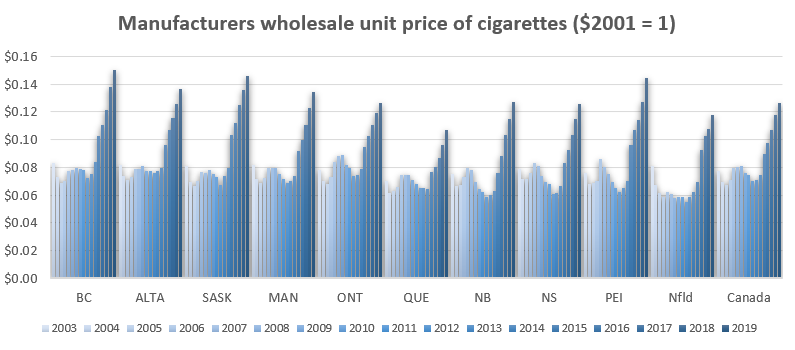
Earlier this month, Health Canada released new data on the average wholesale unit price of manufactured cigarettes sold in each Canadian province over the past 16 years. This data allows us to compare the revenue generated by cigarette manufacturers in each province during that period, including on a per-smoker basis and in comparison with revenues from tobacco taxes in each jurisdiction.

The "average" price says little about what an individual smoker pays, but says a lot about what the companies earn.

From the purchaser's perspective, the "average" wholesale price is not a helpful indicator. For the most part, few people pay the "average" price for a pack of cigarettes. Some brands cost more than others, some stores charge more than others, and some provinces charge more tax than others. 

From a corporate income perspective, however, the "average" price is a core indicator. And when combined with public data on volume of cigarettes sold in each province, it allows us to calculate the dollar value of smokers to the companies' overall bottom line.

The average wholesale price of cigarettes in Canadian provinces has increased by 75% to 123% over the past five years

After more than a decade of stable pricing, tobacco companies began to sharply increase their wholesale prices over the past 5 years, from a national average of $0.095 per cigarette in 2014 to $0.176 in 2019, providing them an additional 85% per cigarette sold. In some provinces the average price was higher, as was the rate of increase. This may be because smokers in some provinces purchase more expensive brands, or it may be because manufacturers charge higher prices or offer fewer price discounts to retailers in some provinces. Because of inflation, the adjusted value of these increases is somewhat less, but still significant, as shown below.


Tobacco companies make $300 more per year from smokers than they did 5 years ago

Nation-wide, the amount of revenue generated by the industry for each Canadian smoker rose from $517 in 2014 to $898 in 2019.

Differences between the provinces can be attributed to differences in the amount of cigarettes purchased (some may smoke more or may purchase contraband) as well as differences in the brands chosen or wholesale prices charged. In 2019, the companies made the most revenue from smokers in the three most western provinces (about $1,100 per year per smoker) and the least in Quebec ($750 per smoker). Their revenue from each smoker has increased by an average of 74% since 2014 - ranging from 53% in Alberta to 100% in Nova Scotia.


Tobacco companies earn about $2.50 per day from Canadian smokers

On a daily basis, smokers in Canada provide from $2.05 (Quebec) to $3.06 (British Columbia) in revenue to cigarette manufacturers. The companies earned $1.04 more per day from the 4.7 million smokers in 2019 than they did from than 5.4 million smokers of 2014 ($2.46 vs $1.42). In some provinces the increase was almost a double: in British Columbia the average smoker paid $3.06 in 2019, compared with $1.51 in 2014.   


Tobacco companies' wholesale revenue is increasing faster than provincial tobacco taxes.

Earlier this month we showed how federal tax revenue was lower and falling relative to wholesale prices. This new data allows us to see that across Canada, while provincial tax revenues are generally higher than industry revenues they are also falling behind. (Ontario collects less in tax revenue than the industry earns from sales in that province) The examples of the province with the highest excise taxes (Manitoba) and the lowest (Quebec) are shown below, with links to data for all provinces provided below. Tobacco taxes are reported for a financial year ending in March, while corporate revenue is provided for the calendar year. 


The take-away
  • The business data Health Canada requires tobacco companies to report provides insight into their evolving pricing practices. These companies are generating significantly more revenue in recent years than historically.

Downloadable fact sheets


Tuesday, 8 December 2020

E-cigarettes and respiratory disease: from "no available evidence" to "significant concern".

Do e-cigarettes cause respiratory diseases (other than EVALI)?

Almost three years have passed since the National Academies on Sciences Engineering and Medicine (NASEM) answered that question with a "we don't know" in their landmark review of the "Public Health Consequences of E-Cigarettes".

The panel of scientists charged with this review looked only at published research that was available before the end of August, 2017. At that time, there were few researchers engaged: of the 17 studies on e-cigarette users the NASEM panel looked at, six were conducted by the same (now somewhat controversial) research team.

With little to go on, the panel found "limited evidence" that on the one hand, e-cigarettes reduced some lung diseases for smokers that switched and, on the other, that it increased lung diseases for non-smokers that vaped. Generally, they concluded that not much was known: "Conclusion 11-1: There is no available evidence whether or not e-cigarettes cause respiratory diseases in humans."

Among their recommendations were a call for the U.S. Food and Drug Administration and others to give priority to funding research into respiratory effects of e-cigarettes. With additional research funding and interest, much more evidence of the impact of e-cigarettes on lung health is available. This post reports on the troubling results of two recently published studies.

Longitudinal study of smokers found e-cigarette users are 30% to 70% more likely to develop respiratory disease

Wubin Xie of Boston University followed 21,000 adults who were participating in the American longitudinal Population Assessment of Tobacco and Health (PATH) study. None of the individuals included in their review reported any respiratory disease at the outset of their participation.

Only a few years later, however, a large percentage of those using e-cigarettes reported respiratory conditions, including COPD, emphysema, chronic bronchitis, and asthma. After adjusting for all possible other factors, the research team found that e-cigarette use was associated with a 30% increase in the risks of chronic bronchitis and asthma, a 60% increase in the risk of chronic obstructive pulmonary disease (COPD), and a 70% increase in the risk of emphysema. They tested for reverse causation and found it not to be an explanatory factor. They repeated the analysis, restricting the analysis to those who had never smoked cigarettes. The results did not change substantially. While cigarette smoking is a known risk factor for respiratory diseases, this study shows that e-cigarette use is an additional independent risk factor for respiratory diseases.

Study: Wubin Xie and colleagues. Association of electronic cigarette use with incident respiratory conditions among US adults from 2013 to 2018.

A review and meta-analyses of the relationship of e-cigarette use and respiratory diseases finds e-cigarette users have a 40% increase in the risk of asthma and 50% increase in the risk of COPD

While Wubin Xie and colleagues were conducting their research in Boston, another group of researchers, Thomas Wills and colleagues were independently researching the same subject from their base in Hawaii, using very different methods. They reviewed past epidemiological studies and conducted meta-analyses of the association of e-cigarette use with asthma and COPD, controlling for cigarette use and other covariates. There were 15 studies in the asthma meta-analysis and 9 studies in the COPD meta-analysis. (Four of the papers they looked at were included in the NASEM review, the others did not meet their selection criteria).

The results of this systematic review were remarkably similar to those posted by Wubin Xie and colleagues: there was a 40% increase in the risk of asthma and a 50% increase in the risk of COPD. The researchers tested competing explanations including possible self-report bias, the possible "ill-worker-effect" and possible reverse causality. None of these alternative explanations stood up to their scrutiny, giving them confidence that the meta-analyses results reflect real relationships.

Dr. Wills and colleagues also provided an updated review of laboratory studies and found that e-cigarette vapours cause biological changes that can lead to respiratory diseases. These adverse biological changes were observed in cell cultures, animal studies and human studies.

The team also assessed their findings against the established criteria for inferring causal relationships, and found that they met the criteria of consistency, strength of effect, temporality, biological plausibility and, in some cases, dose-response gradient. They conclude that "E-cigarette use has consequences for asthma and COPD, which is of significant concern for respirology and public health." 

Growing global concerns

Three years after the NASEM report a much larger body of evidence from independent researchers is available for review, and additional scientific panels have been commissioned by international organizations and national governments to consider the evidence. These reviews have been broader in scope, covering other health effects, not just respiratory diseases, and generally conclude that e-cigarettes are not safe.

These reviews include reports by or for the World Health Organization, the European Union, the Irish Government, the Government of the Netherlands, the Australian Government, and the Spanish Government.

In February 2020, the World Health Organization concluded "ENDS [electronic nicotine delivery systems] on their own are associated with increased risk of cardiovascular diseases and lung disorders and adverse effects on the development of the fetus during pregnancy. ENDS are undoubtedly harmful, should be strictly regulated, and, most importantly, must be kept away from children."

In September 2020, based on evidence available up to April 2019, European Union's Scientific Committee on Health, Environmental and Emerging Risks (SCHEER) concluded that:
  • for users of electronic cigarettes the overall weight of evidence for risks of local irritative damage to the respiratory tract is:
    • moderate for heavy users of electronic cigarette due to the cumulative exposure to polyols, aldehydes and nicotine, and
    • not to be excluded for average and light users. However, the overall reported incidence is low.
In June 2020, after reviewing 67 recent pertinent studies, the Irish Health Research Board concluded that e-cigarette use was responsible for "probable harms" due to respiratory diseases.

In April 2020, the Trimbos Institute reported to the Dutch government that "Newer studies provide more and more indications that the use of an e-cigarette could lead to damage to the respiratory tract and the cardiovascular system."

The Australian government website states categorically that e-cigarettes are not safe. The web-site goes on to state "many scientists are concerned that using e-cigarettes could increase risk of lung disease, heart disease and cancer."

A 2020 Spanish Health Department report states that the adverse short-term effects on the respiratory system are similar to those of cigarette smoking.

There is a growing global scientific consensus that e-cigarette use leads to increased risk of respiratory diseases.


Wednesday, 2 December 2020

Canadian government revenues from tobacco taxes fell by more than 8% in 2019-2020.

Earlier this week, the federal government tabled in parliament its annual report on public accounts. Together with similar reports from provincial governments (or budget statements where the public accounts are not yet ready), we now have a picture of the amount of taxes collected by Canadian governments on tobacco products over the past fiscal year - April 1, 2019 to March 31, 2020.

In all but one province (Manitoba), tobacco tax revenues were down. Last year a total of $7.64 billion were collected by territorial, provincial and federal governments in excise taxes imposed on cigarettes, cigars, smokeless, rawleaf, manufactured and other forms of tobacco. The previous year, the amount collected had totalled $8.29 billion. Links to tables of historic tax revenues and other data are provided below.  

Federal and provincial tobacco tax revenues are declining slowly, once adjusted for inflation.

Despite periodic increases in some provinces, tobacco tax revenues have been essentially flat (with a recent downward trend) for more than a decade, once inflation is taken into consideration. 


Several factors contribute to the amount of tobacco tax received by governments: the tax rate, the number of smokers and the volume of cigarettes smoked on which taxes have been avoided (illicit sales). Other than cigars (which account for less than 2% of federal tobacco tax revenue), tobacco products are taxed on a per-unit or per-weight basis and changes to retail prices have no impact on government revenues.

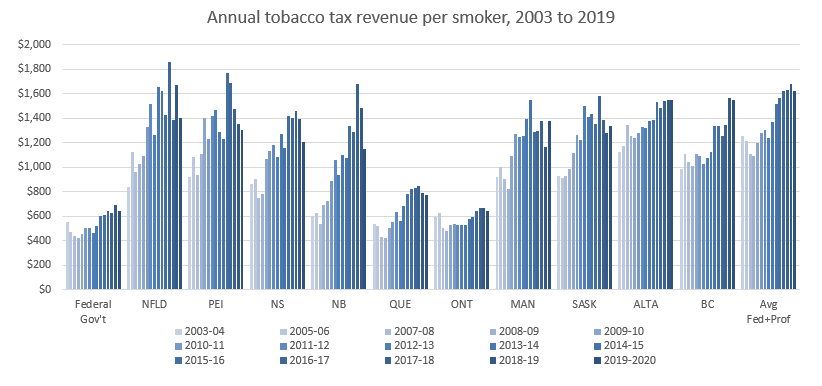
The average smoker provides more than twice as much tax revenue in some provinces than others.

Tobacco tax rates and the sale of untaxed tobacco vary significantly across Canadian provinces, and so too does the amount of tax received per average cigarette smoker. Ontario, which has the second-lowest cigarette tax rate and is believed to have the highest contraband rate, received the least revenue on a per-smoker basis ($650). Quebec, with the lowest tax-rate recieved slightly more ($775). Per-smoker revenue for the other provinces ranged from $1,200 to $1,625. In addition, federal tax revenues on tobacco products were about $650 per smoker. 

The impression that revenues per smoker have grown over the past 15 years is corrected once the revenues are adjusted for inflation. Both adjusted and unadjusted amounts are shown in the figures below.

(These figures are approximations only, as the Canadian Community Health Survey only provides estimates of the number of cigarette smokers and most public accounts only provide total combined revenues for all types of tobacco products. About 95% of the value of the wholesale tobacco market is for manufactured cigarettes.)


Tobacco industry revenues are increasing while tax revenues aren't.

Not all tobacco-related revenues are stagnant. Data released earlier this year by Health Canada (based on calendar, not fiscal years) show that although federal tax revenues have been stagnant, the revenue received through wholesale shipments has continued to climb.

From the information reported to and by Health Canada,  between 2009 and 2019 the volume of cigarette sales has fallen by 17% (from 28.6 to 23.9 billion), wholesale revenues on cigarette sales have climbed by 55% (from $2.7 billion to $4.2 billion) and cigarette taxes remitted to the federal government have increased by 25% (from $2.4 billion to $3 billion).


Related data sheets:

Tuesday, 24 November 2020

Innovative proposals for regulating tobacco retail.

This post highlights two recent and innovative government proposals to address tobacco retailing - including a home grown solution for northern Canada!

Curbing retailer incentive programs

Tobacco companies
motivate retailers
with prizes and rewards.
 
One of the more recent marketing strategies of tobacco companies is to offer incentive programs to convenience store owners and sales clerks. In return for selling more product, participating in sales training or otherwise helping promote tobacco products, these workers can earn points which they can redeem for travel, gift items or other benefits. They can also vie for the right to buy tobacco products more cheaply than their competitors.

This is a problem for public health because it puts additional pressure on retailers to sell cigarettes -- lots of them. It drives the price of cigarettes down because those who do not get special prices are pressured to lower their in order to compete with those who do. It gives store employees a personal incentive to sell more products, irrespective of the benefit to their employer. 

To date, Quebec is the only province to have amended its law to address these new promotional programs. In 2015 it amended its Tobacco Control Act to prohibit tobacco companies from "offering rebates, gratuities or any other form of benefit related to the sale or the retail price of a tobacco product to operators of tobacco retail outlets, including their employees." This measure has ended some of these marketing ploys, but has not stopped the companies from rewarding or punishing retailers by adjusting the wholesale prices.

Nunavut is the first Canadian jurisdiction to introduce legislation to directly address the preferential pricing practices and their health impact. Last month, its legislature gave second reading to Bill 57, a proposed new Tobacco and Smoking Act.   This bill contains many important measures and sets a new high standard for Canadian tobacco control laws. Among its innovations are a clear direction to shut down promotions that encourage retailers to sell more tobacco and "smoking" products (including electronic cigarettes).

The proposed measures include:

  • an end to incentives offered to retailers by manufacturers or wholesalers
  • an end to incentives offered to customers by retailers 
  • an end to price signs at retail (price lists can be shown to customers)
  • an end to price reductions for higher volume sales (like bundled packages)
  • an end to price discrimination (offering retailers or customers a better price than to others)
  • the power to regulate prices 
Reducing the density of tobacco retailers

Over the decades, provincial governments have reduced the number of places where tobacco can be sold. Cigarettes can no longer be sold in pharmacies (except in B.C.), in health care settings (except in New Brunswick). Some provinces have also banned sales in restaurants and bars, amusement parks, and through the internet. 

These restrictions have helped drive down the number of tobacco retailers in Canada from over 40,000 in 2000 to about 28,000 today. But to date no Canadian government has set a target to reduce the density or quantity of tobacco retail outlets.


Last week, Netherlands Health Minister Paul Blockhuis outlined his plan to do so for that country. With a long-term goal of restricting tobacco sales to age-restricted stores, his initial 5-year plan will reduce that country's tobacco outlets from 16,000 to about 6,000 after 2024 by ending sales in vending machines, one line and in supermarkets. A review will begin next year on how to transition to tobacco only stores after 2030. 

The Netherlands has roughly half the population of Canada. After 2024 it will have fewer tobacco outlets per capita (34 for 100,000 people) than any other European Country. By way of comparison, Canada currently has 71 tobacco retail outlets per 100,000 people and 26 gas stations or pharmacies for the same population.

This Dutch approach is supported by an economic review and modelling of the impact in which several options were consieered, such as capping density and using licensing conditions. The government estimates that moving towards tobacco-only stores as they are doing will reduce the number of Dutch smokers by 120,000.


Sunday, 15 November 2020

An update on evidence linking teen vaping to cigarette smoking

Earlier this spring, we provided a review of studies into the relationship between young people using e-cigarettes and their subsequent use of tobacco. This post reports on four more large studies which support the general conclusion that young e-cigarette users are three to four times more likely to become tobacco cigarette smokers 

All four studies provide systematic reviews of previous evidence. The most recently published of these studies provides a a new analysis of longitudinal data from the Population Assessment of Tobacco and Health (PATH) survey in the United States. Two others are meta-analyses commissioned by government health agencies – one from Ireland and Australia. One other, from the European Union, reviewed previous studies, meta-analyses, and e-cigarette components particularly attractive to young people.

Evidence from an analysis of longitudinal data from the PATH survey

Smoking Intention and Progression From E-Cigarette Use to Cigarette Smoking was published in the journal Paediatrics in November 2020. Olusegun Owotomo and his colleagues at the University of Texas used data from the Population Assessment of Tobacco and Health (PATH) study to look at changes in adolescent behaviour from 2014-15 to 2015-16. They used a US nationally representative population of adolescents who were 12 to 17 years old at the beginning of the study period to find out whether the teenager's  stated intention to smoke cigarettes or their use of e-cigarettes predicted actual cigarette smoking one year later. There were four previous analyses of PATH data that examined the relationship between e-cigarette use and subsequent smoking, but this was the first to also examine the effect of intention to smoke.  References to these previous studies can be found in the Australian study by Olivia Baenziger and her colleagues.

It turned out that both intention to smoke and e-cigarette use predicted later smoking.. "Among adolescents who had expressed intention to smoke conventional cigarettes at baseline, e-cigarette use did not predict cigarette smoking at follow-up. However, among adolescents without previous intention to smoke conventional cigarettes, e-cigarette use predicted cigarette smoking." 

If teens said they intended to smoke, they were three times more likely to actually become cigarette smokers. Children who smoked e-cigarettes in 2014-15 were 4.6 times more likely to become cigarette smokers by 2015-16, even if they earlier had no intention of becoming cigarette smokers. This latter finding is very much in line with most other studies of same phenomenon, as we shall see in the following sections.

Evidence from meta-analyses performed by the Irish Health Research Board

Electronic cigarette use and tobacco cigarette smoking initiation in adolescents: An evidence review was made public by the Irish Health Research Board in October. It was prepared to respond to Ireland's Department of Health's request for an answer to the question "Does e-cigarette use by adolescents who are cigarette naïve at baseline lead to subsequent cigarette smoking?"

This review predated the Owotomo study discussed above, so the latter was not included among the papers analyzed.
 
The Irish HRB review included 21 studies, up from the 17 included in the meta-analysis reported by Jasmine Kouja and her colleagues a few months earlier. Of these, 15 longitudinal studies reported adjusted odds ratios. The HRB concluded: "We found a four-fold association between ever using e-cigarettes and initiating smoking tobacco cigarettes in adolescents in a combined analysis of nine cohort studies conducted with follow-up periods between 4 and 24 months"

The analysis considered this relationship using different theoretical constructs. "We identified three theories that attempt to explain the move from using e-cigarette use to smoking tobacco cigarettes, and these are: the gateway theory, the common liability theory, and the catalyst model." The HRB recommends that further studies be designed to test these theories.

Evidence from umbrella review and meta analyses of gateway effect and relapse undertaken researchers in Australia 

With support from the Australian Government Department of Health, Olivia Baenziger and her colleagues prepared a report on E-cigarette use and combustible tobacco cigarette smoking uptake among non-smokers, including relapse in former smokers: umbrella review, systematic review and meta-analysis. It was made available in September ahead of peer-review. 

This study included several components. First, they reviewed three previous meta-analyses, "an umbrella review" and noted that all three had similar findings, that young e-cigarette users were 3-4 times more likely to later become cigarette smokers. Secondly, they identified 25 studies as methodologically suitable for inclusion in their own meta-analysis of the the relationship between e-cigarette use and subsequent cigarette smoking. When all were combined in the meta-analysis, it was estimated that e-cigarette users were 3.25 times more likely to become cigarette smokers.

Thirdly, the researchers found three studies that studied whether former smokers who took up e-cigarettes would relapse to cigarettes smoking. This is the first systematic review to consider the relationship of e-cigarette use to smoking relapse. It found former smokers were 2.4 times more likely to relapse to cigarette smoking if they took up e-cigarette use. 

"Our umbrella and systematic review, along with an updated meta-analysis using data from primary studies, shows strong and consistent evidence that never smokers who have "used e-cigarettes are more likely than those who have not used e-cigarettes to try smoking conventional cigarettes and to transition to become regular tobacco smokers."

Evidence reviewed by the European Commission

Another scientific assessment of the role of e-cigarettes in the initiation of smoking was conducted by the European Commission's Scientific Committee on Health, Environmental and Emerging Risks (SCHEER). In February 2019, the Commission requested SCHEER to review the health effects, cessation impact and also "their role as a gateway to smoking." The SCHEER released its Preliminary  opinion on electronic cigarettes in late September and will make public its final version after reviewing comments that were submitted in response. 

In this paper, the SCHEER reported that "Regarding the role of electronic cigarettes as a gateway to smoking/the initiation of smoking, particularly for young people, the SCHEER concludes that there is strong evidence that electronic cigarettes are a gateway to smoking for young people. There is also strong evidence that nicotine in e-liquids is implicated in the development of addiction and that flavours have a relevant contribution for attractiveness of use of electronic cigarette and initiation." (emphasis in original)

The question of causality and the gateway effect

The reviews discussed above took different approaches and applied different models when considering whether smoking is causally related to e-cigarette use. 

* The Health Research Board reported that its study design "does not allow us to say there is a definitive causal relationship, but it does allow us to say that the findings builds a case towards a causal relationship as the findings are consistent across all studies included in the meta-analysis." It recommended further studies to establish "what drives the relationship between e-cigarette and tobacco cigarette use."

* The EU SCHEER committee considered both the gateway hypothesis and the renormalisation hypothesis to explain the relationship between e-cigarette use and later smoking by adolescents. They concluded "that there is strong evidence that electronic cigarettes are a gateway to smoking for young people."

* The Australian team found that the similarity of results in many places suggested a causal link ("... the consistency of findings across multiple studies and settings supports the likelihood of a causal relationship"), but that the cross-sectional observational design of most studies meant they could not yet rule out "the possibility of residual confounding."

* The longitudinal design of the U.S. study (which was not included in the other reviews) adds further evidence to support a causal relationship. The authors' conclusion implies that the results should be treated as support for a causal connection. "Abstinence from e-cigarette use should be framed as an adolescent smoking prevention strategy."

Take-away
  • Multiple studies and multiple meta-analyses from many countries show remarkably consistent results.  Young people who take up using e-cigarettes are 3-4 times more likely to progress to becoming cigarettes smokers than their peers who do not use e-cigarettes. 
  • This risk of becoming a smoker also applies to those young e-cigarette users who declare they have have no intention of becoming smokers.  Despite their intentions, they are over four times more likely to become cigarette smokers.
  • Former smokers who take up e-cigarettes are over twice as likely to relapse to cigarette smoking.

Monday, 9 November 2020

Which Canadian province is doing the best at reducing smoking?

In Canada, tobacco control is an area of shared jurisdiction: both federal and provincial governments have wide authority to regulate the manufacture, promotion, distribution and sale of tobacco products. Although Canada's constitution generally gives provinces control over commercial activities, the Supreme Court long ago recognized the authority of the federal government to also regulate cigarette promotions and products. 

Despite differences in emphasis and intensity, the tobacco control regulations and programs in each province are largely similar. A province that might be "leading the pack" in one aspect (eg flavour restrictions) may not be so far ahead with others (eg taxes). Added to these differences are also demographic and cultural differences across Canada's wide geography.

This post looks at data on smoking behaviour in Canada's provinces, based on 9 cycles of the Canadian Community Health Survey (CCHS) spanning almost 2 decades. The information presented below is for the general population, sex and age disaggregated information is also available on the following interactive tables:

Smoking rates have fallen across the country

Smoking rates across the country have fallen by almost one-half (a 40% reduction) between the first cycle of CCHS (in 2000) and the period for which complete indicators have been released (2017-2018). 

That is to say that each year over the past 2 decades, for each group of 200 Canadians, every year there has been one less person who smokes every day or on occasion. This pattern holds true in most provinces.

The standings between the provinces have not changed greatly in 20 years. The provinces with the lowest smoking rates in 2017-2018 are essentially the same as those with the lowest rates 18 years earlier - British Columbia and Ontario. Although smoking rates have dropped by a greater proportion in some other provinces, they have not yet caught up.

The reduction has been greatest with respect to daily smoking. Since 2000, the percentage of Canadians who smoke daily has fallen by more than 11 percentage points (11 people in 100). The provinces with the largest declines in daily smoking are Quebec and Prince Edward Island (13.5 percentage points). 

There has been very little change in occasional smoking. There are more occasional smokers in 2017-2018 than in 2000 (1.5 million to 1.1 million). The increase in the rate of occasional smoking is slight but statistically significant (from 4.5% to 4.8%). During this period, the overall population grew by over 5 million people. The profile of occasional smokers (and the number who were once daily smokers) will be explored in a future post.

The greatest drop in smoking has been among the youngest Canadians

Current smoking among teenagers has fallen by two-thirds since 2000. Those born in the 1980s were 3 times more likely to smoke as teenagers than those born in the first decade of this century (19% vs 6%). Comparisons among all provinces have become more difficult, as surveyors are unable to find enough young smokers to provide a reliable estimate for the smaller jurisdictions. Among the larger provinces, Quebec rates for teen smoking (age 12 to 19) have fallen from 27% to 8%, compared with Ontario's from 17% to 6%, Alberta's from 18% to 6% and British Coumbia's from 12% to 5%. 

Fewer and fewer Canadians ever try smoking...

As we observed earlier for Canada as a whole, it is the "never smoking" population that is likely driving reductions in smoking. 

This is especially true in some provinces. For example, British Columbia nad Ontario are also the provinces where people are most likely to have never smoked a single cigarette. In Ontario and B.C., one-half of all citizens and 6 in 10 people in their 20's have never smoked a single cigarette (compared with 5 in 10 in the other provinces). 

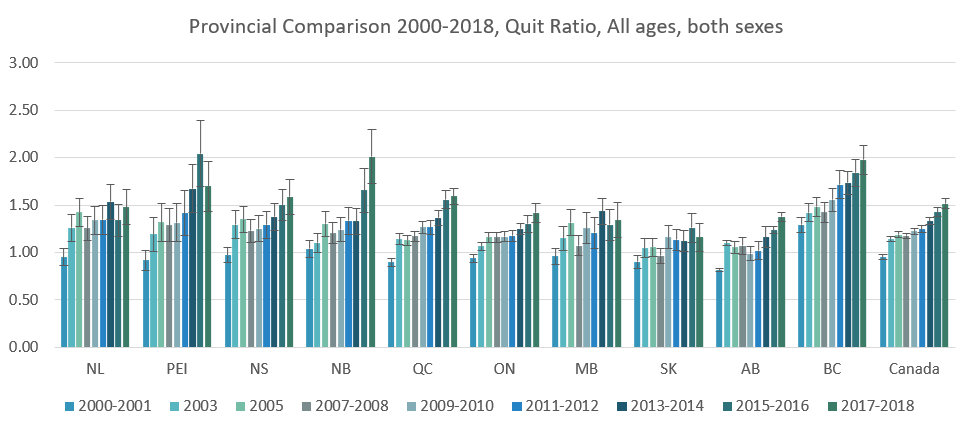
Ontario and Quebec provide an example of this. Although Ontario has a lower smoking rate than Quebec (15% vs 18%), the percentage of Quebec smokers who have quit is no lower: the Quit Ratio of former to current smokers is 1.42 in Ontario and .1.59 in Quebec. Ontario's relative success can be attributed to fewer people having begun smoking. One-half (51%) of Ontarians have never smoked one cigarette, compared 40% of Quebeckers.

... and more smokers have quit.

Overall, the proportion of Canadians who have smoked and then quit has grown slowly, although progress has been uneven across the Country.

British Columbia is also in the lead for this indicator: in that province there are 4 former smokers for every 2 smokers, compared with a national average of 3 former smokers for every 2 smokers. All provinces are doing much better than they were in 2000 - with greater improvements in New Brunswick, Prince Edward Island and New Brunswick. The prairie provinces are doing least well at moving smokers to former smokers. One contributing factor is the relative youthfulness of prairie populations, and the greater likelihood that older smokers will have quit: the median age in the prairies (36) is a full 5 years younger than in B.C. (41).


(Although fewer smokers are quitting every year)

Since 2003, this survey has asked former smokers how long ago they quit. From this we know that the number of Canadian smokers who have quit in the past year has fallen from almost 700,000 in 2003 to 414,000 in 2017-2018. 

This is not unexpected, given that with a falling smoking rate there are fewer remaining smokers year on year. Nonetheless, even as a proportion of remaining smokers, the number of "recent quitters" is not growing. It would appear that in most provinces, smokers are no more likely to quit in 2017-2018 than they were 20 years ago.  

As a result, most former smokers are long-term quitters. Two-thirds of former smokers in Canada quit more than a decade ago, with very few differences across the country.

In fact, death is more responsible for reducing the number of Canadian smokers than quitting. The CCHS shows that for every 10 fewer Canadian smokers in 2018 than there were a decade earlier, there were only 4 more former smokers. The other 6 smokers had disappeared from the CCHS population, mostly likely through death. (During that period, there were 1 million fewer smokers, but only 429,000 more former smokers). 


The takeaway:
  • Individual and community efforts to reduce smoking have succeeded in Canada at a steady if slow pace for the past 20 years.
  • British Columbia has maintained its lead for two decades. Other provinces are generally keeping pace with B.C., and some have made relatively greater progress on some indicators (eg. youth smoking). 
  • Falling smoking rates reflect reduced number of people who start to smoke and increased number of smokers who successfully quit. Some provinces are doing relatively better than others at protecting youth from smoking and from achieving successful population cessation.
  • Demographic differences between the provinces may be responsible for some differences between provincial smoking, starting and quitting rates.